
The practical answer
- Short answer
- A failed ERP implementation costs 3-4x the initial budget and kills stock prices. Here is the failure cost analysis and recovery playbook for C-Suite leaders.
- Best fit
- Industry: Enterprise Technology. Function: IT Leadership
- Operating path
- Project Recovery → Turnaround & Restructuring → Transaction Execution Services
- Key metric
- 70% of ERP initiatives fail to fully meet business goals (Gartner 2026 Prediction)
The Visible Blast Radius: Cap Table & Cash Burn
Most Boards treat an ERP failure as a budget variance. They ask, "How much over budget are we?" and approve a 15% contingency. This is a fundamental misunderstanding of the blast radius.
When an ERP implementation fails, it does not merely cost you the sunk capital of the software licenses and integrator fees. The true cost is a multiplier. Recent data from 2025 suggests that the average cost to recover from a failed ERP implementation ranges between 150% to 200% of the initial budget. If you budgeted $5M, you aren't just losing that $5M; you are about to spend another $10M to fix the mess, often with a new partner.
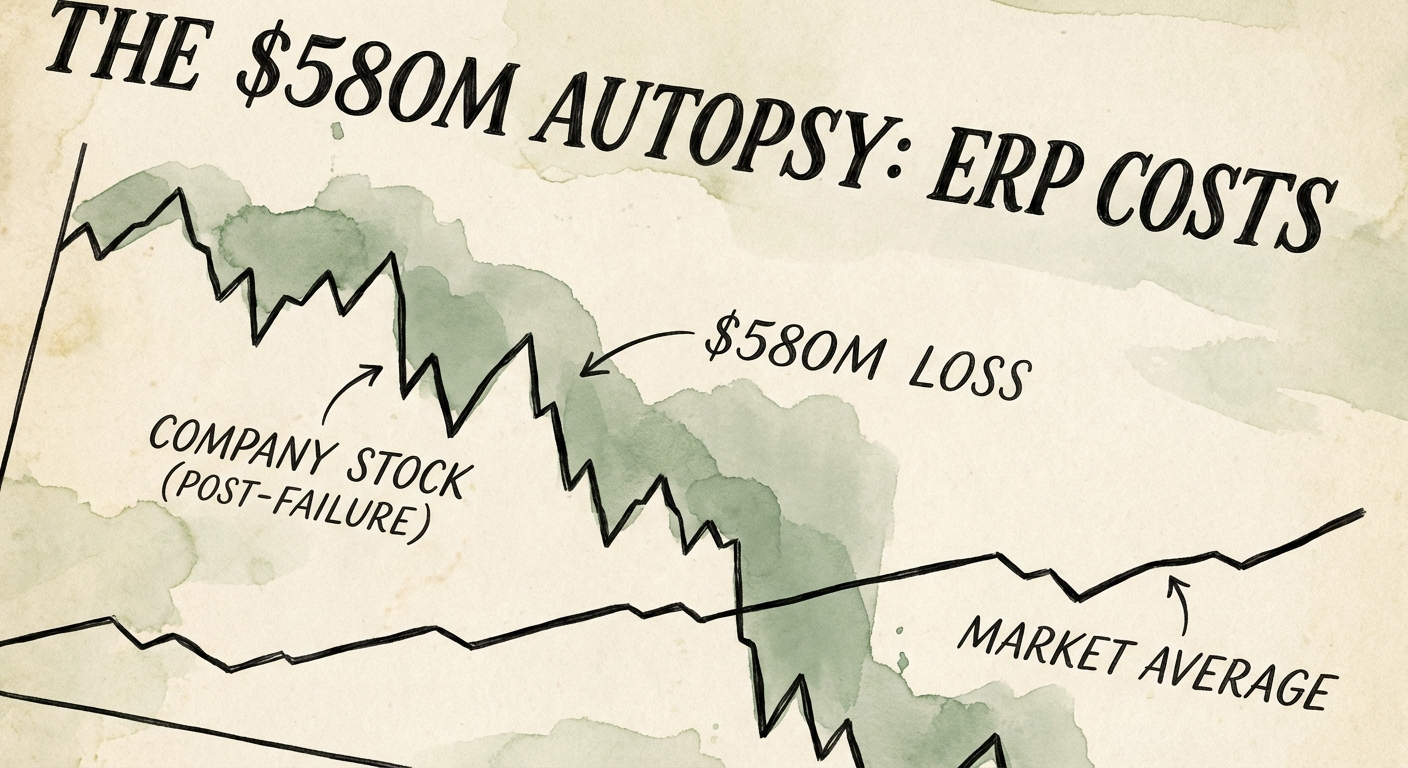
But the cash impact pales in comparison to the valuation impact. Public markets punish operational weakness swiftly. When Revlon announced their ERP failure disrupted operations, their stock dropped 6.9% in 24 hours. When Nike's supply chain integration faltered, they lost $100M in sales and saw a 20% stock dip. These aren't IT problems; they are Enterprise Value destruction events. For a Private Equity-backed firm, a stalled ERP doesn't just annoy the Operating Partner; it freezes the exit timeline. You cannot sell a company that cannot close its books or ship its product reliably.
The "Sunk Cost" Fallacy in ERP
The most dangerous decision in this phase is doubling down on the failing Systems Integrator (SI). We see CIOs paralyzed by the "sunk cost" fallacy, hoping that just one more change order will fix the architecture. It won't. If the foundation is cracked, you are just buying more expensive wallpaper.
The Invisible Killer: Talent Drain and Strategic Paralysis
While the CFO calculates the write-down, the real damage is happening in your engineering and operations teams. A failed ERP implementation is the single fastest way to burn out your top performers. Your best people—the ones you need to drive innovation—are suddenly pulled into "response rooms" to manually reconcile data that the system was supposed to automate.
This triggers the Hero Culture resurgence. Instead of scalable processes, you rely on individual heroics to ship product and close the month. This is unsustainable. Our data shows that operational disruption affects 51-54% of companies post-go-live in failed scenarios. When your best engineers become manual data entry clerks, they quit.
The Leadership Vacuum
Inevitably, the failure leads to a leadership decapitation. The average tenure of a CIO is already short (4.4 years), but a botched digital transformation accelerates this exit. This leaves the organization in a precarious position: you have a broken system, a burned-out team, and leadership fallout.
This is where the "IT Leadership Search" becomes critical—and difficult. You cannot hire a standard "steady state" CIO to fix a turnaround. You need a wartime leader who understands Vendor Intervention and isn't afraid to kill features to save the timeline. Placing an interim executive who specializes in remediation is often the only way to bridge the gap without committing to a permanent hire before the fire is out.
The Recovery Playbook: Stop the Bleeding
If you are in the 70% of leaders staring down a failing implementation, you need to pivot from "delivery mode" to "recovery mode." Hope is not a strategy, and a new timeline from the same vendor is not a solution.
1. The 5-Day Audit: Stop all development. Conduct a disciplined Project Reset assessment. Is the issue the software, the integrator, or the data? 60% of failures stem from misaligned business requirements, not code bugs. If the blueprint is wrong, stop building.
2. Kill the "Stale Committee": Most failing projects are governed by massive steering committees that are terrified of making decisions. Replace the committee with a "Triangle of Authority": The CEO, the CFO, and an external Technical Lead with veto power.
3. Re-qualify the Leadership: If your current IT leader has been "green-shifting" status reports (reporting green while the project burns), they must go. You need radical transparency. The cost of replacing a leader is high, but the cost of another 12 months of failure is existential.
The difference between a stumble and a disaster is speed. The moment you realize the trajectory is wrong, intervene. The market will forgive a course correction; it will not forgive a $580M write-off.