
The practical answer
- Short answer
- PE buyers reverse-engineer your founder dependency from your calendar. Here's the 90-day audit that finds the discount before diligence does — and fixes it.
- Best fit
- Industry: B2B SaaS & Tech Services. Function: CEO & Board
- Operating path
- Founder Extraction → Operational Excellence → Interim Management
- Key metric
- 72% of a CEO's 62.5 hour work week is typically consumed by tactical meetings, leaving minimal room for strategic execution.
The cheapest due diligence a buyer runs costs them nothing
A sponsor evaluating your $40M SaaS business doesn't need to interview your team to find the founder-dependency risk. They can infer most of it from a single export: your last 90 days of calendar invites. Recurring 8:30 standups with the engineering pod. A standing slot called "deal desk — anything over 15% off." Your name on the product sprint review every other Thursday. Each one is a data point, and together they sketch the org chart that actually runs the company — which is rarely the one in the pitch deck.
That gap has a number attached to it. Bain & Company's 2026 Private Equity Valuations Report finds that targets showing severe founder operational dependency take a 20% to 30% haircut in diligence. On a business priced at a healthy ARR multiple, that's not a rounding error — it's the difference between a life-changing exit and a fine one. The buyer isn't punishing you for working hard. They're pricing the day after close, when the person who approved every discount and unblocked every release is suddenly a board member who's "available for questions."
I watched this land on a founder who genuinely believed his involvement was the moat. He was the hardest-working person in his company and he was right about that. He was also the single largest constraint on its enterprise value, and he could not see it because the work felt like leadership. It wasn't. It was a senior individual contributor's week wearing a CEO's title. The whole exercise that follows exists to make that invisible thing measurable — to audit the calendar before the buyer audits the company, while you still have time to change the answer.
A buyer can read your org chart in five minutes. They can read your real org chart from your calendar in thirty — and the second one is the one they price.
What 90 days of invites actually confess
Ask a scaling founder how they spend their week and they'll tell you 40% strategy, the rest "putting out fires." The calendar tells a different story, and it doesn't flatter anyone. Harvard Business Review's CEO time-allocation study tracked chief executives at 62.5 hours a week with 72% of it inside meetings. The question isn't whether you're in meetings — you are. It's which four buckets those meetings fall into.
Tag every 30-minute block across the trailing quarter as one of four: Strategic (capital allocation, hiring the layer above the work, M&A prep), Revenue (only deals no VP could close), Operational Delivery (standups, sprint reviews, line-by-line cash review, discount approvals), or Administrative. For a company heading toward a transaction, the Operational Delivery bucket should be trending hard toward zero. It almost never is. McKinsey's State of Organizations benchmark puts roughly 60% of executive time into reactive coordination — "work about work" — and a founder's calendar concentrates that failure at the top of the building.
Then read the recurring meetings as evidence, because that's how a buyer reads them. A standing product committee that can't close a sprint without your nod means you don't have a head of product — you have a coordinator who escalates. A weekly cash-flow review where you go line by line means your CFO is functioning as a controller. The 15%-discount approval that runs through you means there's no commercial leader who owns margin. Every recurring tactical block is a named gap in your leadership team, and in diligence those gaps get interviewed, confirmed, and subtracted from your multiple. (If the discount-approval pattern looks familiar, our breakdown of the 7 signs your founder-led sales process won't scale past $10M walks through how to hand that off.)
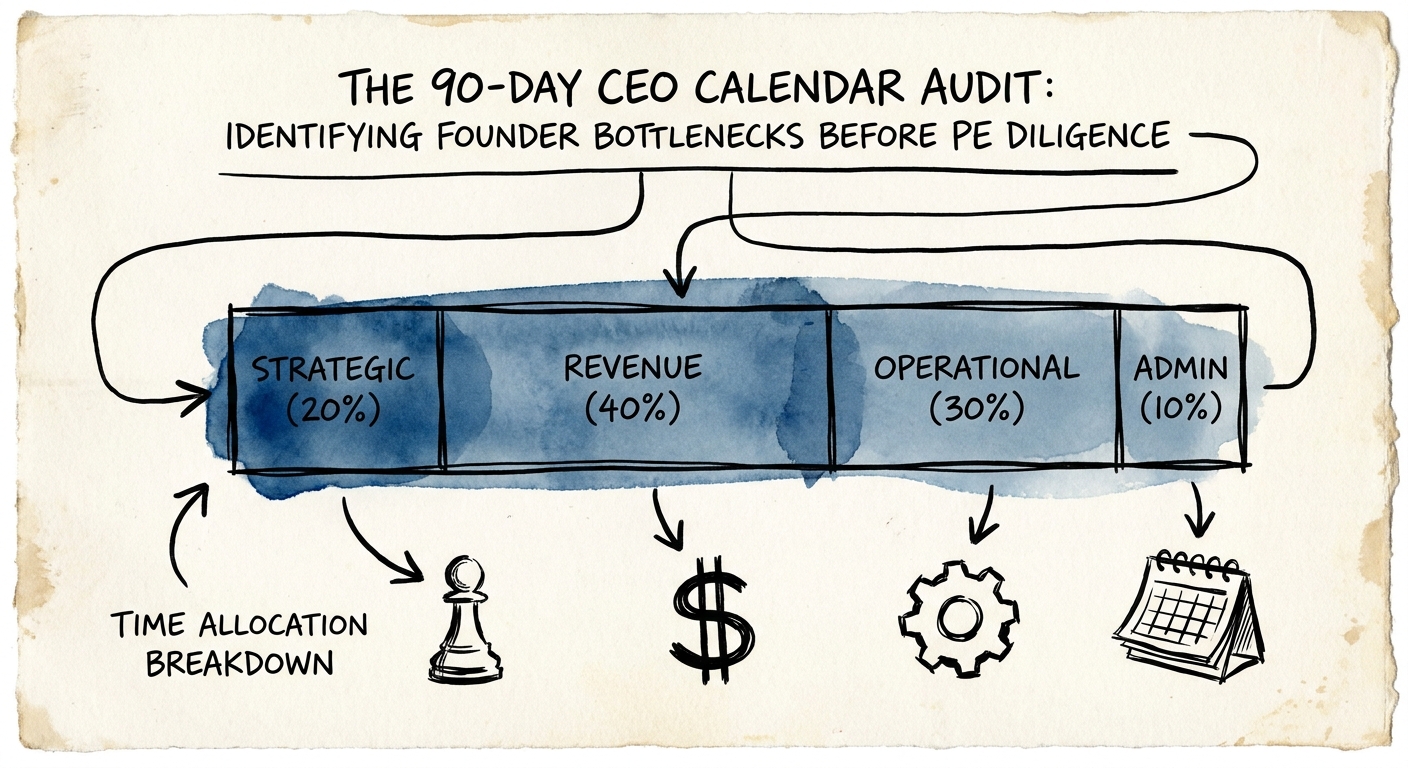
You can't extract yourself in a 60-day window — start now
The brutal arithmetic: founder dependency is a multi-quarter fix, and diligence is a 60-day window. You cannot empty your calendar once the LOI is signed; the buyer is already inside, talking to your team. The extraction has to be deliberate and it has to start before anyone's looking. Pick the bucket with the most blocks and exit one department at a time — usually delivery first, because it's where founders hide the most hours and where a strong second-line leader is easiest to install.
There's a second-order payoff that founders underestimate. Gartner's 2026 workplace productivity analysis found the busiest 10% of executives absorb 53% of an organization's synchronous meeting time. When you pull yourself out of the tactical syncs, you're not just freeing your own week — you're unclogging the decisions that were queuing behind you. Your VP of Engineering starts shipping without the Thursday review. The deal desk learns to own margin. The company gets faster precisely because you got out of it, and that velocity shows up in the metrics a buyer cares about.
This matters because the post-close survival data is unforgiving. PitchBook's 2026 due diligence and founder-risk report shows 73% of founders don't make it through the standard hold period — most because they never made the shift from operator to board-level executive. The calendar audit is how you find out, on your own terms, whether you've made that shift yet. So do the Monday version: export your last 90 days, tag every block into the four buckets, and circle every recurring meeting that requires your presence for a routine decision. That circled list is your extraction backlog. Work it down with the founder extraction checklist of 30 processes to document before exit, and treat the full arc the way buyers do — as a 12-month journey from founder dependency to scalable operations. The goal is a calendar that proves the machine runs while you're unreachable. That's the version of you that commands a premium.