
The practical answer
- Short answer
- Why Adobe Partners must pivot from creative services to 'Content Supply Chains' using Firefly. Valuation impact, efficiency metrics, and the 12x exit strategy.
- Best fit
- Industry: Digital Agencies & SIs. Function: Content Operations
- Operating path
- GTM Execution → Commercial Performance → Performance Improvement
- Key metric
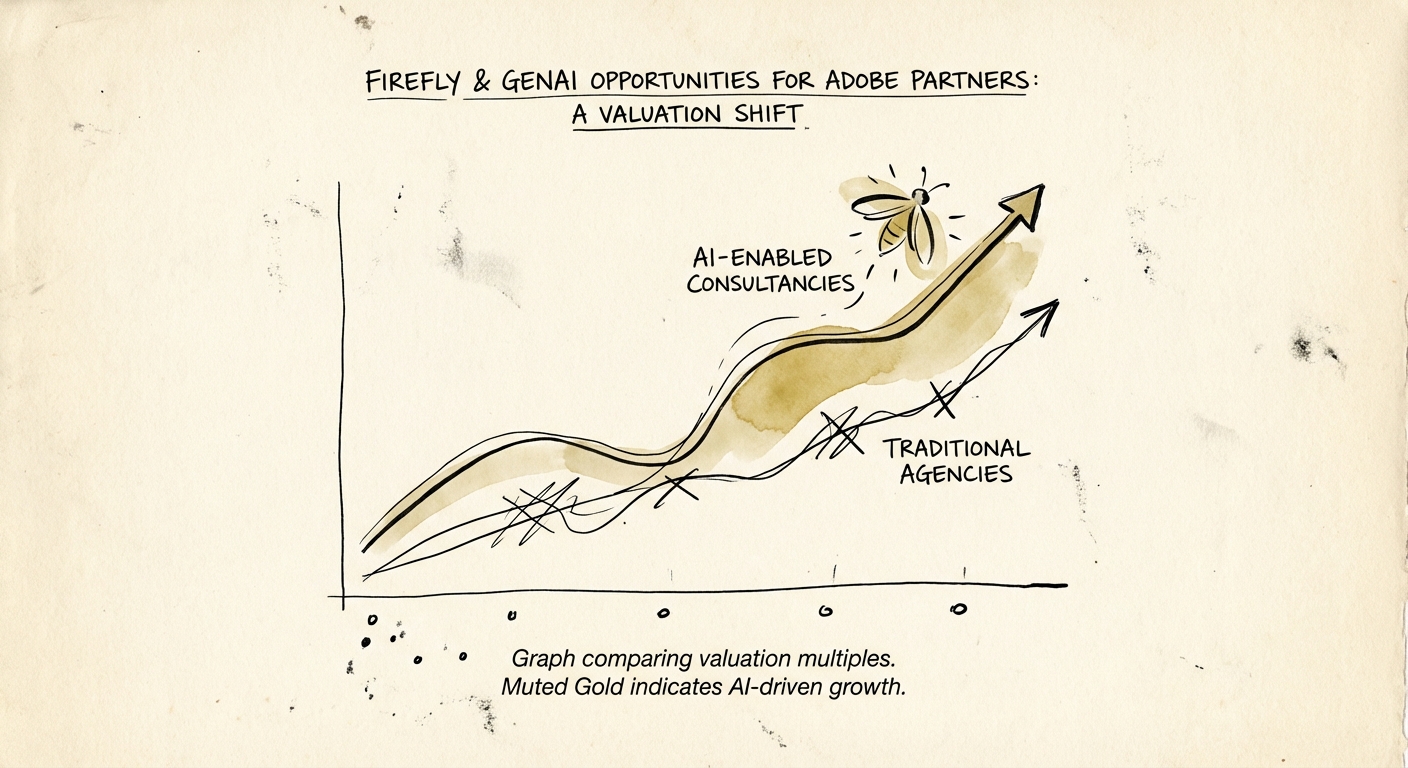
- 12x EBITDA multiple for 'Tech-Enabled' Content Supply Chain partners vs. 5x for traditional creative agencies.
The Hourly Production Trap: Why the Hourly Model is Dead
For the past decade, the valuation ceiling for digital creative agencies and mid-market Adobe solution partners has been stubbornly fixed. Traditional agencies trading on billable hours for creative production typically exit at 4x to 6x EBITDA. The economics are brutal: you hire expensive creatives, mark up their time, and pray utilization stays above 70%.
That model is effectively over. According to Adobe’s own internal data, enterprise demand for content is projected to grow by 500% over the next two years, yet marketing budgets remain flat or are contracting. Your clients cannot afford to pay you hourly rates to meet this demand. If your agency attempts to scale creative output linearly with headcount, your margins will collapse.
This creates a bifurcation in the partner ecosystem. On one side are the hourly production firms continuing to sell manual design hours. These firms are seeing their pricing power erode as AI tools democratize production. On the other side are the ‘Content Supply Chain’ architects—partners who use generative AI not just to make images, but to build automated, industrial-scale content factories. These firms are trading at 12x to 15x EBITDA because they are valued as tech-enabled platforms, not service providers.
The GenAI Divide
Research from BCG indicates a massive ‘GenAI Divide.’ While 95% of organizations are testing AI, only 4% are ‘future-built’ companies that have integrated it into core workflows. These leaders are seeing 2x revenue increases and 40% cost reductions compared to laggards. For Adobe partners, your new mandate is simple: stop selling assets, and start selling the infrastructure that allows clients to become that top 4%.
Generative AI in itself is a powerful tool, but if it cannot be put to effect in a secure and scalable way that is managed, auditable and governed—it's just a fun feature, not a strategic value driver.
The Firefly Moat: Why Enterprise Indemnification Wins Deals
Many agency founders ask, ‘Why Adobe Firefly when Midjourney or Stable Diffusion creates higher-fidelity art?’ This question fundamentally misunderstands the enterprise buyer. Your enterprise clients—the Pfizers and Coca-Colas of the world—care less about artistic nuance and more about brand safety and legal liability.
Adobe’s strategic masterstroke with Firefly is commercial indemnification. Because Firefly is trained exclusively on Adobe Stock images, openly licensed content, and public domain material, Adobe indemnifies enterprise clients against copyright claims. In a boardroom terrified of IP lawsuits, this is the only feature that matters. It allows you, as a partner, to sell GenAI implementation as a compliance-safe efficiency play rather than a risky creative experiment.
Selling the ‘Content Supply Chain,’ Not the Tool
The opportunity for partners is not reselling Firefly licenses (the margins are negligible). The opportunity lies in implementing the Content Supply Chain solution set: Workfront (planning), Firefly (creation), and Experience Manager (delivery). Your service offering must shift from ‘We design banners’ to ‘We implement the GenStudio architecture that reduces your cost-per-asset by 60%.’
Consider the valuation difference between marketing agencies and consultancies. Agencies are valued on revenue; consultancies are valued on intellectual property and structural lock-in. When you wire an enterprise’s entire marketing workflow into an Adobe-based GenAI supply chain, you are no longer a vendor; you are critical infrastructure. That is how you break the 6x EBITDA ceiling.
Execution Strategy: Pivoting Your Practice
To capture this premium, Adobe partners must restructure their delivery models immediately. The ‘body shop’ model of staff augmentation is a liability in the age of AI. Instead, you must build ‘Asset Velocity’ practices.
1. Productize ‘Brand Tuning’ Services
Generic Firefly models are insufficient for big brands. The high-margin service for 2026 is Custom Model Fine-Tuning. Partners should offer ‘Brand DNA’ packages where they train Firefly models on a client’s specific visual identity, ensuring every generated asset is on-brand automatically. This creates high switching costs for the client and recurring revenue for you.
2. Shift Pricing to ‘Output-Based’ Contracts
Stop billing by the hour. Start billing by Content Velocity or Asset Volume. If you can use Firefly to generate 1,000 localized banner variations in the time it took to hand-design 50, you should capture that value, not pass the savings entirely to the client. This mirrors the utilization shift seen in high-performing managed services firms, where efficiency drives margin expansion.
3. The Integration Play
The ‘last mile’ of GenAI is the hardest. Images generated in Firefly are useless if they sit in a folder. The highest-value partners are those connecting Firefly API outputs directly into AEM Assets and Marketo. This integration work commands $250/hour+ bill rates and is ‘sticky’ engineering revenue, unlike disposable creative services.
The window to claim the title of ‘GenAI Expert’ in the Adobe ecosystem is closing. By 2027, this will be table stakes. Today, it is the single greatest lever to double your exit multiple.