
The practical answer
- Short answer
- Why generic Zendesk apps trade at 2x revenue while native CX platforms command 10x multiples. A diagnostic guide for ISV founders on building exit-ready architecture.
- Best fit
- Industry: B2B SaaS / CX. Function: Product Strategy & Corp Dev
- Operating path
- Exit Readiness → Operational Excellence → Transaction Advisory Services
- Key metric
- 10x Revenue multiple for 'Native' Zendesk platforms (e.g., Tymeshift, Klaus acquisitions).
The Tale of Two Ecosystems: Connectors vs. Native Platforms
In the private equity ecosystem, not all Annual Recurring Revenue (ARR) is created equal. Nowhere is this more apparent than in the Zendesk Marketplace, where a stark bifurcation has emerged between "Sidebar Apps" and "Native Platforms." Following Zendesk's strategic acquisitions of Tymeshift (Workforce Management) and Klaus (QA), the market has sent a clear signal: deep, native integration commands a premium, while surface-level connectors are viewed as commodities.
Our analysis of 2025-2026 deal flow in the Customer Experience (CX) ecosystem suggests a massive valuation gap:
- Sidebar Apps (The "Connector" Class): Apps that primarily function as iFrames in the agent sidebar, passing data back and forth to a third-party system without storing state in Zendesk. These trade at 2x-4x ARR. They are viewed as features, not products, with high churn risk as Zendesk expands its own capabilities.
- Native Platforms (The "Strategic" Class): Solutions like Tymeshift that leverage Zendesk's Sunshine platform, Custom Objects, and native data models. These trade at 8x-12x ARR. Acquirers view them as "stickiness engines" that cannot be easily ripped out without breaking the customer's core support workflow.
For founders, the lesson is critical: If your app can be replaced by a Zapier script or a native Zendesk feature update, your exit valuation is capped. To unlock the 12x multiples seen in top-tier SaaS exits, you must transition from being a "window" into another app to being a "fundamental component" of the Zendesk data model.
In the Zendesk ecosystem, you are either a feature waiting to be built by the platform, or a data layer that the platform can't live without. The former trades at 2x; the latter trades at 10x.
The Technical Debt of the 'Sidebar' Strategy
Many ISVs launch on the Zendesk Marketplace with a "Minimum Viable Integration"—often a lightweight sidebar app that surfaces data from an external CRM or ERP. While this drives initial install growth, it creates a "valuation ceiling" during due diligence. When Private Equity firms or strategic acquirers like Salesforce ecosystem aggregators evaluate Zendesk ISVs, they look for Data Gravity.
The Sunshine Litmus Test
The primary diagnostic we use for Zendesk ISVs is the "Sunshine Ratio": What percentage of your app's value is derived from Zendesk Custom Objects and Events vs. external APIs?
- Low Gravity (Risk): The app stores all data on its own AWS/GCP servers and merely displays it in Zendesk. If the customer uninstalls the app, their Zendesk data remains pristine. Result: High Churn (20%+ annually), Low Multiple.
- High Gravity (Value): The app writes data into the Zendesk ticket lifecycle. For example, a QA app that tags tickets with sentiment analysis metadata inside Zendesk's schema, allowing that data to be used in Zendesk Explore reporting. Result: Negative Churn, High Multiple.
The acquisition of Tymeshift demonstrated this perfectly. It wasn't just a WFM tool; it was a WFM tool built on Zendesk. It used Zendesk's agent status data in real-time. This level of integration creates a defensive moat against competitors who are merely "integrated with" Zendesk rather than "built for" it. Similar dynamics are visible in the Snowflake Native App ecosystem, where data locality drives valuation.
The AI Agent Disruption: Evolve or Be Automated
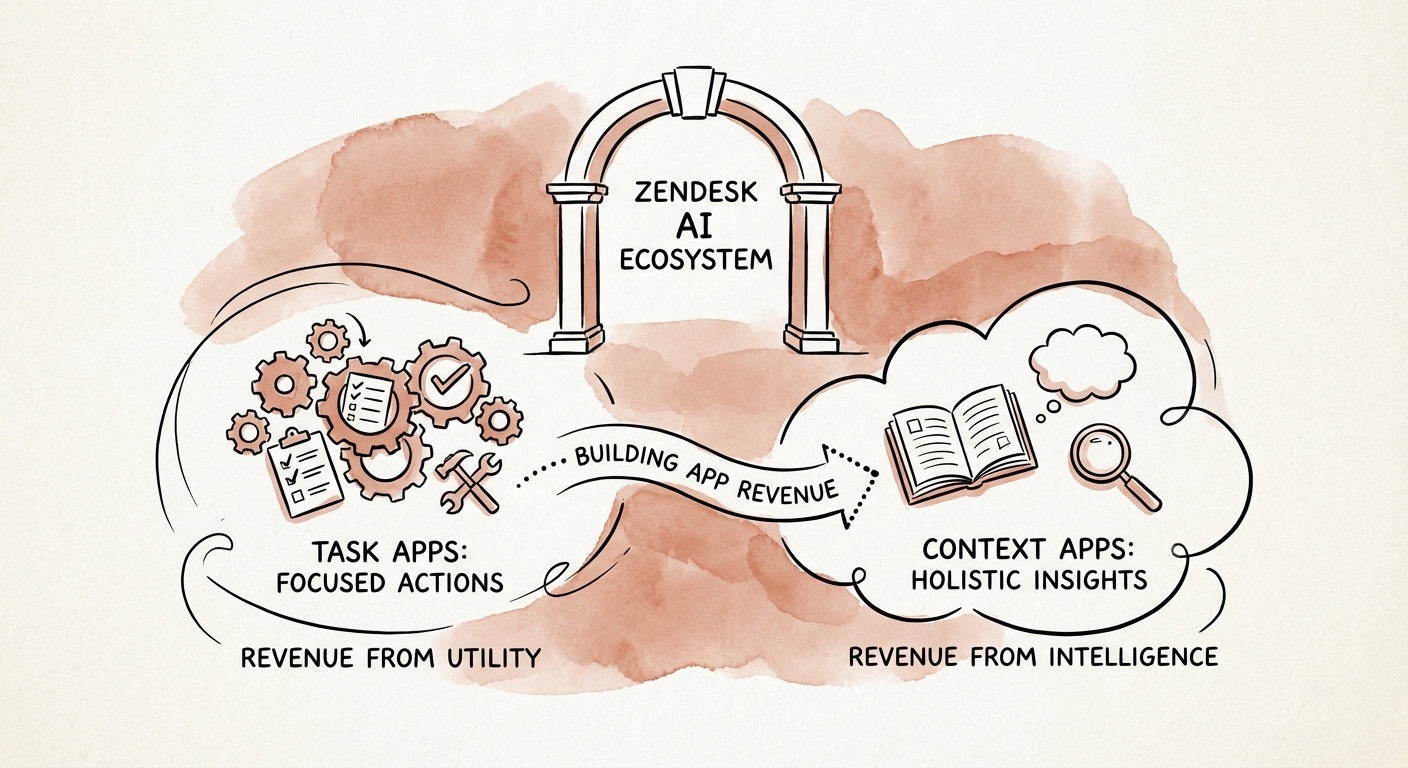
The 2026 roadmap for Zendesk is dominated by AI Agents and autonomous service. This poses an existential threat to "Task" apps and a massive opportunity for "Context" apps. If your app performs a manual task (e.g., "click here to process a refund"), it is liable to be replaced by a Zendesk AI Agent capability.
However, AI Agents need context to make decisions. ISVs that position themselves as "Context Providers"—supplying the structured data that Zendesk's AI needs to resolve tickets—are seeing valuation premiums. For example:
- The "Task" App (Obsolete): A sidebar button that opens a shipping carrier's portal.
- The "Context" App (Valuable): A background service that injects "Predicted Delivery Date" and "Refund Eligibility" directly into the Ticket Fields, allowing Zendesk's AI to automatically answer "Where is my order?" tickets without human intervention.
Strategic buyers are paying premiums for ISVs that enhance the value of the platform's core AI. By feeding the "Brain" of Zendesk, you become indispensable. This mirrors the trend we see in the Shopify ecosystem, where apps that fuel Shopify's 'Sidekick' AI are trading at significantly higher multiples than legacy theme editors.