
The practical answer
- Short answer
- The average CRO lasts 1.8 years — shorter than the revenue engine they were hired to build takes to compound. Here's the month-by-month tenure math and how PE boards break it.
- Best fit
- Industry: Private Equity Software. Function: Executive Leadership
- Operating path
- Team & Hiring → Operational Excellence → Transaction Execution Services
- Key metric
- 62% of companies see revenue growth decline or flatline following a CRO departure.
1.8 years is shorter than the thing you hired them to build
Here is the number that should ruin your weekend if you sit on a software board: the average Chief Revenue Officer now lasts 1.8 years in the seat. A complex enterprise sales cycle runs six to nine months. Compensation plans take a full year to re-bait and a second year to prove out. Net revenue retention only reveals whether last year's deals were healthy when this year's renewals land. In other words, you are hiring someone to build a machine with a 36-month feedback loop and replacing them on a 22-month clock. The architecture never gets the chance to compound, because the architect is gone before the second renewal cohort tells you anything.
The CRO is the most volatile seat in the modern C-suite, and it is not close. A SaaStr analysis of Pave compensation data across 14,000 executives puts go-to-market leader turnover at 32% a year — meaning one in three of your revenue chiefs is gone inside twelve months. CFOs don't churn like this. Neither do CTOs. The revenue seat is uniquely exposed because it is the one role where a single quarter's miss is legible to every member of the board, and a quarter is a rounding error in the time it takes to fix a broken pipeline.
That volatility detonates a private equity hold period rather than dents it. Research on the cost of CRO turnover found that 62% of companies see growth decline or flatline in the fiscal year after a CRO departs, with a median drop of four percentage points. Run that through a software multiple and the damage isn't a severance line item — it's a re-rating. Picture a $45 million ARR business carried at a forward growth assumption of 25%. Lose four points to a leadership vacuum during the year you're prepping the data room, and you are no longer the 25%-grower the deck promised. You're the 21%-grower a buyer diligences downward. The seat didn't just cost you a search fee. It cost you the story.
A CRO needs three full quota cycles to prove a system works, and the average board fires them after two. You're not hiring a revenue leader — you're starting a clock that runs out before the engine ever turns over.
You budgeted for a CRO and scoped a VP of Sales
Most early CRO exits trace back to a single bait-and-switch the board never admits it ran. The title says Chief Revenue Officer. The mandate, the comp plan, and the org chart say VP of Sales with a fancier card. A real CRO owns the whole commercial system — new bookings, marketing demand, pricing, customer success, and the RevOps data spine underneath all of it. What boards actually grant is accountability for net-new bookings while marketing still reports to the CEO, success reports to the COO, and pricing lives in a finance spreadsheet nobody will surrender. You have made one person answerable for a number that four other people control. That is not a job. It is a tripwire.
Watch where it snaps. By the first or second board meeting, the metrics quietly silo the org: marketing is graded on top-of-funnel volume, success on NPS, and the CRO on a revenue target that assumes all of those teams execute flawlessly on cue. When the number slips, the CRO can't point to the real leak — unqualified leads, a churn problem upstream, a forecast built on CRM garbage — because they were never handed authority over any of it. So the board reads "missed number" as "wrong hire," and the 19-month exit gets scheduled. Then you repeat the exact failure pattern that sinks most VP of sales hires inside 18 months, except now you've branded it a C-suite failure and priced it accordingly.
There is a fast diagnostic for whether you've made this mistake. Ask the CRO — or the candidate — to walk you through CAC payback and the NRR drag from weak onboarding. A genuine revenue architect answers in the language of the whole system: where cash recovery slows, which cohort retention is masking, how pricing leakage shows up two quarters later. A glorified sales manager answers in pipeline coverage and rep ramp. If you are working through a Series B GTM readiness assessment, the loudest red flag isn't a thin pipeline — it's a revenue leader with no line of sight into the marketing budget or the RevOps stack. A CRO who can't see the inputs cannot forecast the output, and a CRO who can't forecast is, by month 19, a CRO you're replacing.
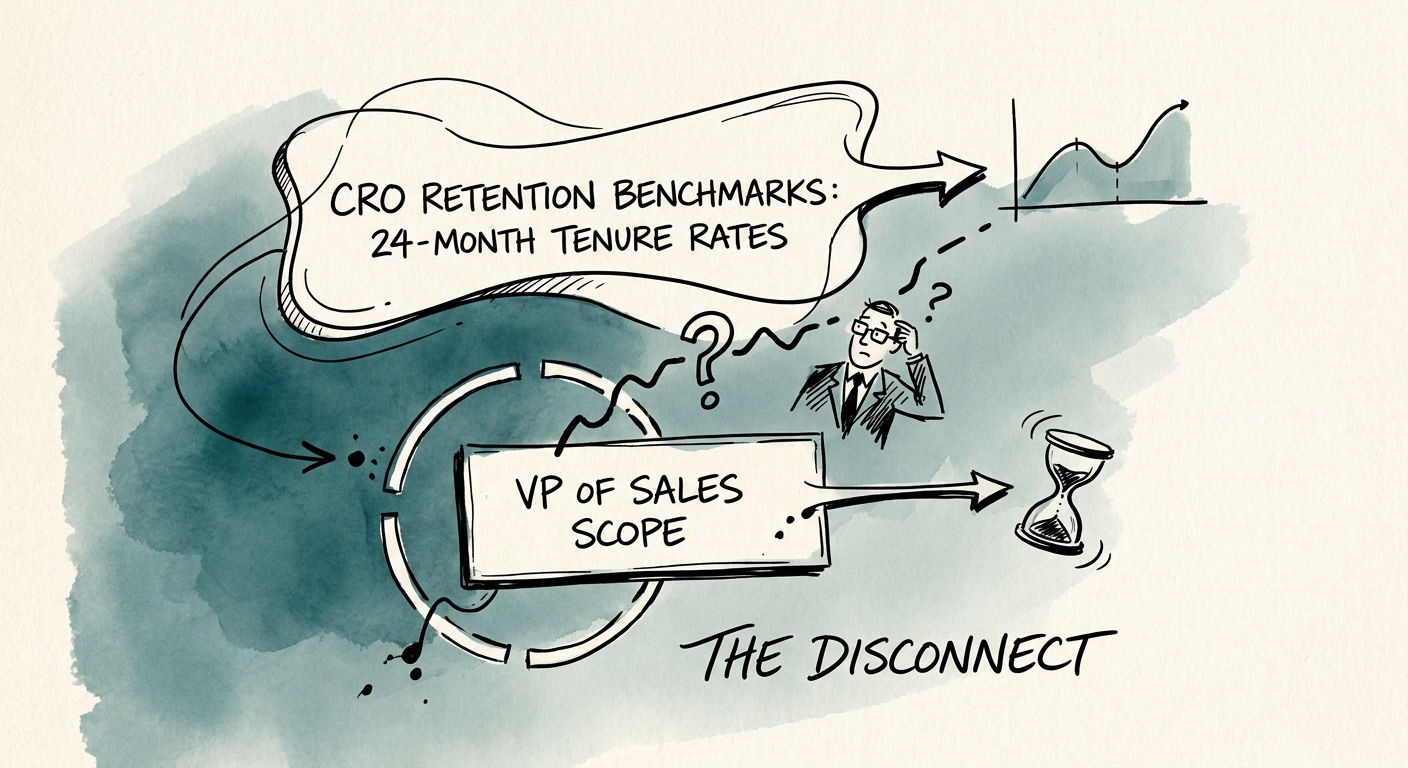
Engineering a 36-month tenure before the offer letter goes out
Stretching a CRO past the 24-month wall is less about finding a better human and more about not lighting the fuse before they arrive. Three moves do the work.
First, audit the revenue engine before you open the search, not after the new hire walks into it. You need to know whether you're handing someone a verified, multi-threaded book of business or a pipeline hallucination dressed up for the last raise. This matters because the math on a failed hire is punishing: C-suite replacement runs two to four times the executive's total compensation, so a $400,000 CRO who washes out is a $1.6 million cash event before you count the growth points and multiple erosion stacked on top. Recruiting a premium operator into a rotten environment doesn't fix the environment. It just burns a premium operator.
Second, write a month-by-month definition of "working" and put it in the offer. The single most common own-goal is a board that expects an outside CRO to bypass the six-to-nine-month enterprise sales cycle by sheer talent, then reads the first two quarters of pipeline rebuild and comp-plan surgery as a lack of urgency. Anchor the first 90 days to diagnosis, not bookings: a documented read on conversion velocity, CAC payback, and where net revenue retention is quietly leaking. If historical pipeline conversion is 15%, nobody gets to model 25% without naming the product or pricing change that earns it. Month 6 looks like a validated baseline. Month 12 looks like a fixed comp plan and a forecast you'd bet on. Month 24 looks like the number. Confuse those milestones and you've pre-scheduled the firing.
Third, grade the CRO on the health of the revenue operations system, not the lagging scoreboard of closed-won. Forecast accuracy, marketing efficiency, and retention of your top three account executives tell you whether the machine is real twelve months before the ARR does. Then make the comp structure agree with the timeline — vesting and earnouts weighted toward the 24- and 36-month marks, so the person building a durable engine isn't financially punished for the fact that durable engines take three quota cycles to prove. Do this and the tenure clock that quietly runs out at month 19 instead carries your revenue leader to the exit you actually underwrote.