The practical answer
- Short answer
- Undocumented customer relationships create transfer risk in M&A. Learn the 3-level framework buyers expect before trusting customer revenue.
- Best fit
- Industry: Professional Services & SaaS. Function: Operations & Sales
- Operating path
- Process Documentation → Operational Excellence → Transaction Execution Services
- Key metric
- 3 levels Documentation hierarchy buyers expect to see before trusting customer revenue transferability.
Undocumented Customer Relationships Create Transfer Risk
In private equity due diligence, there is a saying: "If it isn't written down, it doesn't exist." For founders who have built their businesses on charisma, informal handshakes, and personal trust, this can be uncomfortable. You know your top client will renew because you had dinner with their CEO last week. The private equity buyer knows nothing of the sort. To them, that relationship is a single point of failure, and they will price that risk into the deal.
We call this the "Handshake Discount." When a buyer sees that key revenue streams are tethered to the founder rather than the firm, they don't just worry about transition risk; they quantify it. High customer concentration combined with founder dependency can reduce buyer confidence and create price pressure. In a meaningful exit, that can represent real value lost because relationships live in the founder's head instead of the data room.
The Difference Between "Founder Loyalty" and "Brand Stickiness"
Buyers are looking for transferability. They need to know that the revenue will survive your departure. If your top account stays because they like the founder personally, that is a liability. If they stay because your firm has integrated into their workflows, documented their success criteria, and mapped their buying committee, that's an asset. The goal of customer documentation is not just to prove the revenue exists, but to prove it is sticky beyond your personal influence.
A buyer cannot underwrite customer loyalty that only exists in the founder's head. The relationship needs contracts, engagement history, success metrics, and a transition plan.
The Documentation Hierarchy: What Buyers Actually Want to See
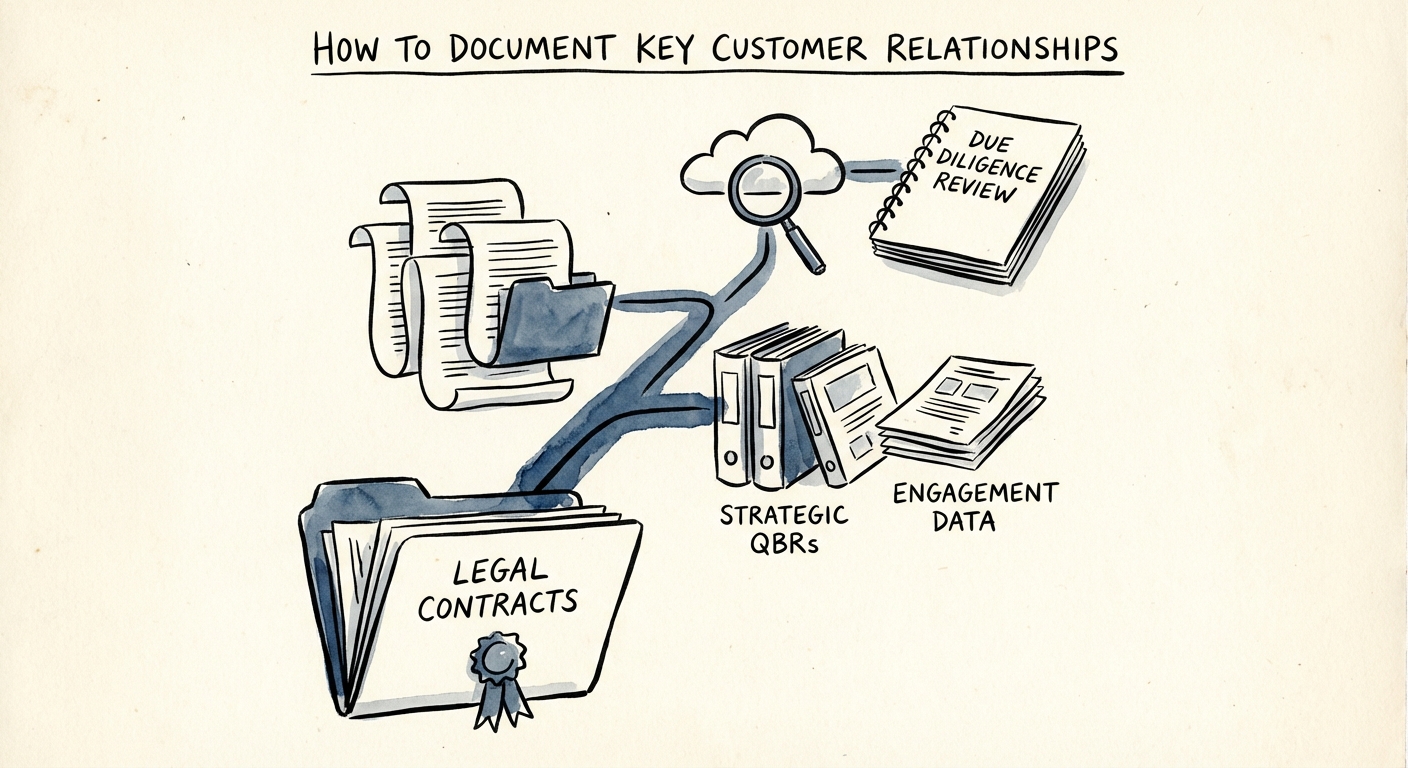
When a PE associate opens your data room, they are looking for a "Golden Thread" of documentation that connects the initial promise of the contract to the ongoing reality of the relationship. Most companies stop at Level 1. To command a premium multiple, you must reach Level 3.
Level 1: The Legal Baseline (The "What")
This is the bare minimum. If these aren't perfect, the deal stops.
- Master Services Agreement (MSA): Signed, current, and clearly defining the legal relationship.
- Statements of Work (SOWs): Detailed scope for every active project. No "verbal change orders."
- Auto-Renewal Clauses: Buyers love these. If you have to fight for every renewal, it's not recurring revenue; it's recurring effort.
Level 2: The Engagement Trail (The "How")
This proves the relationship is active, healthy, and operational—not just a dormant contract.
- Quarterly Business Review (QBR) Decks: The single most valuable artifact in due diligence. A folder of QBRs dating back 2 years proves you are strategically aligned and delivering value.
- Client Org Charts: A visual map of the client's organization, highlighting your champions, detractors, and budget holders. This shows you understand their power structure.
- Engagement Logs: CRM exports showing regular touchpoints from multiple members of your team, not just the founder.
Level 3: The Strategic Lock-In (The "Why")
This is where you earn the Transferability Premium.
- Joint Product Roadmaps: Evidence that the client is co-investing in your future.
- Success Metrics & KPI Dashboards: Automated reports showing the ROI you generate for them.
- Documented Case Studies (Internal): Detailed "win wires" explaining exactly how you solved their specific problems, creating a playbook for future account managers.
The 6-Month "Institutionalization" Sprint
If you are planning to exit in the next 12-24 months, you cannot afford to leave your relationships undocumented. You need to launch an "Institutionalization Sprint" to transfer equity from your personal brand to the company's ledger.
Month 1-2: The Audit
Start with a contract revenue analysis. Identify every client representing >5% of revenue. Do you have a signed MSA? Is the SOW current? If not, paper it now. "Cleanup" during due diligence looks like panic; cleanup a year before looks like maturity.
Month 3-4: The Delegation
Force a transition of trust. Bring a VP of Sales or Customer Success Manager into every founder-led meeting. Make them the primary voice on the QBR. Your goal is to have the client email them for problems, not you. Document this shift in your CRM.
Month 5-6: The Artifact Creation
Formalize your QBR process. Create the "Account Dossier" for your top 10 clients—a single dossier containing everything a new owner would need to run the account without you. This includes the customer reference strategy—identifying who will speak to the buyer and knowing exactly what they will say.
By treating your customer relationships as documented assets rather than personal favors, you don't just protect your exit value; you build a business that is fundamentally more scalable and resilient.