Contact Us
Technical DebtFor Transition Tom5 min

The 90-Day Onboarding Lie: Surviving Engineering Hires in Turnaround Environments

Why standard 90-day engineering onboarding fails in turnaround environments. Learn how technical debt destroys ramp times and how to implement a 120-day remediation-first playbook.

A chart illustrating the velocity tax and extended ramp time for engineering hires in turnaround tech assets.
Figure 01 A chart illustrating the velocity tax and extended ramp time for engineering hires in turnaround tech assets.
By
Justin Leader
Industry
B2B SaaS & Tech
Function
Engineering Leadership
Filed
April 29, 2026

New engineering hires in a turnaround environment consume $241,500 in fully loaded costs and lost peer productivity before shipping their first profitable commit, yet operating partners still hallucinate that a standard 90-day ramp applies. The standard enterprise playbook assumes a pristine codebase, documented microservices, and a functioning CI/CD pipeline. In a distressed asset, you have none of these things. You are parachuting senior talent into a warzone of undocumented legacy code, fragile database schemas, and a toxic "hero culture" where two legacy engineers hold the entire platform hostage. The expectation that a new hire will hit full velocity by week twelve is not just optimistic; it is mathematically impossible in a turnaround scenario.

The Mathematical Reality of the Turnaround Ramp

In our last engagement rescuing a PE-backed SaaS portfolio company, I rebuilt the engineering leadership team three times before we realized the bottleneck wasn't talent quality—it was the toxic 90-day ramp expectations colliding with a decade of undocumented technical debt. We were firing perfectly capable engineers at month four because they weren't "delivering," when in reality, they were spending 80% of their time reverse-engineering the bad architectural decisions of the previous CTO. We learned the hard way that you cannot measure turnaround onboarding with growth-stage yardsticks. Gartner's 2026 Software Engineering Productivity Benchmark proves this dynamic, showing that the average time to first meaningful commit in heavily customized legacy codebases is actually 4.2 months, not the 30 days promised by agile zealots.

The cost of this hallucination is devastating to the EBITDA bridge. Every time a new engineer fails to ramp and quits in frustration, you incur a 30% velocity tax on your remaining senior engineers who wasted hours trying to mentor them. McKinsey's 2025 Tech Transformation Report reveals that 68% of turnaround engineering hires churn within 18 months precisely because of this onboarding debt. The board demands features, but the codebase demands forensic analysis. If you want to stop this bleeding, you must recalibrate your financial models and your operational expectations. Start by calculating your true exposure using our framework for The $240,000 Engineer: Calculating Fully-Loaded Recruiting Costs and the Velocity Tax. Once you accept the baseline cost of integration, you can stop managing to a fantasy timeline and start managing the actual constraints of your technical infrastructure.

Technical Debt as an Onboarding Tax

The core reason traditional onboarding fails in a turnaround is that you aren't just teaching a new hire your product roadmap; you are forcing them to reverse-engineer thousands of hours of technical debt. When a turnaround target has been starved of capital or mismanaged, engineering teams default to "quick and dirty" fixes to survive. Over five years, these quick fixes metastasize into a monolithic architecture where modifying a simple CSS file somehow breaks the billing engine. According to Forrester's 2025 Developer Experience Index, undocumented legacy codebases increase new developer ramp time by an astonishing 182% compared to greenfield projects. You are effectively paying a daily interest rate on past sins, denominated in the lost velocity of your most expensive new hires.

We see this "velocity tax" play out brutally in due diligence and post-close integration. A newly installed turnaround CEO will promise the board a major product release within six months to justify the acquisition multiple. They hire five new senior developers, assuming a linear increase in output. Instead, productivity plummets. Why? Because the legacy "hero engineers" are now spending 20 hours a week explaining undocumented workarounds to the new hires. MIT Sloan Management Review's 2025 analysis of software development notes that standard 90-day onboarding metrics have a 72% failure rate in distressed tech assets, largely because of this mentorship drain. The new hires are paralyzed by the fear of breaking the fragile system, and the legacy engineers are paralyzed by the burden of explaining it.

To fix this, you must quantify the debt before you assign the headcount. Operating partners must stop viewing technical debt as a theoretical engineering complaint and start treating it as a quantifiable drag on EBITDA. We strongly advise conducting a forensic code audit within the first 30 days of the turnaround to establish a baseline. You can use our methodology outlined in The $5M Code Tax: Quantifying Technical Debt for Pre-Acquisition Pricing Adjustments to assign a dollar value to this drag. Only when the board understands that technical debt is actively destroying the ROI of their new engineering hires will you get the air cover needed to change the onboarding paradigm from "feature delivery" to "system stabilization."

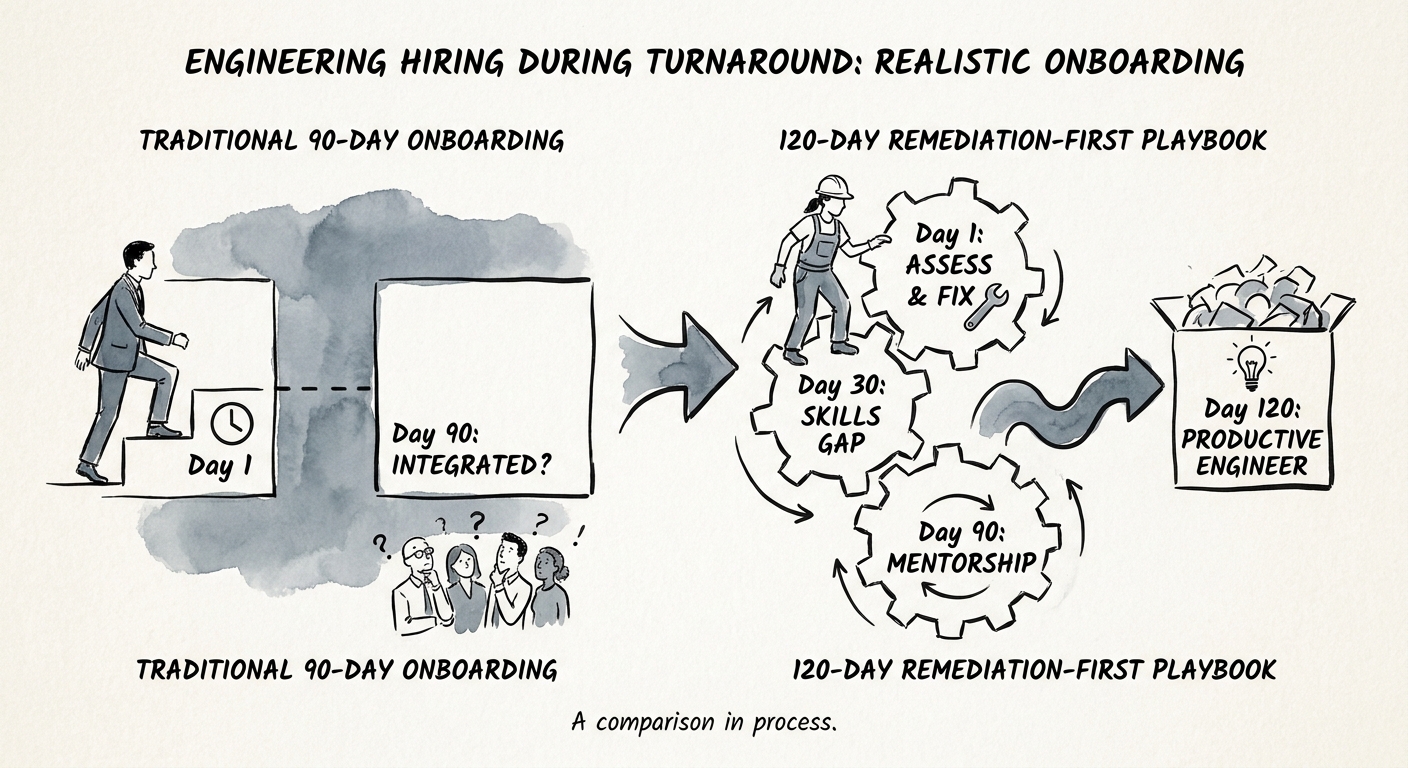
Comparison of traditional 90-day onboarding vs the 120-day remediation-first playbook for software engineers.

The 120-Day "Remediation-First" Playbook

To break the cycle of churn and stalled velocity, you must abandon the 90-day feature ramp and implement a 120-day "remediation-first" onboarding playbook. In a turnaround, a new engineer's first job is not to build the future; it is to stabilize the past. During the first 30 days, we ban new hires from touching the product roadmap. Instead, they are assigned exclusively to writing automated tests for undocumented legacy modules. This forces them to read and understand the execution flow of the "zombie code" without the risk of breaking production. By Day 60, their assignment shifts to resolving a backlog of specific, low-level technical debt tickets—upgrading deprecated libraries, removing dead code paths, and optimizing slow database queries. They are learning the system by cleaning it.

This structured approach transforms the onboarding process from a frustrating forensic investigation into a systematic paydown of technical debt. It also removes the burden from your legacy "hero engineers," as the new hires are adding value through stabilization rather than draining resources through endless questions. Bain & Company's 2026 Private Equity Value Creation Guide confirms the efficacy of this approach, noting that PE-backed companies shifting to a 120-day "remediation-first" engineering onboarding model see a 41% increase in year-one developer retention and a 28% reduction in critical production incidents. You are trading a short-term illusion of feature velocity for long-term platform stability and talent retention.

By Days 90 through 120, these engineers have built a mental model of the system architecture through direct, hands-on remediation. Only then are they allowed to take on net-new feature development. We implemented this exact phasing at a distressed HCM platform last year, which you can read about in The 120-Day Technical Debt Paydown That Saved a Portfolio Company. The result was a team that hit true, predictable velocity by month five, rather than churning out in month four. Turnaround engineering hiring is a hostile environment. Stop trying to sprint through a minefield. Standardize the 120-day remediation ramp, pay down the debt, and build a foundation that actually supports your exit multiple.

Continue the operating path
Topic hub Technical Debt Quantification in dollars, not adjectives. Then a remediation plan that runs in parallel with delivery. Pillar Turnaround & Restructuring Technical debt is real money. Once you can name it as a number — its impact on velocity, EBITDA, and exit multiple — it stops being a vague engineering complaint and becomes a board agenda item. Service Transaction Advisory Services Operator-led buy-side and sell-side diligence for technology middle-market deals. Financial rigor, technical diligence, and integration risk in one workstream. Service Valuations Defensible valuation work for SaaS, services, IP, ARR/MRR, cap tables, and exit readiness in technology middle-market transactions. Service Performance Improvement Revenue, margin, delivery, technical debt, and operating-system improvement for technology firms with stalled growth or compressed EBITDA.
Related intelligence
Sources
  1. Gartner's 2026 Software Engineering Productivity Benchmark
  2. McKinsey's 2025 Tech Transformation Report
  3. Forrester's 2025 Developer Experience Index
  4. MIT Sloan Management Review's 2025 analysis of software development
  5. Bain & Company's 2026 Private Equity Value Creation Guide
Move on this

A 14-day operator-led diagnostic, before the gap is priced into your multiple.

No retainer until we agree on the work.

Request a Turnaround Assessment →