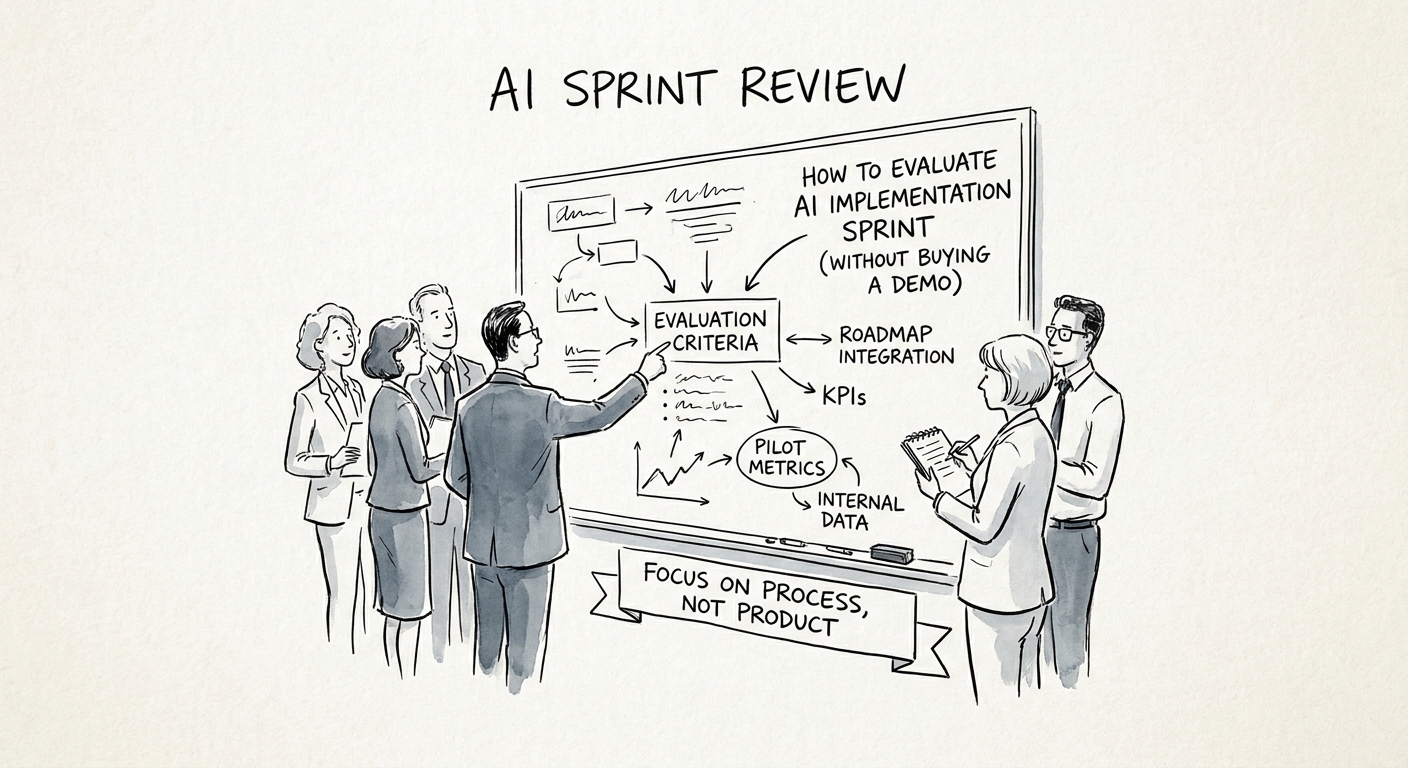
Every demo wins. That's the problem.
You watched the vendor type a question, and the AI answered it in two seconds with a perfectly formatted summary pulled from three systems. The room nodded. Someone said "we need this." And you almost signed.
Here is what the demo did not show you: the data was a curated sample, not your actual export with the duplicate customer records and the free-text "notes" field where half your business logic actually lives. The question was the one the tool answers best, asked the way it likes to be asked. There were no permission boundaries, no audit trail, no person who had to override a wrong answer in front of a customer. A demo is engineered to remove every reason to say no. That is its job.
A paid implementation sprint is the opposite instrument. You are not buying a demonstration that it works; you are buying a controlled investigation into whether it works on your stuff, and what it costs to get there. The distinction matters because the failure rate is not theoretical. Year after year, the research from McKinsey, IBM, and PwC lands on the same uncomfortable finding: the gap between a working pilot and a value-generating deployment is not the model. It is adoption, governance, and the operating-model change nobody demoed. So evaluate the sprint by how honestly it confronts those three, not by how cleanly it performs.
Five things a real sprint produces that a demo never can
A sprint earns its fee by producing artifacts a salesperson would rather not generate, because each one is a place the project could be told to stop. Walk in expecting these five, and treat a missing one as a signal.
1. A current-state map of one named workflow — with its exceptions. Not "customer service." The specific path: a refund request arrives, gets routed, gets checked against policy, gets approved or escalated. The demo skipped the requests that don't fit the policy cleanly. The sprint should hand you the exception list, because that's where automation either holds or breaks.
2. A source-system inventory and a data-repair estimate. The honest output here is rarely "your data is ready." It's "these two fields are clean, this one is free-text chaos, and reconciling them is three days of work before the pilot can run." That estimate is the single most useful thing a sprint produces, and the one a demo structurally cannot.
3. A written control model. Who reviews AI output before it reaches a customer. When the system says "I'm not sure," what happens. Where the override button is and who is allowed to press it. The Bain and MIT Sloan Management Review material on AI operating models keeps circling the same point: the deployments that survive contact with real users are the ones where the human-in-the-loop rules were designed first, not bolted on after an embarrassing error.
4. An adoption plan that names workarounds. A pilot people quietly route around is a failed pilot with good metrics. The sprint should tell you who has to change their Tuesday, what they'll resist, and how you'll know if they've gone back to the spreadsheet.
5. A scorecard with a baseline. If the sprint cannot tell you the number the workflow produces today, it cannot prove the pilot moved it. "Faster" is not a baseline. "Refund cycle time is currently 31 hours" is.
Notice what unites these: each one defines a limit, including an explicit list of what will not be automated. A sprint proposal full of limits is a serious one. A proposal that promises everything works is a demo wearing a statement of work.
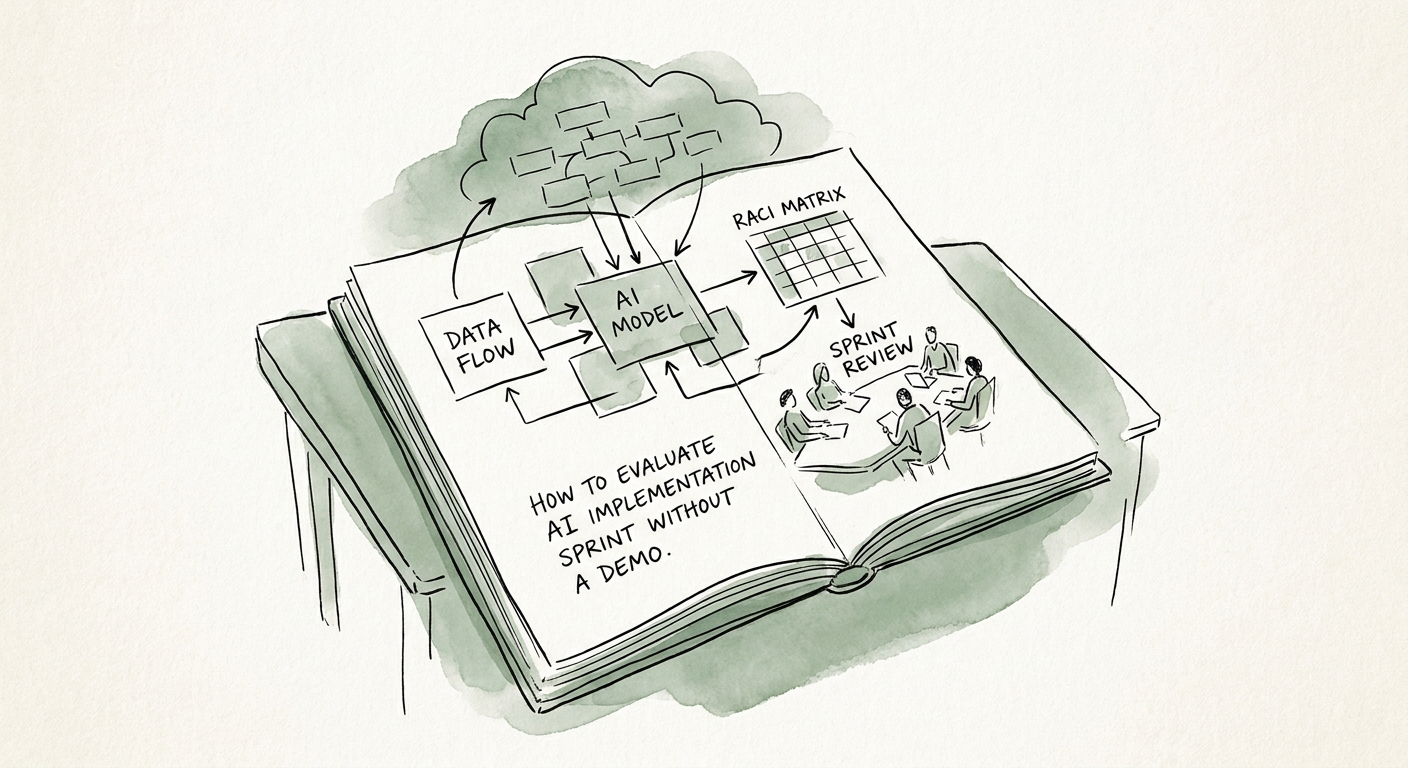
Three questions that end the sales theater on Monday
Before you sign a sprint, get the team that will actually do the work on a call and ask them to walk through one ugly example end to end. Not the demo example — yours.
First: "Show me what happens when two of our source systems disagree." A team that has built real implementations will answer immediately, because they've been burned. A team selling you a demo will reach for the abstract — "we have robust data handling." Push until you get the specific mechanic.
Second: "When the AI is uncertain, who sees it, and what do they do?" The right answer describes a person, a queue, and a rule. The wrong answer describes a confidence threshold and nothing about the human on the other side of it.
Third: "What is the one criterion that means this pilot is NOT ready for production?" If they can't name a tripwire, they don't have a production bar — they have a hope.
Match the money to the work, too. A short diagnostic should choose the workflow and surface the readiness gaps; the scoped sprint builds the first governed pilot; ongoing support should be priced against monitoring, retraining, and error rates, not "access." If you haven't even picked the workflow yet, start with the AI Opportunity Score and let the candidate processes rank themselves. When you've chosen one and the data is roughly in reach, move into the 90-Day AI Implementation Sprint — and use a 90-day implementation plan to force the order: readiness, then controlled build, then adoption and measurement. The sprint that skips to tooling is the demo, just with an invoice attached.
