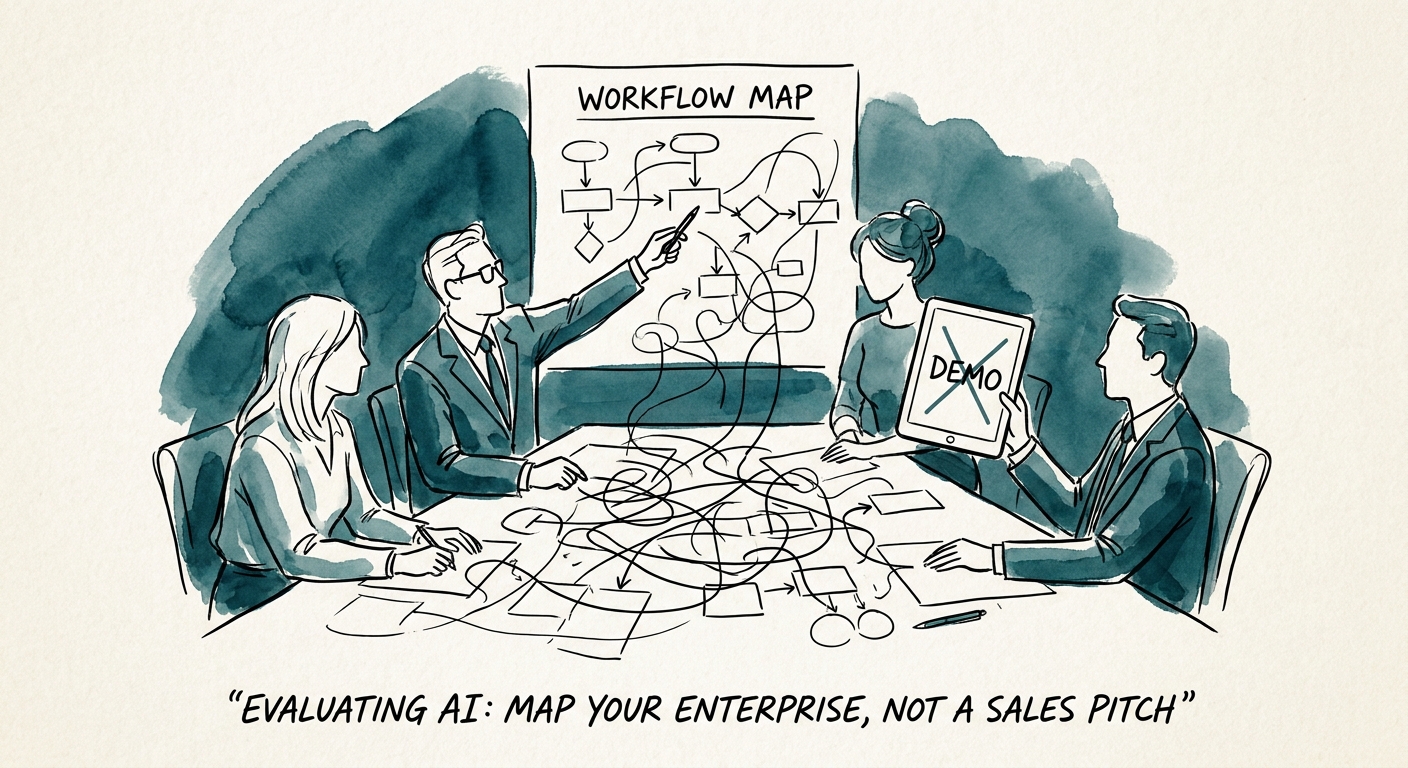
The demo was always going to work
Here is what you are not seeing in the room. The dataset was cleaned by hand. The example was chosen because it has no weird exceptions. Nobody asked who approves the output, because in a demo nobody approves anything — it just appears. The version you watched is the version where everything goes right, run for the fourth time after the first three were edited out.
None of that is dishonest. It is what a demo is. The problem starts when you treat a smooth demo as evidence that the same thing will work on your messy data, with your exceptions, under your approval chain, measured against your numbers. Those are four different bets, and the demo tested none of them.
So stop grading the demo. Grade the partner's willingness to walk you behind it. The research keeps pointing at the same culprit: value comes from changing how the work is done and how it is governed, not from model quality. McKinsey's 2025 State of AI ties returns to operating-model redesign; IBM's Institute for Business Value finds the gap is execution and ownership; PwC's 2025 Responsible AI survey puts controls and accountability at the center. A demo cannot show you any of that. The questions below can.
Five questions, and what a bad answer sounds like
Bring these to the next conversation. The goal is not to hear "yes" — it is to watch how fast and how specifically they answer. Confidence on the limits is the signal.
1. Which single workflow, and what is it costing us today? A real partner names one process and asks you for a baseline number — hours, error rate, cycle time, something. A weak one talks about "AI across the business." If they can't anchor to a current cost, there is nothing to improve against.
2. What does our data actually look like, and where will it fail you? Good answer: they want to see a sample before promising anything, and they expect it to be inconsistent. Bad answer: data readiness never comes up. The demo data was perfect; yours is not, and someone has to say so out loud.
3. Who approves the output, and what does the audit trail show? If the answer is "the model just does it," walk. The NIST AI Risk Management Framework exists because ungoverned automation creates risk you only discover later. You want named control points and a record of who decided what.
4. What are you deliberately not automating? This is the tell. A partner who has shipped to production can list the things they leave to humans without hesitation. A partner who has only ever demoed thinks everything is automatable, because in a demo it is.
5. How do we know it worked in 90 days? They should hand you the metric and the measurement method, not a vibe. Bain's 2025 agentic AI research is blunt that disconnected pilots that nobody measures are where budgets go to die.
If those answers come fast and specific, you are probably talking to operators. If they're vague, you're talking to a sales deck. Need the wider plan before you start scoping a build? That's what the AI Transformation Blueprint is for.
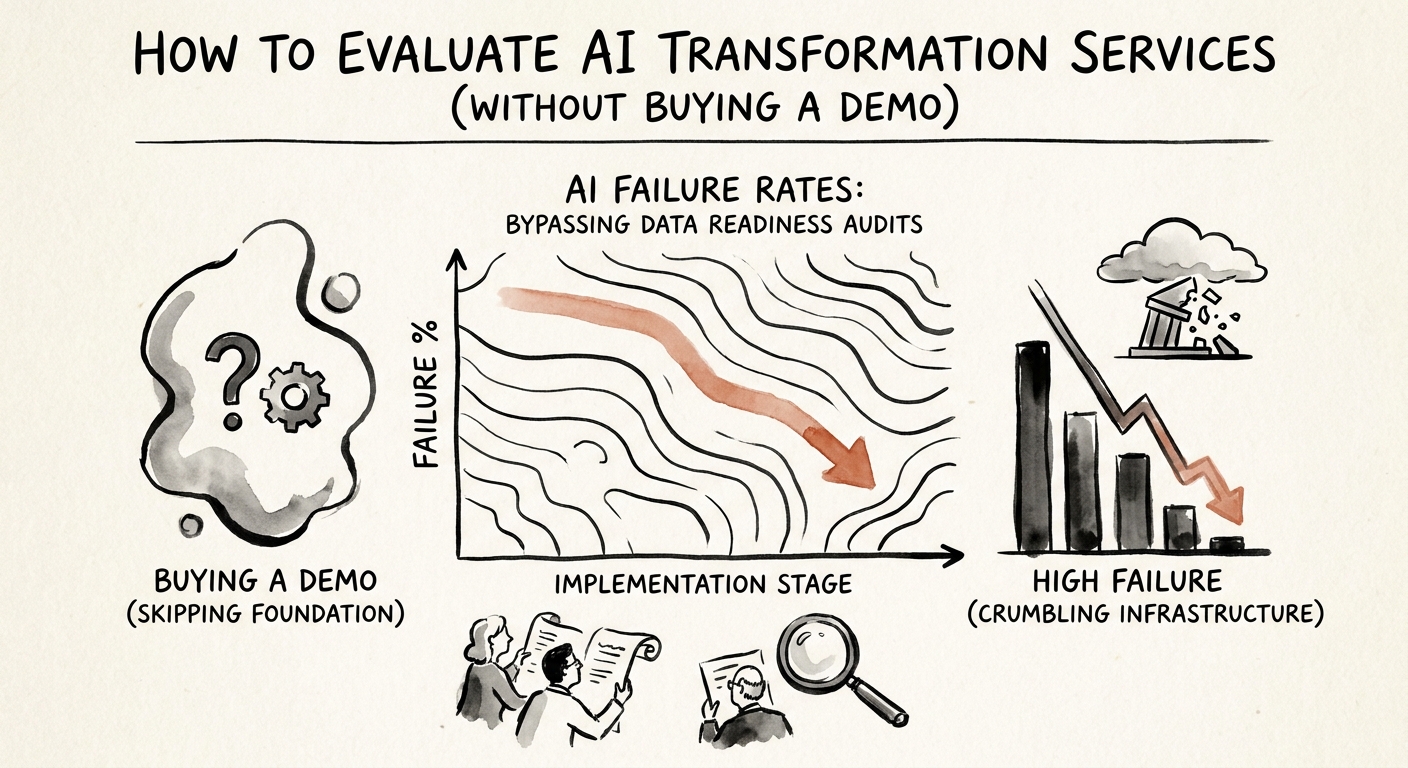
Buy the boring version first
The partner you want will quietly make your engagement smaller than the demo implied. Instead of "AI across operations," you'll walk out with one workflow, one owner, an approval rule, a training plan for the three people who touch it, and a scorecard with a number on it. That is less exciting than the demo. It is also the version that survives contact with your Tuesday.
Here is the trade that matters: a narrow workflow that twelve people actually adopt beats a broad capability that impresses the board and changes nothing. Adoption is the whole game. A tool nobody uses has a measurable ROI, and it is zero.
To pick the right first workflow before you sign anything, run the AI Opportunity Score — it surfaces which process has the cost and the readiness to be worth doing. Then take that to the QuickStart AI Audit for an evidence-backed starting point you can hold a partner to.
