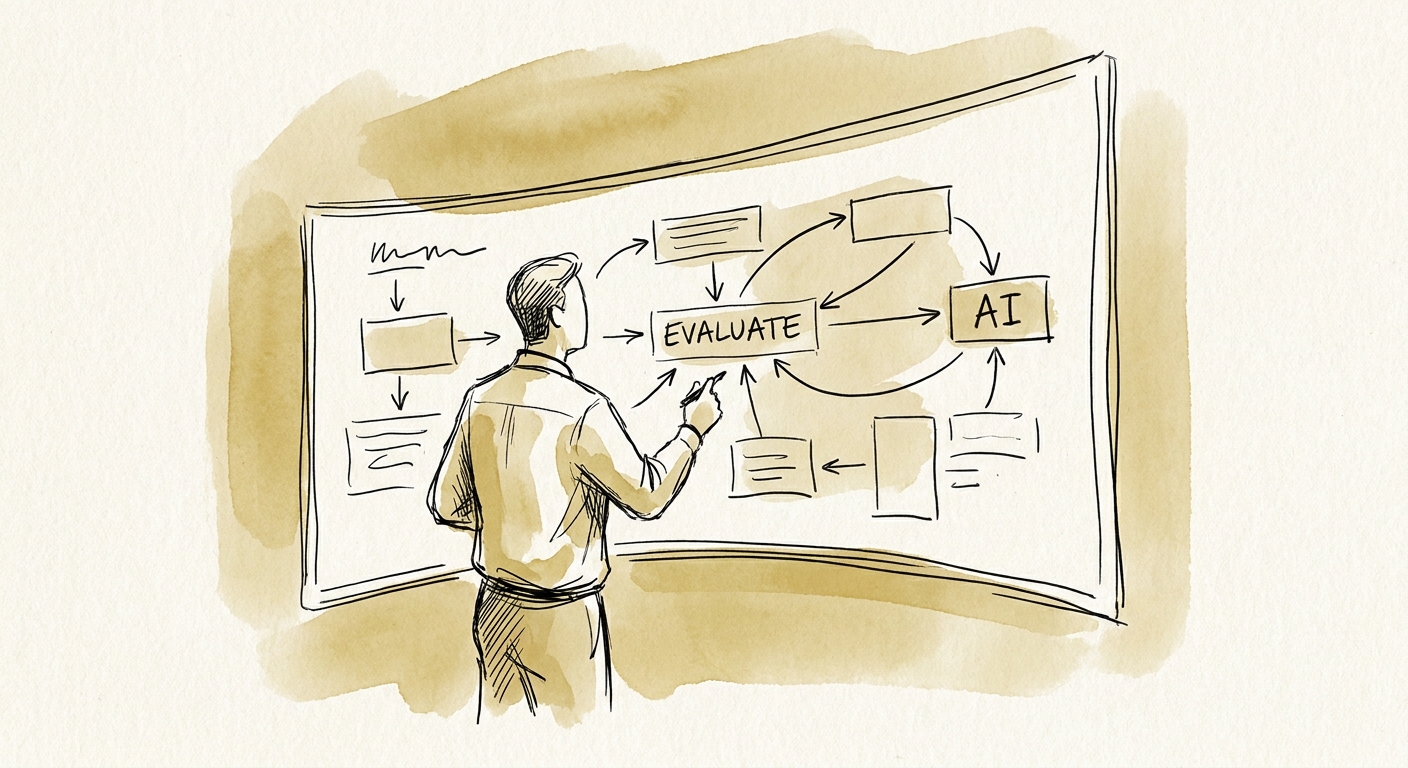
The demo always works. That's the problem.
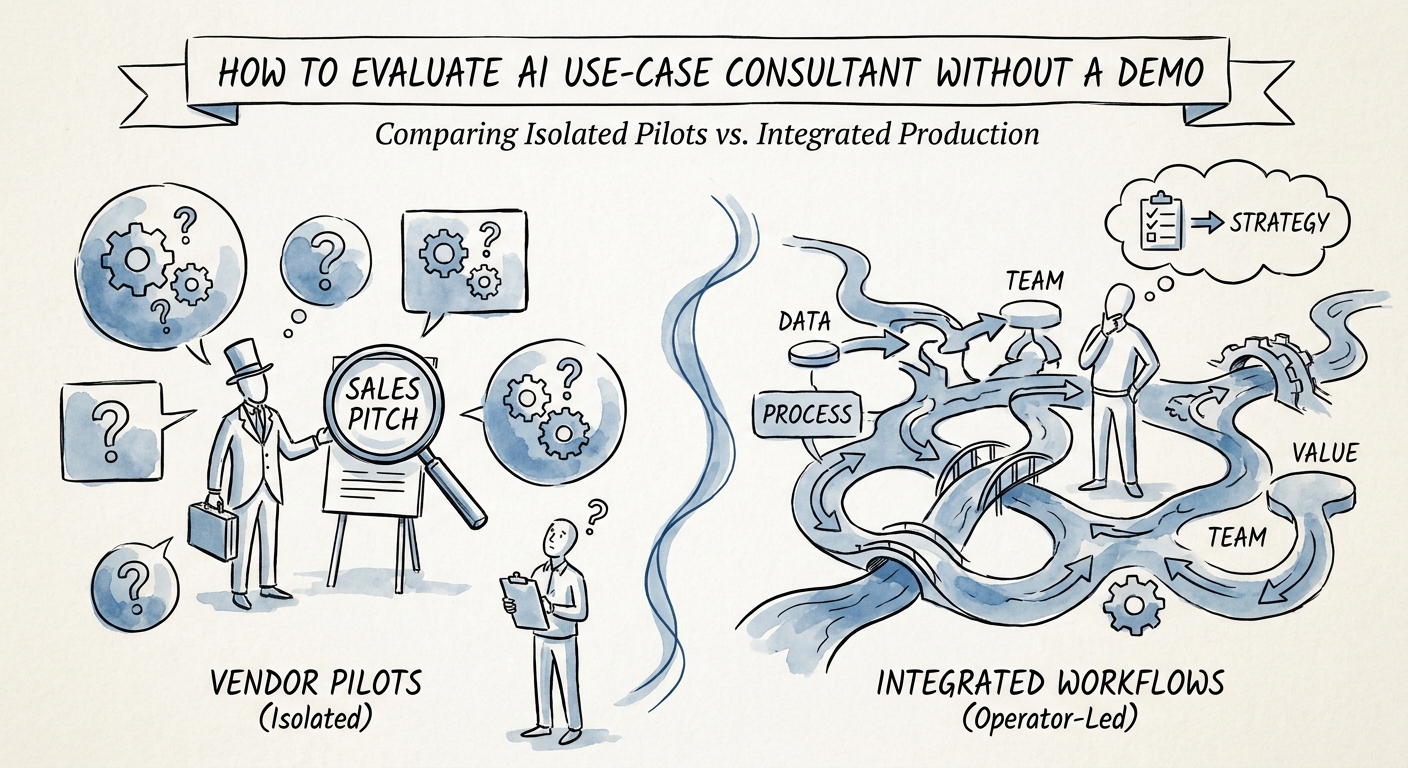
Here is the scene I've watched play out a dozen times in mid-market tech companies. A consultant flies in, opens a laptop, and shows an AI assistant answering questions about a contract in three seconds flat. The room nods. Someone says "that would save us so much time." A statement of work appears the next week. Six months later there's a half-built tool nobody trusts, and the contract data it was supposed to read still lives in four systems that don't talk to each other.
The demo wasn't a lie. It was a curated best case — clean inputs, a happy path, no exceptions, no permissions, no auditor asking who saw what. The trouble is that a demo measures the consultant's slide-building skill, not their ability to make the thing survive contact with your actual operation. McKinsey's State of AI 2025 is blunt about where value actually comes from: it follows fundamental workflow redesign, not from bolting a clever tool onto a process you never changed. So the first thing a credible consultant does is refuse to demo. They ask about your process instead.
The test is simple. Before any screen lights up, can they reconstruct one of your workflows from your description alone — the decision being made, who owns that decision, where the data lives, what happens when an input is missing or wrong, and what number tells you it worked? If they can't get past "what would you like the AI to do," they're going to sell you a feature, not fix a business problem. IBM's Institute for Business Value frames AI as a capability system — data, operating model, adoption, measurement — and a consultant who can only discuss the model and the UI is missing three of the four legs.
Make them describe your worst day, not their best one
The whole game flips when you ask about failure. A demo lives on the happy path. Production lives on the exceptions. So put the exceptions on the table early and watch what happens.
Try these on your next call. "Show me what your system does when the document is a scanned PDF from 2019 with a coffee stain." "What happens when two source systems disagree on the customer's name?" "When the model is confident and wrong, how does a human catch it before it reaches a client?" "Who is allowed to see this output, and how do you prove that boundary held six months from now when our auditor asks?" These aren't trick questions. They're the questions NIST's AI Risk Management Framework organizes an entire discipline around: map the context, measure the risks, manage the controls, govern the accountability. A serious partner has lived these questions and answers them with specifics. A demo merchant gets vague and starts talking about "robust pipelines."
The integration answer is the one that separates the two most cleanly in a mid-market tech shop. Your AI use case almost never touches a tidy database in isolation — it reaches into identity, file permissions, email, and the collaboration data scattered across the tools your team actually uses. Microsoft's documentation on Copilot's data-protection architecture is worth reading even if you never deploy Copilot, because it lays out exactly how access boundaries, permissioning, and auditability constrain what an AI system can safely surface. If a consultant has never thought about the fact that an AI assistant inherits whatever the connected account can see — including the HR folder someone forgot to lock down — they will build you a confidentiality incident with a friendly chat interface.
Name the four owners before you price the work
Here's the move that costs nothing and tells you everything. Ask the consultant to name four people on your side before they estimate a single hour: the business owner who lives with the outcome, the risk owner who signs off on what could go wrong, the data owner who controls the sources, and the adoption owner who gets your team to actually use it. PwC's 2025 Responsible AI survey found that accountability works when it sits with the teams making decisions, not parked with a lone policy owner off in a corner. A consultant who reaches for those four roles unprompted has run real engagements. One who jumps straight to architecture and pricing is selling software and treating your operation as an afterthought.
Run it as a scorecard. Four screens, pass or fail: did they diagnose the workflow before reaching for a product, did they handle the failure and exception cases with specifics, did they show real fluency in integration and access boundaries, and did they name the owners before naming the price. A consultant who clears all four is worth a paid pilot. One who clears two but dazzled you with a demo is the most expensive mistake on the table — because the demo is exactly the thing that makes a weak partner look strong.
If you want to walk into that evaluation already knowing the shape of your own use case — so the consultant is reacting to your diagnosis instead of selling you theirs — start with the AI Opportunity Score, then bring the picture to Human Renaissance AI transformation services. Define the problem first, and no demo can redefine it for you.
