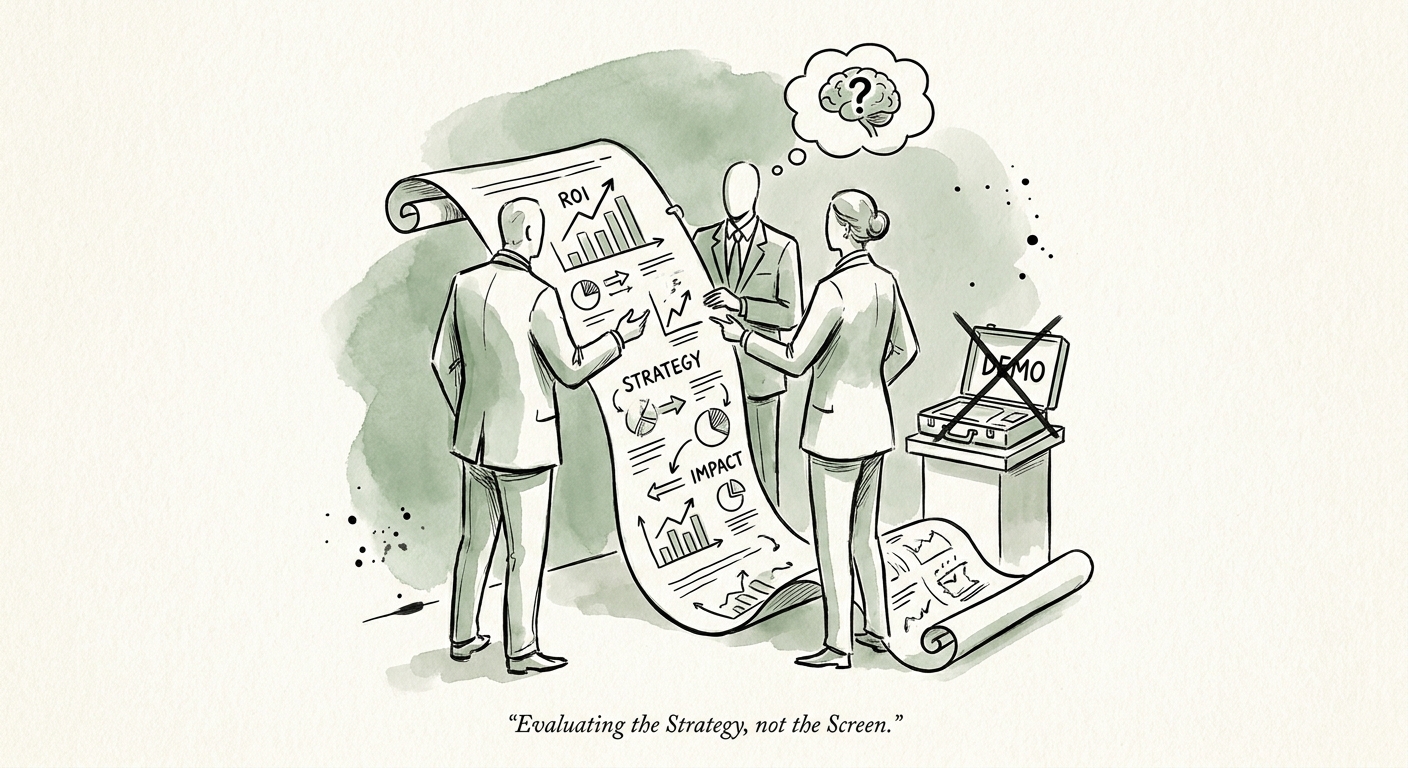
The demo is the worst part of the interview
A fractional Chief AI Officer walks into the room with a slick agent demo, a tour of three other companies they've "transformed," and a slide that says "AI-native operating model." Forty minutes later everyone's nodding. Two quarters later you have four half-finished pilots, no one who can say which workflow actually moved a number, and a monthly invoice you're starting to resent.
The demo tells you the candidate can present. It tells you nothing about whether they can run a portfolio of AI work inside your company, where the data is messier than any sandbox and the politics are real. McKinsey's State of AI 2025 is blunt about where the gap sits: the organizations seeing real returns are the ones redesigning workflows and putting senior leaders on the hook for outcomes — not the ones with the best tooling tour. A fractional officer who leads with capability instead of theater is the one worth interviewing further.
So flip the meeting. Spend the demo time on a single question: what would you have authority to decide here, and what would you escalate to me? IBM's Institute for Business Value research on AI capabilities frames the role as building durable capability — data readiness, operating model, adoption, benefits tracking — into one repeatable cadence. If the candidate can't draw that loop on a whiteboard without their deck, the demo was the only thing they brought.
Four authority tests, run before the rate conversation
Because this is a fractional hire — part-time, often two or three days a month, frequently splitting attention across clients — authority matters more than it would for a full-time exec. You won't be in the room when most decisions happen. So you're not buying their presence; you're buying their judgment and their standing to act. Test for both, in this order:
1. Can they stop something? Describe a pilot you're personally excited about and ask how they'd kill it if the numbers didn't show. A real chief will tell you the kill criteria up front. A narrator will reassure you it'll work. 2. Who owns the risk decision? Hand them the NIST AI Risk Management Framework as a prompt and ask them to walk you through govern, map, measure, and manage for one concrete workflow — say, automating customer-email triage. You want named owners and checkpoints, not "we'll build a responsible-AI policy." 3. Where does sign-off live? PwC's 2025 Responsible AI survey makes the point that responsible AI only works when it lives inside the build-and-rollout decision, not in a separate document. Ask: who approves a use case, who monitors data exposure, who signs off on what the model produces, who owns whether anyone actually adopts it? Four answers, four names. 4. What's the first measurable outcome? Not a vision. A metric, a baseline, and a date.
What most boards get wrong is treating these as soft questions to ask after they've fallen for the demo. Run them first, and the demo becomes irrelevant — you'll already know whether this person can operate.
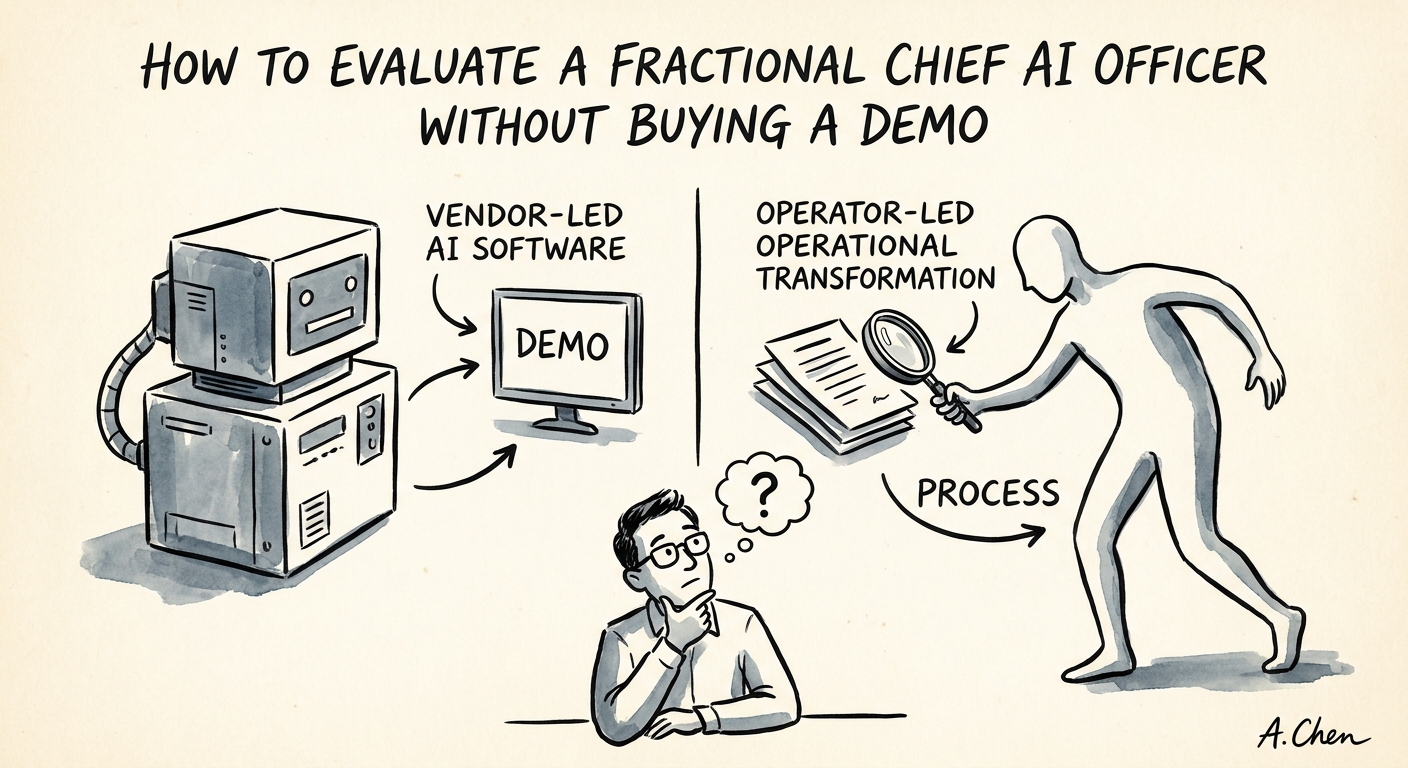
What the first 90 days has to produce
A fractional officer who can't show a tangible result inside one quarter is a recurring advisory fee in disguise. Set the bar before they start. By day 90 you should hold: a ranked list of candidate workflows with rough value attached to each, a governance cadence with named owners (the four from test three), a tool-access policy that says who can use which AI on what data, and two or three workflows moved into real production — not slideware. Bain's 2025 research on agentic AI transformation is consistent on this: the agentic capabilities everyone wants only pay off when the unglamorous foundation work — data, ownership, guardrails — is done first. The first mandate is to build that foundation, not to demo what's possible.
One Monday move: before you sign anyone, write down the single workflow you'd be furious to see still stuck in "pilot" 90 days from now. That's your acceptance test. Bring it to every candidate and watch who flinches.
If you'd rather not architect the role from scratch, Human Renaissance AI transformation services can help you turn fractional AI leadership into a governed operating system with owners and accountable outcomes — not a title that bills monthly and decides nothing.
