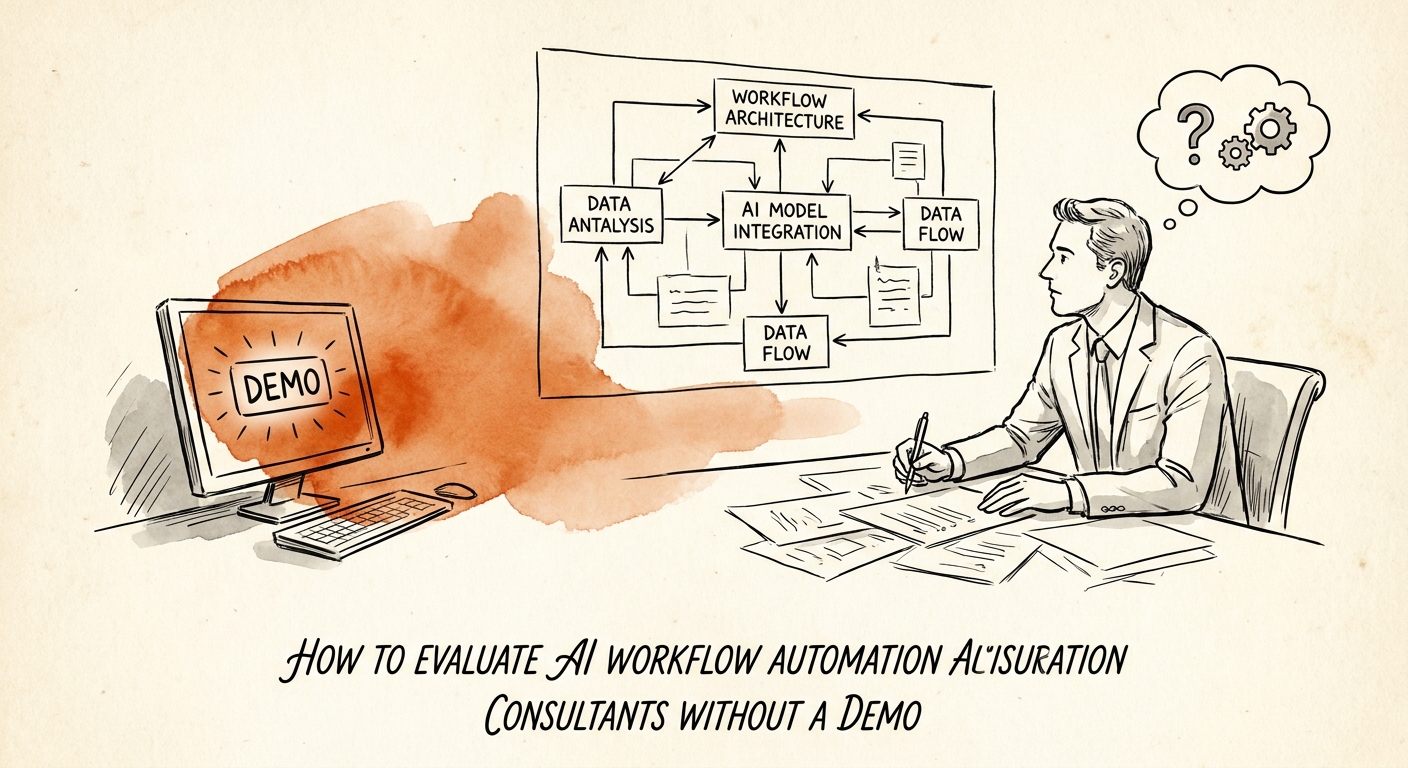
The demo is rigged, and not on purpose
Every workflow automation demo you've watched ran on clean inputs. The invoice had a clear vendor name. The support ticket fit a category. The lead form had every field filled in. That's not deception — it's just how demos get built. The problem is that the clean version of your work is only a fraction of the volume, and the consultant gets paid on the messy remainder you never saw on screen.
So stop watching demos and start asking for process maps. Before anyone proposes a tool, model, or agent, a credible consultant should be able to draw your current workflow: what triggers it, where the inputs come from, who hands off to whom, who owns each step, where exceptions go today, what needs approval, and how you'd know it worked. McKinsey's State of AI research and the IBM Institute for Business Value both keep landing on the same finding: the value comes from redesigning how work flows, not from bolting a model onto a mess. If the map is fuzzy, automation just makes the confusion run faster — and now it runs faster at 2 a.m. with no one watching.
A simple test: ask the consultant to walk your process backward, from outcome to trigger, without looking at their slides. If they can only narrate forward through the demo flow, they've memorized a script, not understood your operation.
Make them name the failure modes out loud
Here's the question that separates an operator from a tool reseller: "Show me what the automation does when the input is wrong." Not edge cases in the abstract — your specific garbage. The duplicate record. The customer who replies to a closed ticket. The field that's blank half the time. The PDF that's actually a scanned photo of a fax.
You want a consultant who answers in mechanisms, not adjectives. The good answer sounds like: low-confidence outputs route to a human review queue; every automated action writes to an audit trail; there's a rollback path when a batch goes sideways; and quality gets measured against a baseline you agreed on, not "it feels faster." The PwC Responsible AI survey and the NIST AI Risk Management Framework exist precisely because automated decisions touch real people — affected users, permission boundaries, things that are hard to un-send. If a consultant can describe how the workflow succeeds but goes vague on how it fails safely, you're looking at a system that hasn't been run in anger. Don't buy the happy path. You already have a happy path; it's the rest you're paying to fix.
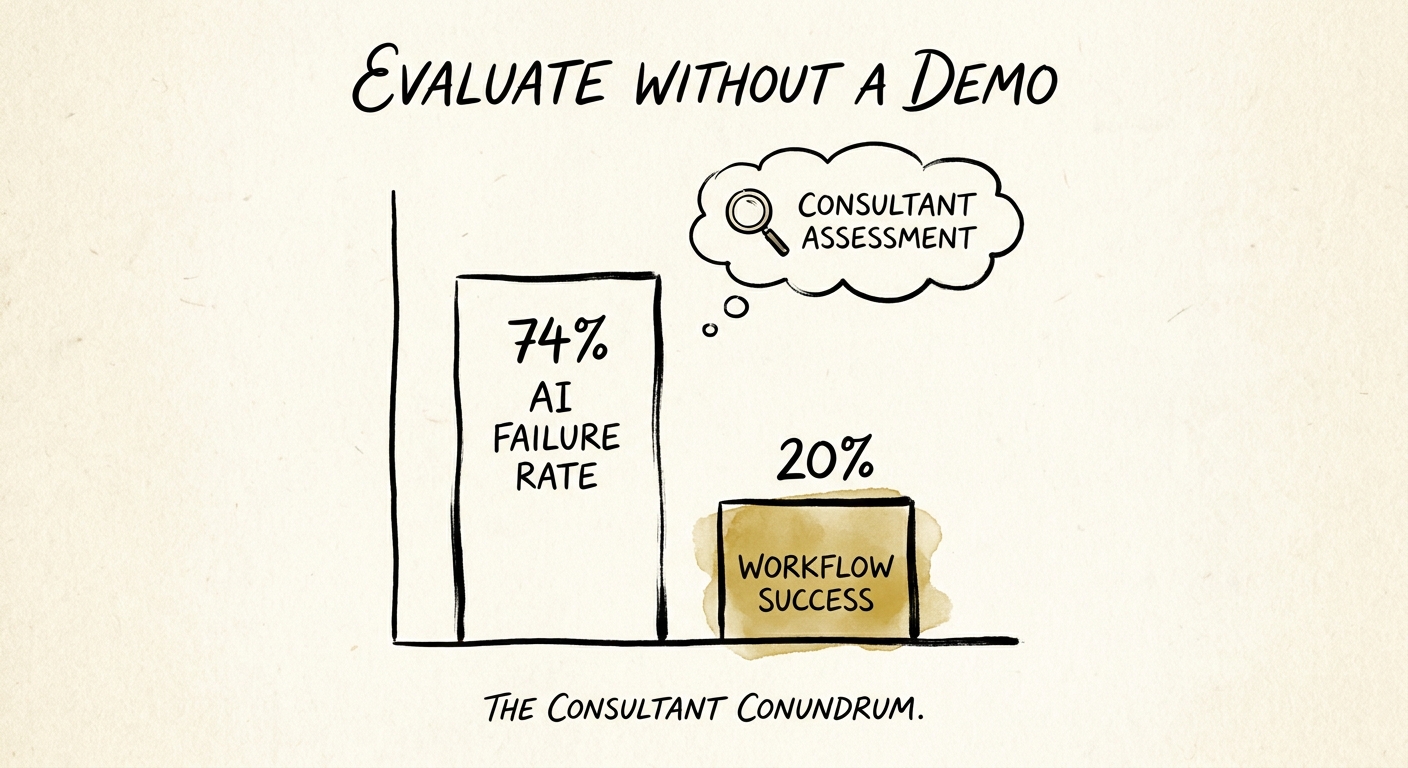
Watch for the word "agent" doing too much work
The fastest way to overpay right now is to let "agentic" reframe a routing problem as a frontier-tech project. Bain's research on agentic AI is useful here because it draws the line: a genuine agent reasons across steps and calls tools to get something done. A lot of what gets sold as "agentic" is really classification, retrieval, drafting, and routing wearing a fancier label — work that a simpler, cheaper, far-more-governable pipeline handles better. The consultant you want recommends the least complicated architecture that can still be measured and controlled, and can tell you, unprompted, when an agent is overkill for your problem.
So on your next call, do three things. Ask for the backward process walk. Hand them your three ugliest real inputs and make them describe the handling. And when they reach for "agent," ask what the workflow needs that plain routing can't deliver. If you want the structure for that conversation, AI workflow automation is the right lens when the bottleneck is handoff design, and AI agents and internal copilots is the right lens only when the work genuinely needs a governed assistant with tool access.
