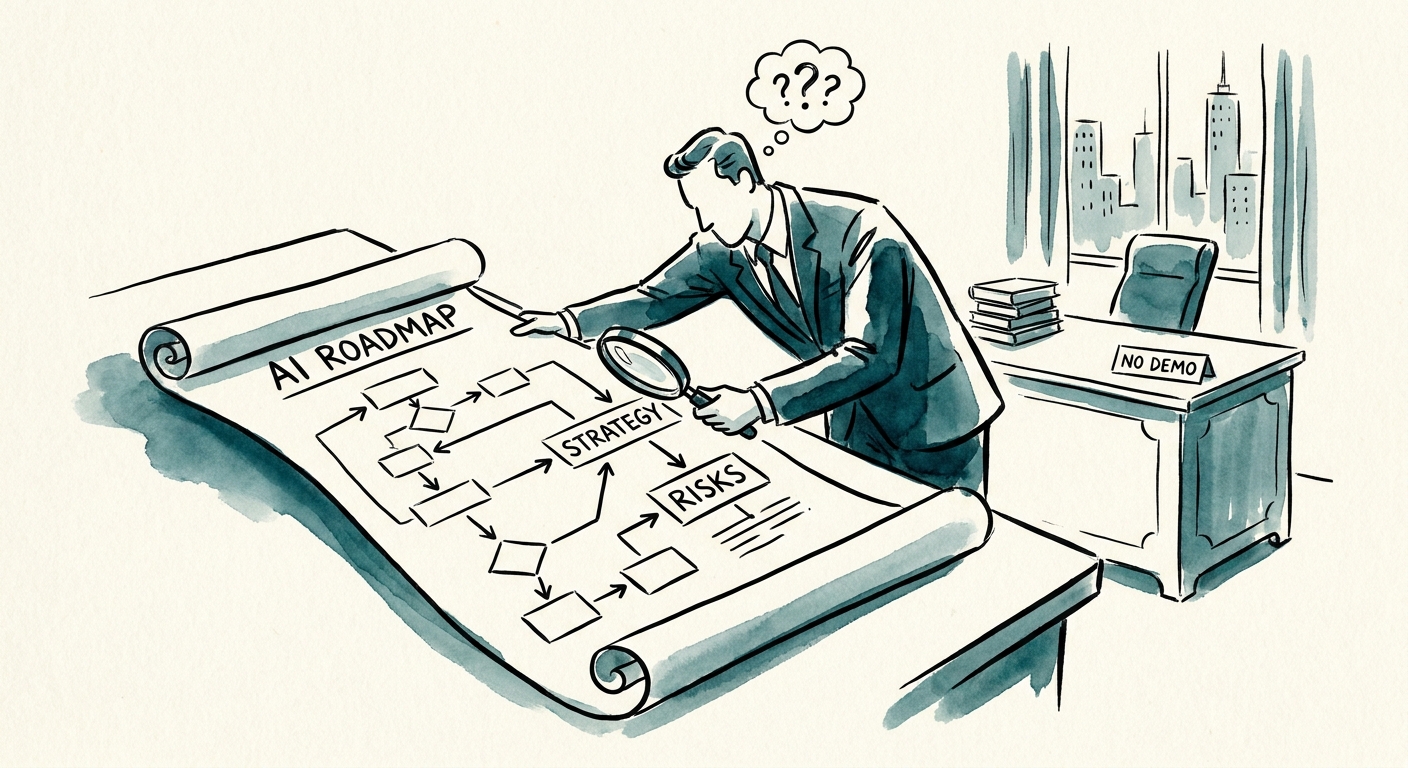
A demo runs on clean data, willing users, and zero consequences
Here is what a demo never shows you: the support rep who pastes a customer's SSN into the prompt window, the sales ops lead who quietly refuses to use the new tool because it once hallucinated a renewal date, the source document last updated in 2021 that contradicts the one updated last week. The demo is a controlled burn. Your business is a wildfire.
So when a consultant offers to "hop on a quick screen share and show you what we built for another client," treat that as the appetizer, not the meal. The interesting question is not whether the workflow works in a sandbox. It is what the consultant did when it broke in production, because it always breaks somewhere, and the good ones have scar tissue to prove it.
The pressure to buy on the demo is real. The RSM middle-market AI survey shows AI has climbed to a genuine boardroom priority, which means leaders feel behind and want to move. But the OECD report on AI adoption by small and medium-sized enterprises is blunt about why smaller firms stall: it is rarely the model. It is data that nobody owns, processes nobody documented, and skills nobody budgeted to build. None of those show up in a slick demo. All of them show up six weeks after go-live.
Ask for the seven artifacts. Watch which ones don't exist.
Replace "show me a demo" with "send me the artifacts from a real engagement, redacted." A consultant who has actually shipped will have a folder for this. One who has only sold will scramble. Here is the list to request before a second meeting:
1. A prior workflow map. Not a pretty diagram, the messy before-and-after of an actual process, showing where a human still has to step in. 2. A source inventory. Which documents, systems, and databases fed the assistant, and who confirmed they were current. 3. A risk register. The list of things that could go wrong and the control for each. The NIST AI Risk Management Framework is the right shape here; a serious consultant can map their register to govern, map, measure, and manage without being prompted. 4. A data-handling design. Push hard on this one against the CISA AI Data Security Best Practices: how do they fence off sensitive sources, scope permissions by role, log what the model touched, and route an uncertain answer to a person instead of guessing?
5. A reviewer design. Who checks the output, how often, and what happens when it is wrong. 6. A value model. The arithmetic connecting the workflow to hours saved or revenue moved, not "efficiency," an actual number with assumptions you can argue with. 7. A post-launch cadence. The schedule for tuning the thing after week one. The tell is simple: ask "who owns this workflow the Monday after you leave?" If the answer is a shrug or "your team, of course," you have found a builder, not an operator. Say a 60-person logistics firm hires someone who can produce five of these seven from memory; that consultant is worth three who can only screen-share.
Buy the boring parts: accountability, rollback, and the decision not to automate
The reason this matters more than usual right now: ambition is cheap and follow-through is rare. Gartner's agentic AI forecast projects that more than 40 percent of agentic AI projects will be scrapped by the end of 2027. A consultant pitching you a fully autonomous agent on day one is selling you into that statistic. The ones who last propose a phased release with human review points, explicit cost assumptions, data-quality gates, rollback rules, and, the most underrated artifact of all, a clear list of what they will deliberately not automate yet.
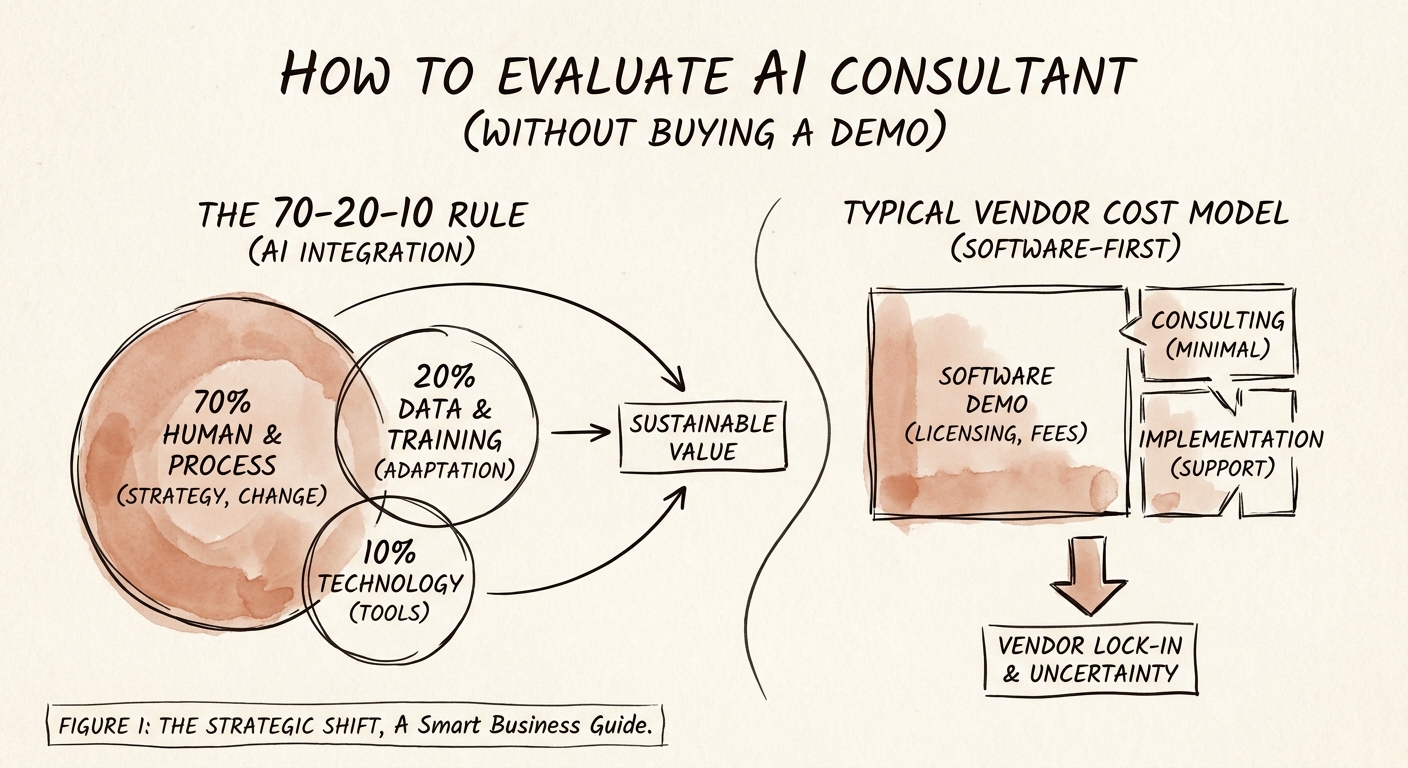
That restraint is the signal. The Deloitte State of AI report keeps landing on the same point: value comes from changing how work gets done, not from configuring a tool. A consultant who stops at configuration has handed you a clever feature and left the hard part, adoption, review, accountability, measurement, on your desk.
So do this before your next vendor call: write down the single workflow you actually want fixed, the people who touch it, and the number that would prove it worked. Then judge every consultant against your spec instead of their demo. The AI QuickStart Audit is built to produce exactly that spec, your workflow, your data reality, your success metric, so you walk into evaluations holding the scorecard instead of watching theirs.