The roadmap that survives contact with a Tuesday
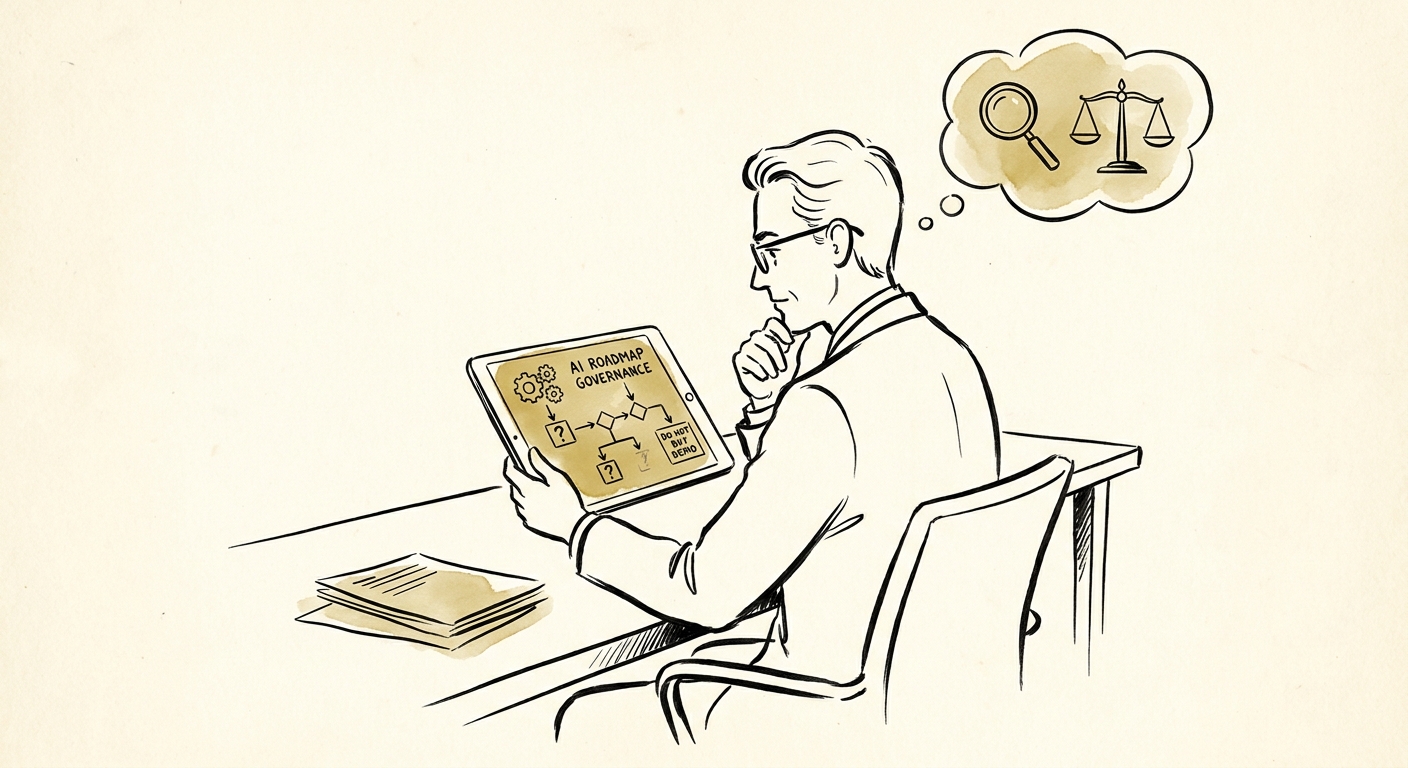
Here is the deck you will be shown. Phase 1: Discovery and Alignment. Phase 2: Pilot. Phase 3: Scale. Phase 4: Center of Excellence. There is a gradient background, a maturity curve, and a slide where three tools are compared in a feature grid. By minute twenty you are nodding, and the live demo of the chatbot answering a sample question seals it. None of that tells you whether a single real workflow at your company will run on this in ninety days.
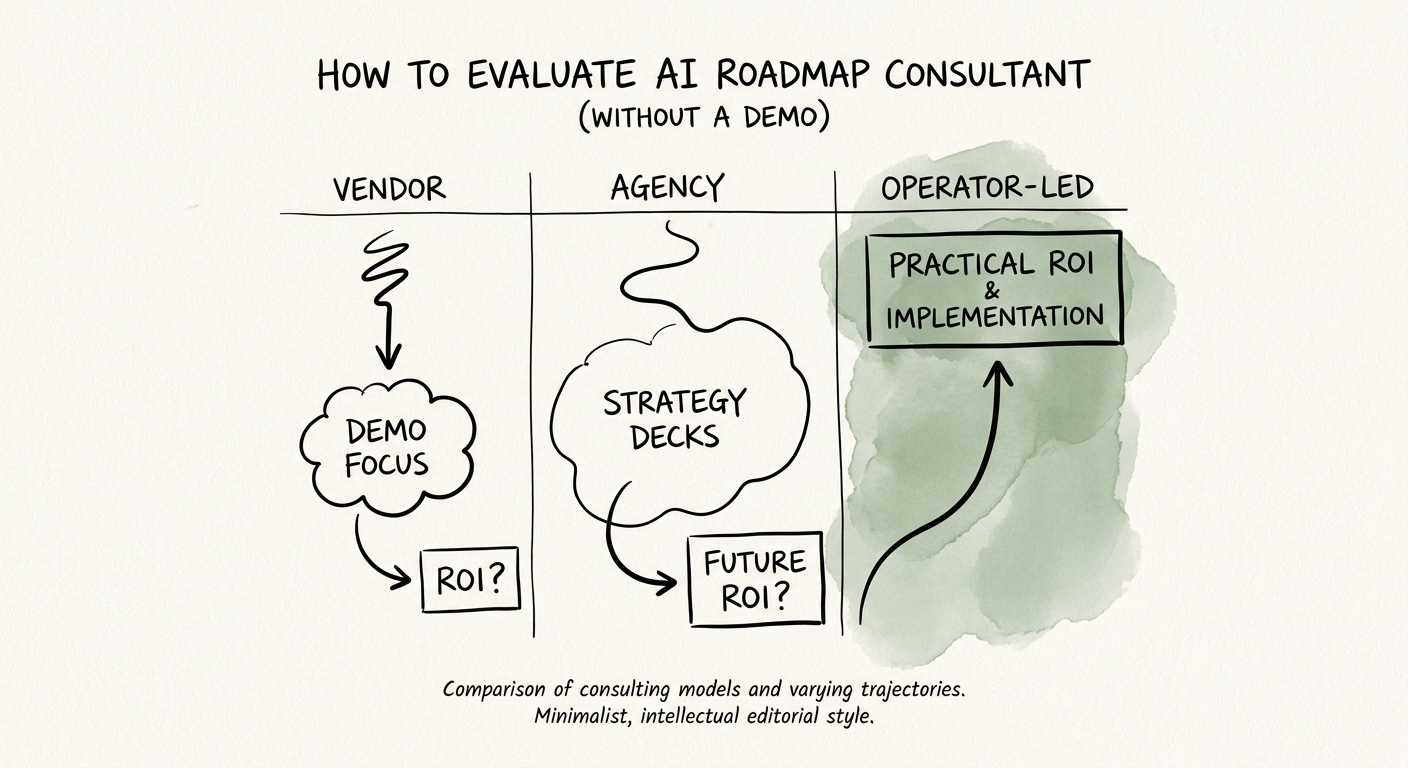
The tell is not in the demo. It is in what the consultant can describe about your operation before they have a contract. Ask them to take one workflow you actually run — say, how a 60-person services firm turns a signed SOW into a project kickoff, or how an order exception gets routed when the quantity does not match the PO. Now ask: which system holds the data, who owns that data today, what does "wrong" look like, and who notices when it is wrong. A roadmap consultant answers in nouns and names. A demo seller answers in features.
This is not a high bar invented to be difficult. The RSM middle-market AI survey, the OECD report on AI adoption by small and medium-sized enterprises, and Deloitte State of AI in the Enterprise 2026 keep landing on the same unglamorous point: the programs that stick are the ones with a named workflow, ready data, and a path off the pilot bench into production. The roadmap is supposed to be the map of that path. If it cannot name a starting workflow, it is a brochure for a journey with no first step. Run the AI readiness assessment buyer guide as a parallel screen on the same consultant.
The line items roadmaps leave off the page
A roadmap's price is usually the consultant's fee plus a software license, and both are visible. The work that decides whether the roadmap works is the work nobody puts on the slide. Ask the consultant to walk you through these, line by line, and watch whether they have done it before or are improvising.
Source cleanup: the contracts folder where half the PDFs are scans and three customers are spelled four ways. Permission design: when the AI summarizes a deal, can it read the salary field in the CRM, and who decided that? Review workflow: the first month, someone checks every output before it goes out — whose job is that, and how many minutes a day does it cost them? Retained logs: when a client asks "why did your system tell us X," you need the record. Training and the support that comes after launch, when the AI changes behavior and nobody on staff knows why. The NIST AI Risk Management Framework and CISA AI Data Security Best Practices exist precisely because this layer is where programs quietly fail, and a real roadmap budgets for it in weeks and named owners, not a footnote.
Then there is the data-handling question the roadmap usually waves at. Before any production workflow, you should be able to state, in one sentence each: what data leaves your walls, where it goes, how long it is kept, and who can flip the switch to production. OpenAI Enterprise Privacy is one example of the controls you verify against — a model provider documenting retention and access — but the point is that the consultant should hand you that answer for whatever stack the roadmap recommends, not send you to read it yourself. Hold the roadmap's promised timeline against the 90-day AI implementation plan and see where the phases get vague.
Score it on what is true in week twelve
There is one question that collapses a four-phase roadmap into a yes or no: what will be true at the end of the first production workflow that is not true today? Make the consultant answer in measurables. "Kickoffs that used to take three days of back-and-forth go out same-day." "The exceptions queue that one person clears manually drops by half." If the answer is "the organization will have AI maturity" or "teams will be enabled," you are holding a deck, not a plan.
For an SMB or mid-market buyer, the deliverable you are paying for is a sequence your own leadership team can run after the consultant leaves — a first workflow with a named owner, a baseline number, an adoption cadence, and a written rule for when you keep going or pull the plug. Not a tool shortlist. Not a strategy you re-buy every quarter. The maturity-curve slide is the most expensive thing in the room precisely because it commits to nothing you can check in twelve weeks.
So before you sign: pick the one workflow, write down the number it should move, and put the consultant's name next to it. If they flinch at being measured on a single workflow, that is your answer — the roadmap was always going to be the product, and the production never was. Keep the whole decision honest with AI ROI measurement without fake savings, and when you are ready to build the real sequence, that is the work we do.