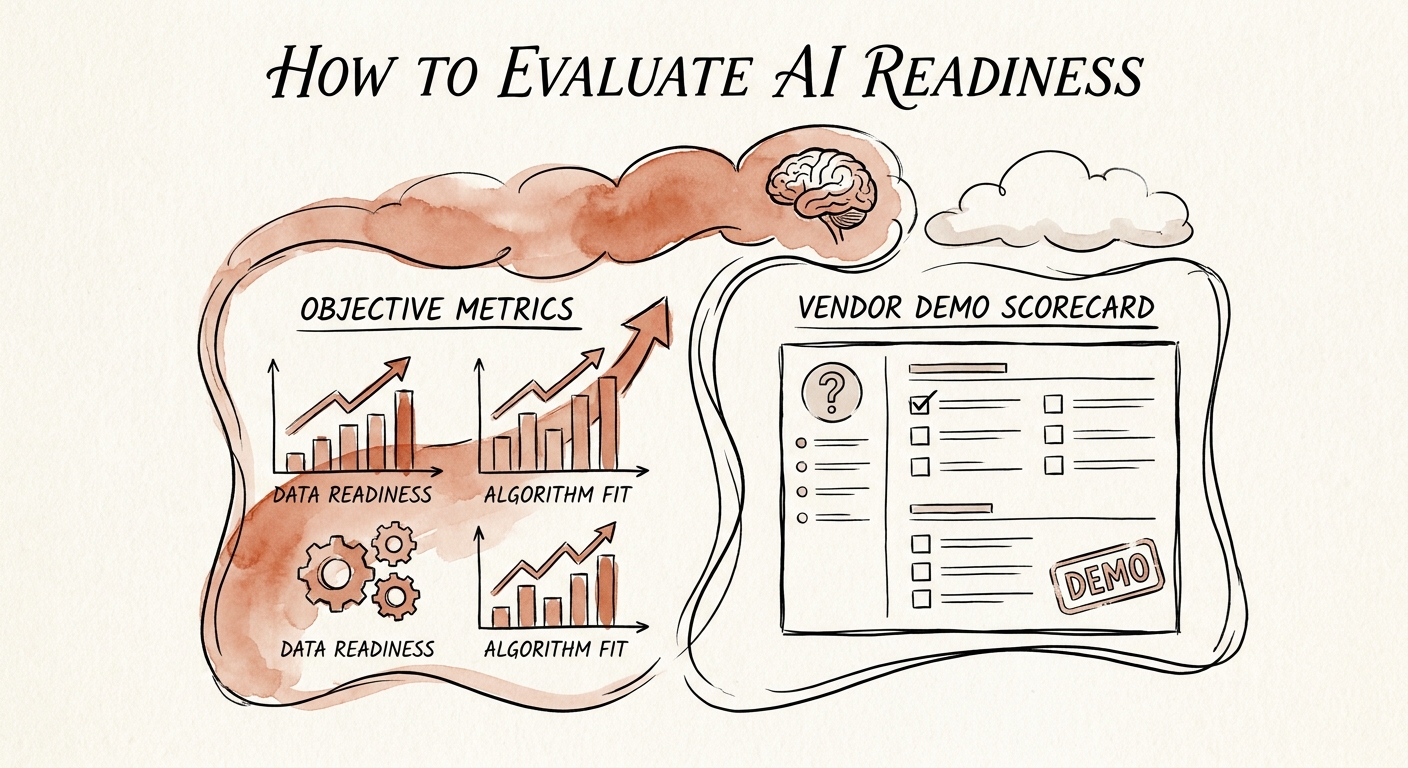
The slide that should make you suspicious
Somewhere around minute eleven of the pitch, a vendor flips to a radar chart. Your company scores 2.4 out of 5 on "AI Maturity." There's a quadrant. You're in the lagging one. The next slide, conveniently, is the engagement that moves you up and to the right. If that sequence feels familiar, it's because the assessment was built backward: the conclusion (buy this) was set first, and the diagnosis was reverse-engineered to support it.
The fix is to read the assessment as the person writing the check, not the person watching the demo. The real adoption constraints for a company your size are unglamorous and well documented — process ownership, in-house skills, data quality, and how much management bandwidth a change actually consumes. The RSM middle-market AI survey, the San Francisco Fed small-business AI analysis, and the OECD SME AI adoption report keep landing on the same point: the blocker is rarely the model. It's whether someone owns the workflow, whether the data is clean enough to trust, and whether anyone has the hours to run the change. A score that doesn't touch those things is decoration.
So before you grade the vendor, grade the document. The test: pick the single use case the assessment recommends first and ask whether it names an owner, a source system, a reviewer, and the business action that changes. If those four blanks aren't filled in, you don't have a roadmap, you have a mood ring. The workflow automation screen walks through exactly how to pressure-test that first candidate.
Read the governance section, or the lack of one
Here's a fast way to separate an assessment written by operators from one written by a sales engineer: turn straight to the part about data and risk. If it's a paragraph of reassurance, that's the tell. If it's a set of pointed questions, you're holding something useful.
You don't need to be a compliance officer to run this check. The NIST AI Risk Management Framework gives you the spine — does the assessment actually map your context and the specific ways this workflow could go wrong, or does it treat risk as a checkbox? Then the CISA AI Data Security Best Practices gives you the sharper follow-ups: which data feeds the system, who can see it, what gets logged, and what happens when a sensitive record lands in the pipeline. An assessment that can't answer those for your first use case has not earned the right to recommend it.
Picture a 60-person services firm whose assessment proudly recommends an AI assistant that drafts client replies from past email threads. Reasonable on the demo. But ask the CISA questions and the cracks show: those threads contain other clients' names and pricing, nobody decided who reviews a draft before it sends, and there's no log of what the assistant pulled. None of that surfaces in a maturity score — it surfaces when you interrogate the document. Run the recommended workflow through the AI use-case scoring model as a second opinion on whether it's valuable, ready, governable, and worth the disruption, before a contract makes the decision for you.
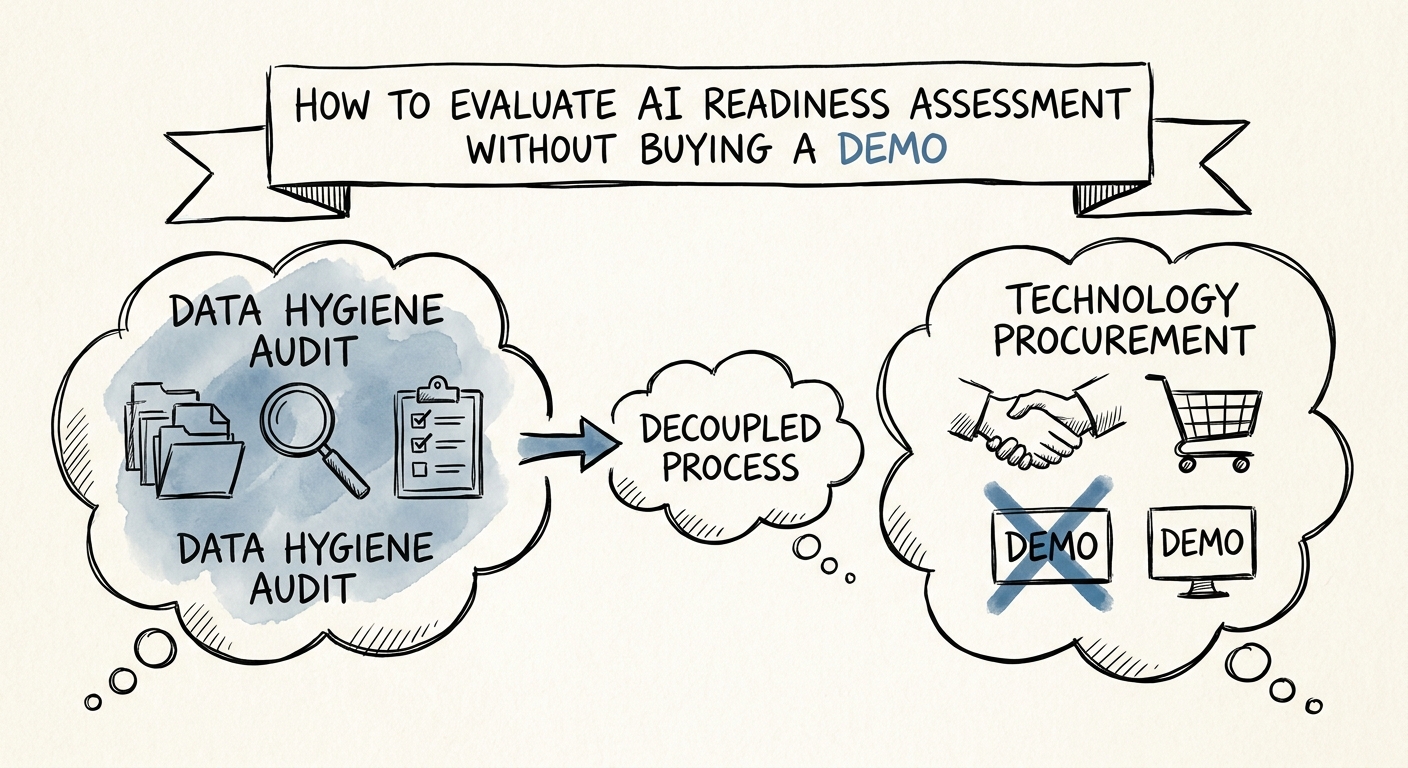
What a useful assessment actually hands you
The deliverable you want is short and opinionated: a ranked list. This workflow first, here's why, here's the owner. This one not yet, here's the data we have to clean before it's safe. This one never, the value isn't there. A document that ranks and says no is worth more than one that scores everything a polite "developing."
This matters because the most expensive mistake at your scale isn't picking the wrong tool — it's mistaking motion for results, which is the buying risk the Deloitte State of AI in the Enterprise 2026 keeps flagging. A good assessment tells you which workflow can survive a normal Tuesday — real inputs, a distracted reviewer, an edge case at 4:45pm — not which one demos cleanly in a controlled sandbox. And it commits to the proof: the one metric that will show, in 90 days, whether the thing worked.
So when the assessment lands, do three things Monday. Find the first recommended workflow and confirm a real person's name is attached as owner. Confirm there's a stated proof metric you could read off a dashboard, not a vibe. And confirm at least one "not yet" with a reason — its absence means nobody pushed back. If all three hold, you can sequence the rollout; the 90-day AI implementation plan turns a ranked assessment into a dated rollout, and the AI transformation blueprint is where to start if you'd rather have the ranking built with you than sold to you.