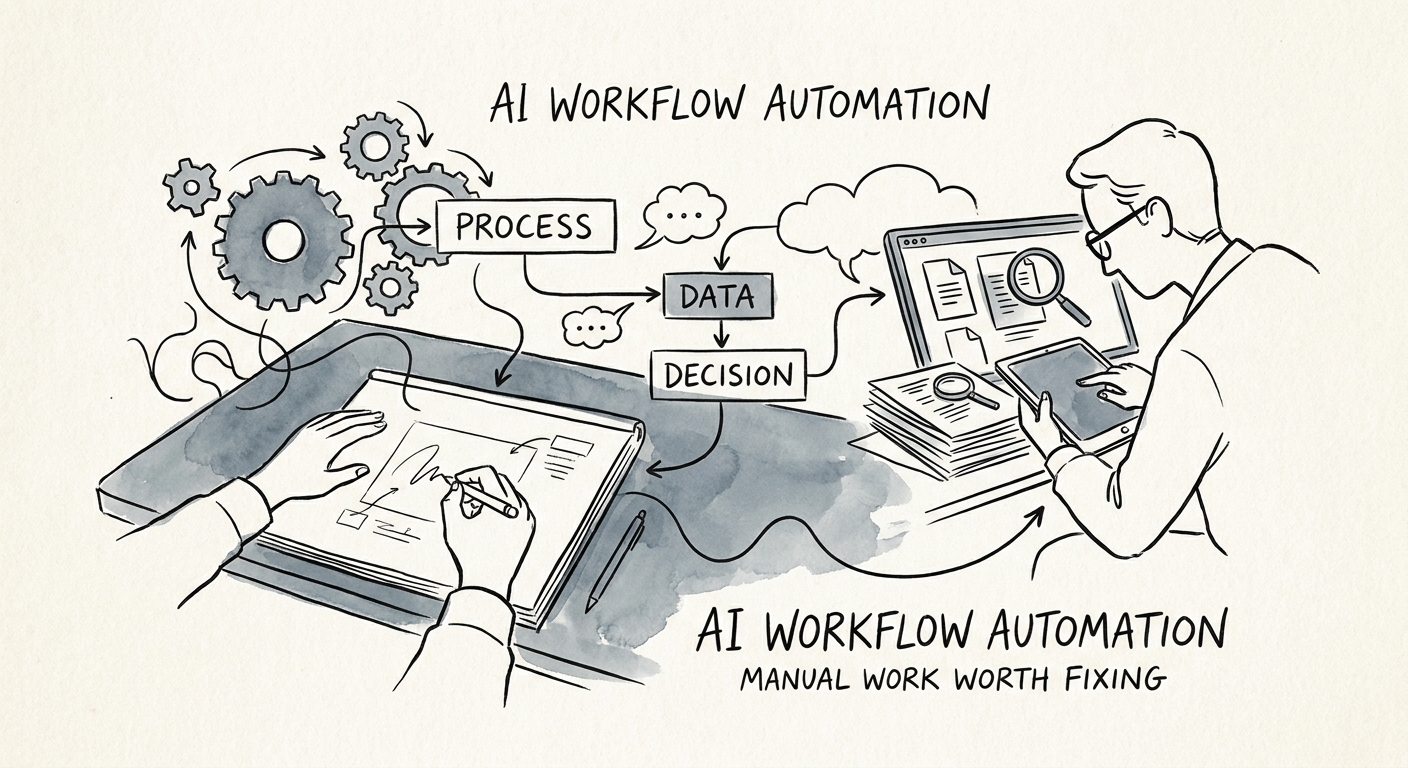
The loudest annoyance is almost never the right first build
Walk into any 40-person company and ask which manual task drives people crazy, and you'll get a fast answer: the expense reports, the meeting notes, the someone's-always-chasing-an-approval thing. Then you automate it, spend six weeks on it, and discover it ran four times a week and saved nine minutes a run. Meanwhile the invoice-coding work that quietly eats a half-day every single day, the work nobody complains about because they've stopped noticing it, sits untouched.
That's the trap. Manual work that feels painful and manual work that's actually expensive are two different lists, and they rarely overlap. Pain is about how the work feels in the moment. Cost is frequency times duration times error rate times what an error costs you downstream. The first list is loud. The second list is where the money is.
The broader pull toward adoption is real, and the San Francisco Fed small-business AI analysis documents how quickly smaller firms are reaching for it. But adoption pressure is exactly what pushes teams toward the visible annoyance instead of the costly habit. Before you pick anything, separate the two lists on paper.
Five tests that sort your list into automate-now, fix-first, and leave-alone
Take every candidate and run it through five gates. A task that clears all five is an automate-now candidate. A task that fails one or two specific gates usually isn't a bad idea — it's a process problem wearing an automation costume.
1. Does it repeat on a schedule you can predict? Daily intake queues, weekly reporting, every-new-customer onboarding steps — predictable cadence is the difference between something worth building and a one-off that an email would have solved. 2. Can you write the rule a stranger could follow? If the work lives entirely in one person's head and changes based on "it depends," you don't have a workflow yet — you have judgment, and automating judgment you can't articulate just produces confident garbage faster. 3. Are the inputs clean enough to trust? Pulling from a structured system beats pulling from a shared drive where half the files are named "final_v3_USE_THIS." 4. How often will a human have to step in? A 5% exception rate is a tune-up; a 40% exception rate means you've built a thing that needs babysitting. 5. Can someone check the output before it touches a customer, an invoice, or the books?
That last gate is where failure cost lives, and it's where most quick-win lists fall apart. A wrong line in a draft status update is a shrug. A wrong line in a customer-facing quote, a tax filing, or a payroll run is a phone call you don't want. The OECD SME AI adoption report is blunt about the gap between wanting AI and having the capacity to run it — and the test that exposes that gap fastest is "who owns this process today?" If the honest answer is "nobody," automation won't fix that. It'll just give the orphan a faster engine.
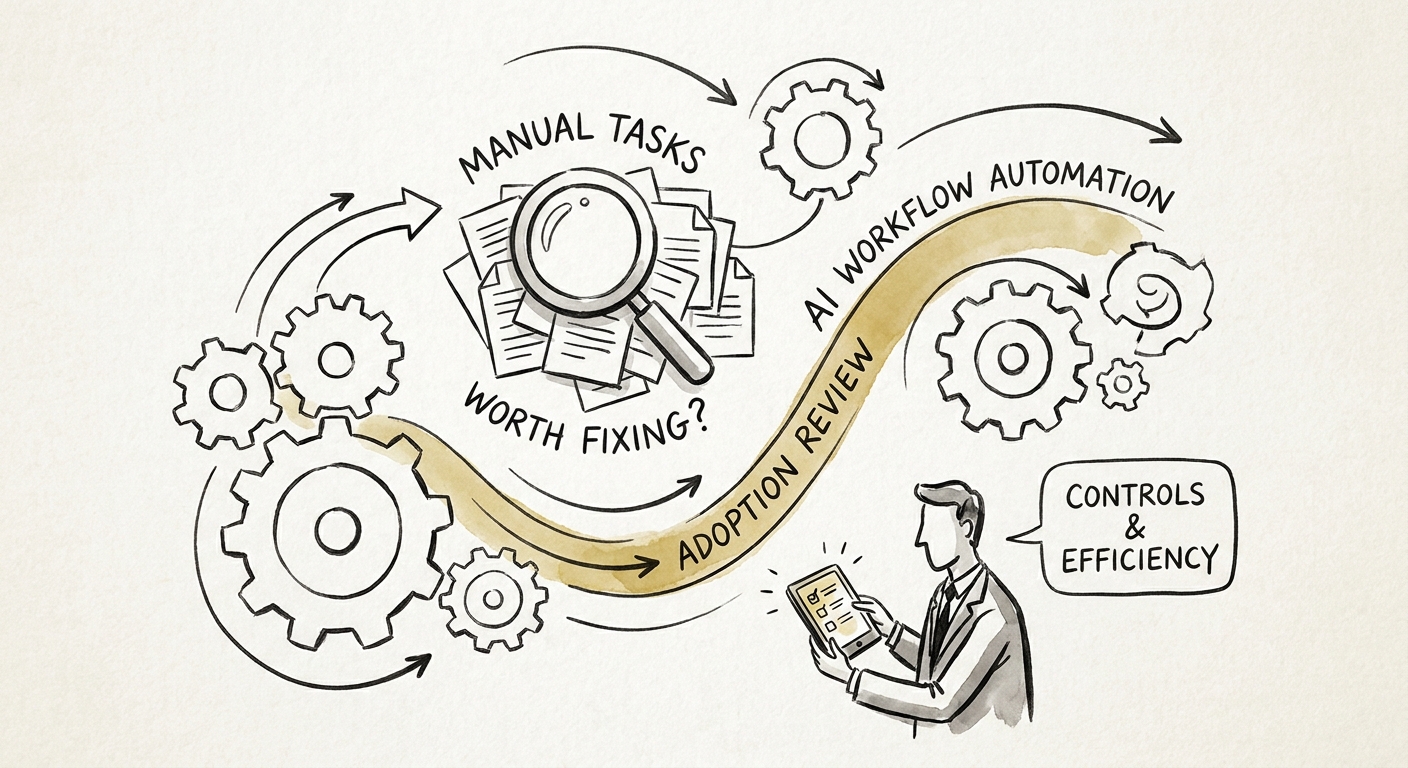
Write the one-page spec before you open a single vendor tab
Here's the move that saves the most regret: take your top automate-now candidate and write it up before you look at any product. Eight lines. What event kicks it off. Where the inputs come from. The decision rules in plain language. What the output is. Who reviews it. Which system it writes to. What happens when the AI isn't sure. And the one number you'll measure before and after — usually cycle time or rework rate.
Say it's the invoice-coding example. Trigger: invoice lands in the shared inbox. Inputs: PDF plus your chart of accounts. Rule: match vendor and line items to a GL code, flag anything new. Output: a coded entry staged for approval. Reviewer: the bookkeeper, who approves or corrects in one click. Exception path: unknown vendor goes to a human queue, not into the ledger. Baseline: 30 minutes a day, 8% miscodes caught at month-end. If you can't fill all eight lines, you're not ready to buy — and that's a finding, not a failure. It tells you the process needs tightening first. The Deloitte State of AI report keeps making the same point: usage isn't improvement. A redesigned handoff with a visible review loop is.
Pick one candidate, write its eight lines this week, and run it past the person who'd have to live with the output. That conversation alone will reorder your list. When you're ready to scope the first build, the path continues at AI Workflow Automation — the same migration discipline we brought to a 28,000-user cutover with zero downtime applies here, because automation still comes down to people, inputs, exceptions, and review cadence. Start the spec at Scope an AI workflow.