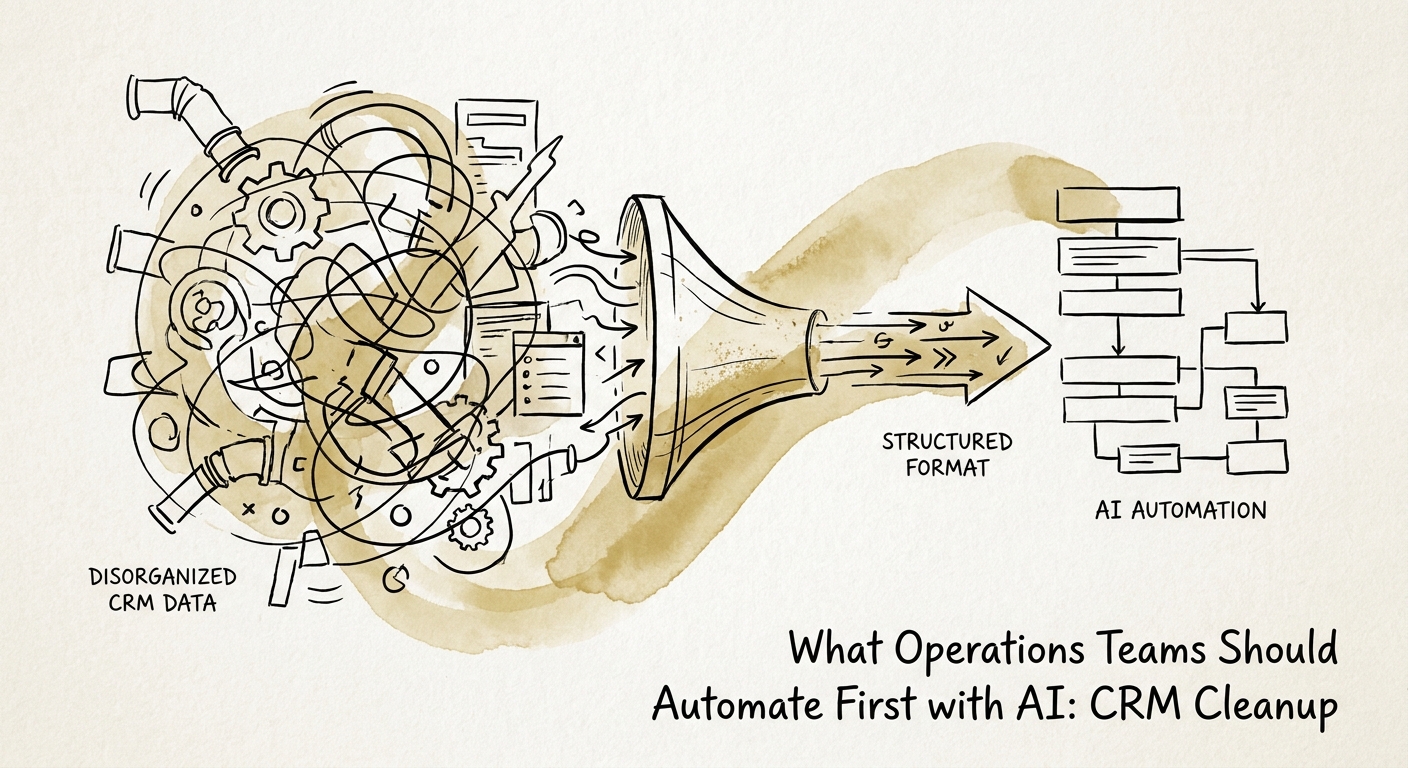
Open your pipeline report and count the lies
Here's the exercise I run with B2B services operations leaders before we touch a single AI tool: pull up the open-opportunity list and read the "Next Step" field on the top 20 deals. You'll find "circling back," "waiting to hear," a date from four months ago, and a handful that are just blank. Now look at the account list and search for the same company spelled three ways — "Acme Inc," "Acme, Inc.," and "ACME Incorporated," each owned by a different rep, each with its own contact record. That is the system your CFO is forecasting off of.
Operations teams almost always want AI to do the exciting stuff first: summarize discovery calls, predict which renewals are at risk, auto-route inbound leads. Every one of those workflows reads from the CRM. The Salesforce State of Sales research ties modern sales execution directly to data quality and AI-assisted work, and the Deloitte State of AI in the Enterprise 2026 is blunt that scaling AI takes operating changes, not a model you switch on. If you point a forecasting model at duplicate accounts and stale stages, you don't get insight — you get confident garbage.
CRM cleanup wins the first slot for a reason that has nothing to do with how interesting it is. It's reversible, it's queueable, and it produces a result a sales VP can see in a Monday pipeline review. For a 40-to-200-person services firm with no data-governance department, that combination is rare. The OECD SME AI adoption report makes the same point from the resourcing angle: smaller firms need adoption paths sized to the people they actually have.
Three queues, zero overwrites — and the line AI never crosses
The mistake I see is letting an AI agent "clean the CRM" by writing directly to records overnight. Wake up to a merged account that combined a parent company with its competitor subsidiary, and you've just deleted a rep's commission history. Don't automate the write. Automate the recommendation. Build it as three review queues a human clears like an inbox.
Queue 1 — Normalize. AI standardizes company names, job titles, and industry codes, and flags formatting drift. Low judgment, high volume; an ops coordinator can approve a stack of these in an afternoon. Queue 2 — Enrich. AI fills missing firmographic fields (employee count, region, segment) from approved data sources and shows its source for each. Queue 3 — Escalate. Anything that touches money or ownership — possible duplicate accounts, opportunities stuck two stages behind their close date, conflicting contact owners — goes to the account owner, never to the bot. This is exactly the reviewable, measurable posture the NIST AI Risk Management Framework asks for: the AI's behavior stays observable before it alters a business record.
The bright line for a services CRM is the difference between hygiene and commercial judgment. AI can say "these two Acme records look like the same company." Whether that's a true duplicate, a parent-child relationship, a separate divisional buyer, or a partner account routed under different rules — that's a call the deal owner makes. Get this boundary wrong and your "cleanup" quietly rewrites attribution and renewal math. Tie the program to CRM cleanup pipeline velocity ROI rather than vague hours-saved, because the real payoff shows up downstream in routing speed and forecast trust.
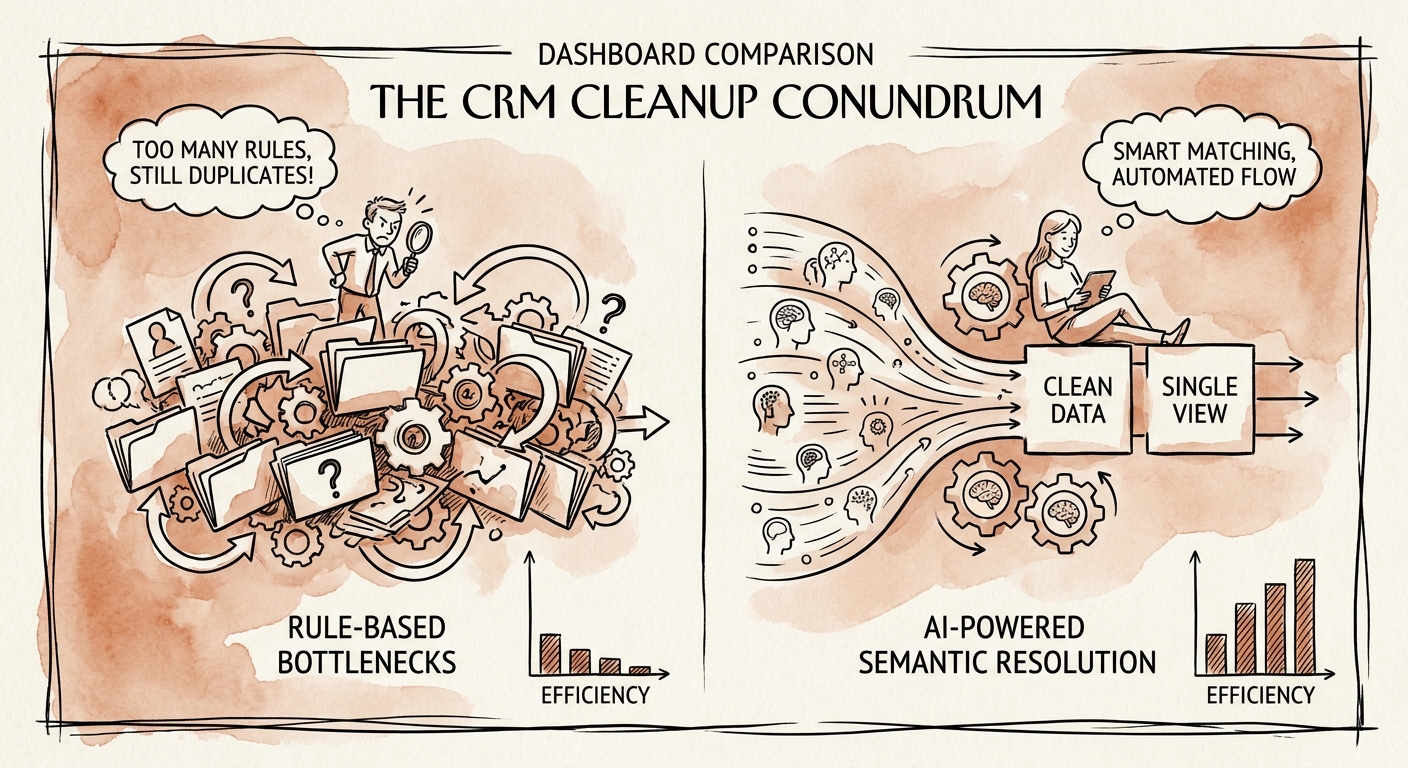
What you measure in week one — and the trap that kills it
Run the pilot for two weeks on one segment of the book — say, the accounts owned by a single sales team. Track four numbers: records surfaced to the queue, percentage human owners actually accepted, time to clear a full queue, and the change in how fast new leads route to an owner. The acceptance rate is the one that matters most. If owners are accepting only a minority of what the AI flags, your prompts or your data sources are wrong, and you've found that out at the cost of two weeks instead of two quarters of corrupted pipeline.
One thing services firms underweight: CRM records carry contract terms, deal notes, and named personal contacts. The moment AI reads or enriches those, you're inside scoped-data territory, so set the data-access boundary deliberately — which fields the model can read, which it can never export, and where enrichment data is allowed to come from. The CISA AI data-security best practices are the right reference for drawing that line at the start of the pilot rather than after the damage.
When the queues run clean, you've earned the right to build on top: lead routing, renewal-risk flags, account research summaries, and the executive pipeline report that's finally trustworthy. That sequence — fix the data the other workflows depend on, prove the governance, then layer value — is the roadmap. If you want help shaping yours, that's where to start.
