The "Closed Won" That Closed Eight Months Ago
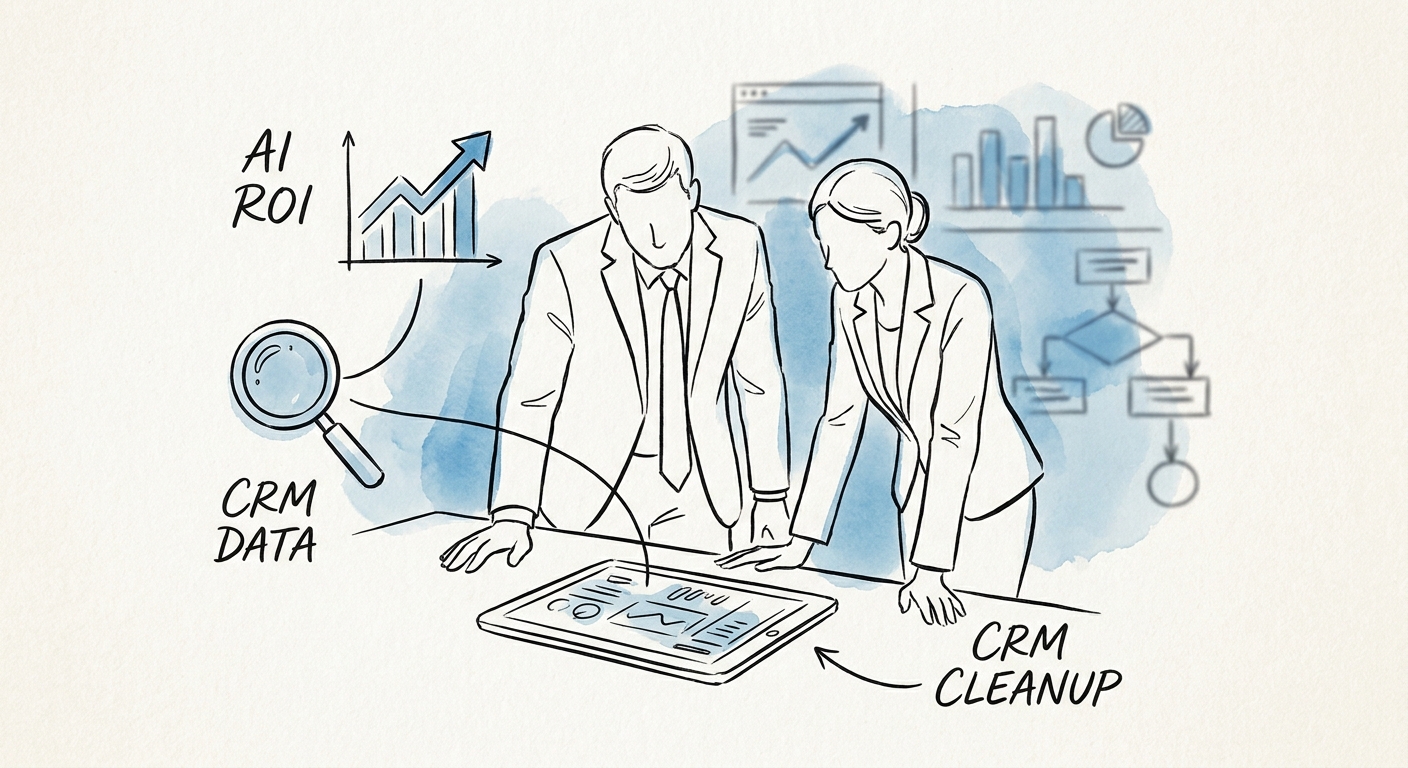
Open any B2B tech CRM that's been running for three years without discipline and you'll find the same archaeology: an opportunity sitting in "Negotiation" since last fiscal year, owned by a rep who left in March, with a next-step field that reads "follow up." Multiply that by a few hundred records and you don't have a messy database — you have a forecast that lies to your board with a straight face. That's the real cost, and it's why Census reporting shows businesses piling into automation: the manual cleanup never gets done, because no quarter has a spare two weeks for it.
So AI gets pointed at the CRM. Fine. But here's where most RevOps teams botch the ROI case: they measure the cleanup, not the consequence. "We deduped 4,000 accounts and corrected 11,000 fields" is an activity report, not a return. The question your CFO is actually asking is narrower and meaner: did the pipeline start telling the truth faster? For a software company living and dying by ARR coverage, the ROI of CRM cleanup is denominated in forecast variance, pipeline aging, and stage-exit honesty — not records touched.
Baseline the Lie Before You Pay to Fix It
You cannot prove a forecast got more honest if you never measured how dishonest it was. Before a single AI agent touches a record, snapshot the rot: what percentage of open opportunities have a close date already in the past, how many sit in a stage with zero activity in 30+ days, how many are owned by inactive users, and — the one that bites at quarter-end — how far your stage-weighted forecast diverged from actuals over the last four quarters. In a healthy B2B tech pipeline, a deal that's been in "Proposal" for 90 days isn't a deal, it's a story the rep tells the deal desk. Count those. That's your baseline.
Then govern the work like a system, not a one-time scrub. NIST's AI Risk Management Framework gives you the spine: define intended use, measure quality, set controls, name who reviews. The reason this matters for CRM specifically is that the high-value edits are exactly the dangerous ones. An AI that reassigns ownership or pushes a stale deal to "Closed Lost" is editing the forecast. Those changes need a human approval trail; reformatting phone numbers does not. And because the cleanup will read sales notes, customer records, and any enrichment feed, CISA's data-security guidance applies directly to what the model is allowed to see and where those records travel.
The Four Numbers That Decide Whether You Scale It
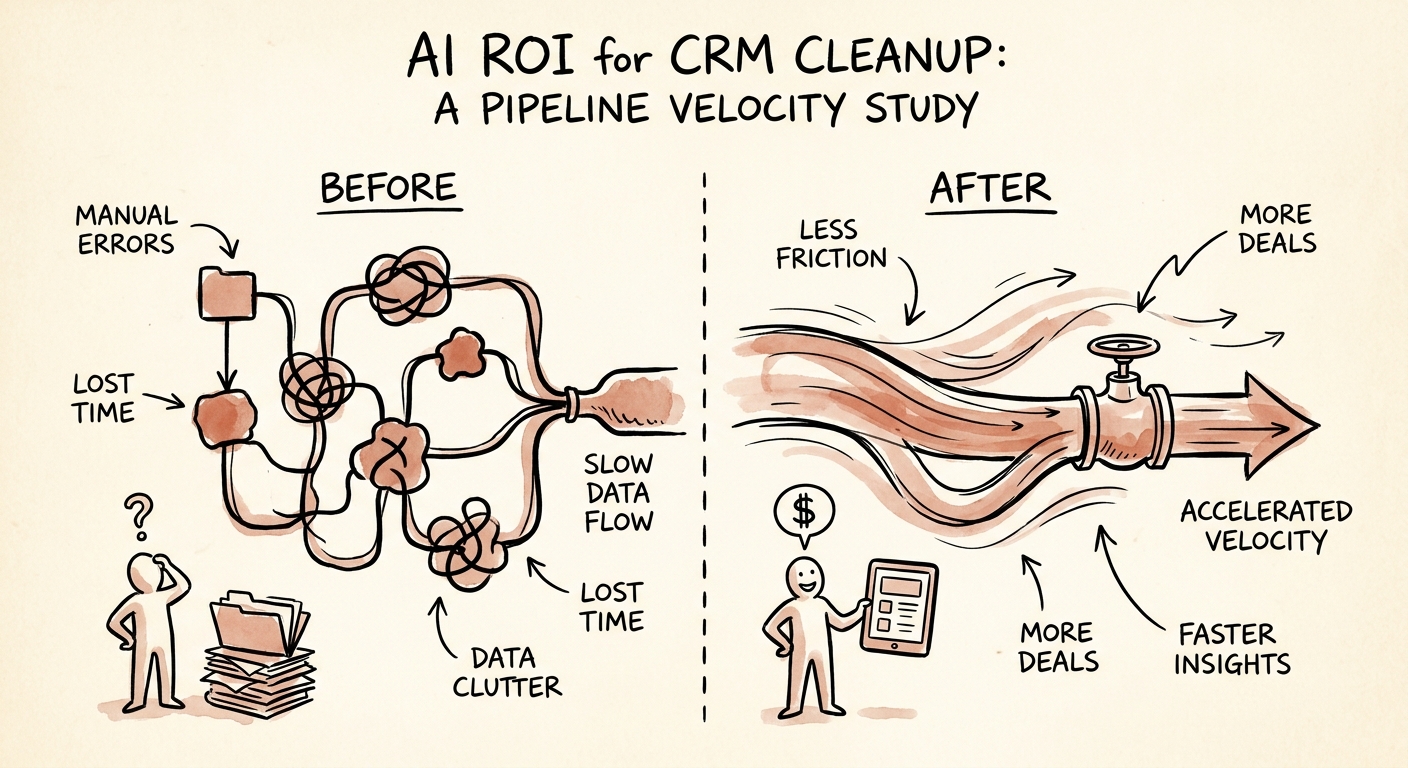
Run the pilot on one sales segment, not the whole org, and judge it on outcomes a manager can challenge in a normal pipeline review. Four numbers tell you everything. First, pipeline aging: did the median time-in-stage drop for live deals because the dead ones finally left the count? Second, stage-exit compliance: are deals advancing with their required fields populated instead of empty next-steps? Third, follow-up latency: did the gap between a triggering event and the rep's next touch shrink? Fourth, forecast variance: did your stage-weighted call land closer to actuals than the trailing baseline? If those four didn't move, the cleanup was cosmetic — and the fix is ownership and stage definitions, not more AI.
Here's the test that protects you from buying a confident-sounding mess: every AI-suggested change should ship with its evidence and its risk tier. Low-risk dedupe and formatting can flow automatically. An ownership reassignment or a stage downgrade should surface to the manager with the source record, the recommendation, and a one-click approve/reject — so the review trail is the product, not an afterthought. A pilot that mass-updates the forecast with no one able to explain why is worse than the dirty data you started with.
What most B2B tech teams get wrong: they ask whether stage names and ownership rules are agreed on only after the AI has already moved 600 deals. If your team can't say what "Negotiation" means without a debate, no cleanup tool can rescue you — it'll just propagate the disagreement at machine speed. Settle the definitions first. If you want a structured way to scope it, start with a CRM-quality baseline, a one-segment cleanup sprint, and an ROI review wired to implementation cost and manual-work triage. Monday's move: pull your four baseline numbers and put a date on every open opportunity older than your sales cycle. You'll know in an afternoon whether you have a data problem or a discipline problem — and only one of those is worth paying AI to fix.