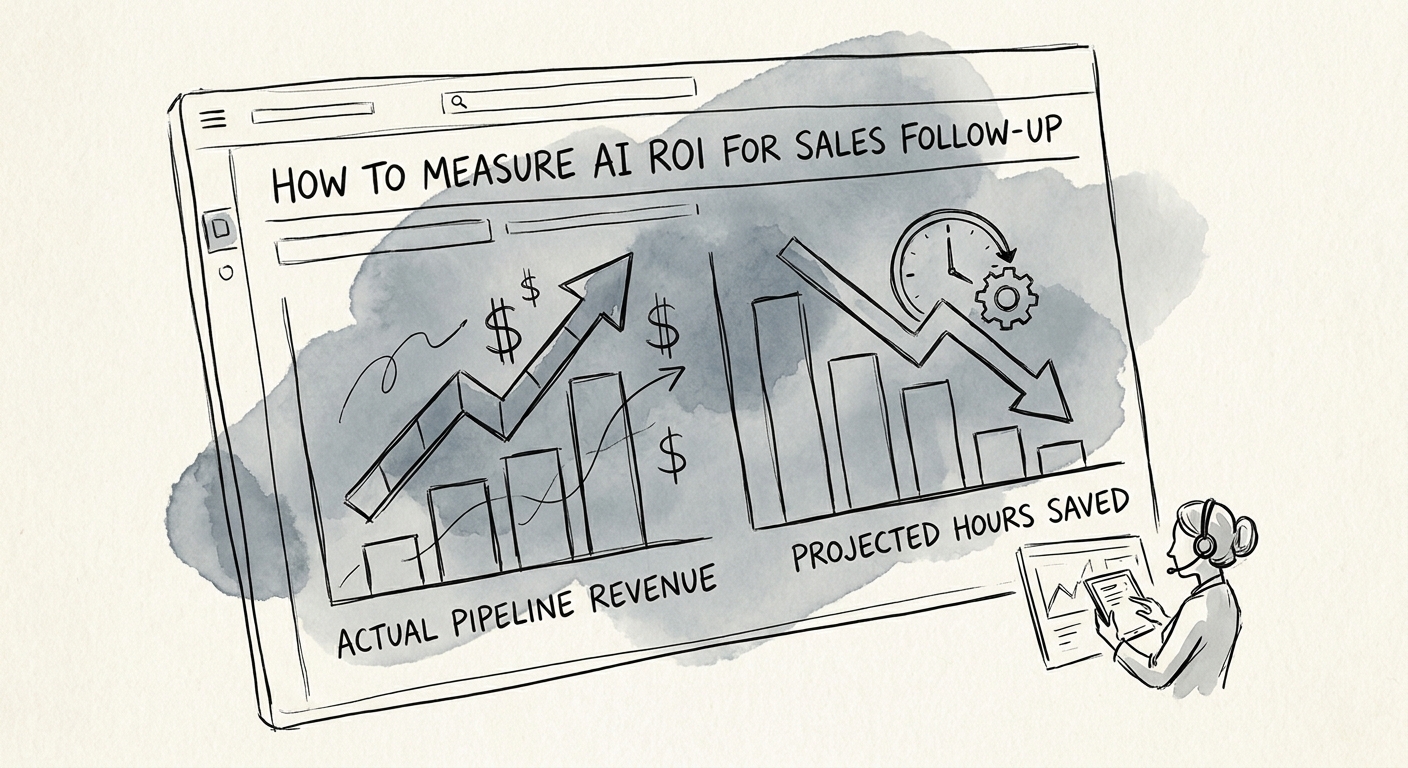
The dashboard says reply volume tripled. Finance still won't sign off.
Say a 60-person B2B software company turns on an AI follow-up assistant. Within a month the activity report looks incredible: post-demo recaps go out in minutes instead of next-day, stalled deals get nudged automatically, and total touches per rep triple. The VP of Sales forwards the chart to the board. Then finance asks one question that empties the room: did any of that become bookings we wouldn't have closed anyway?
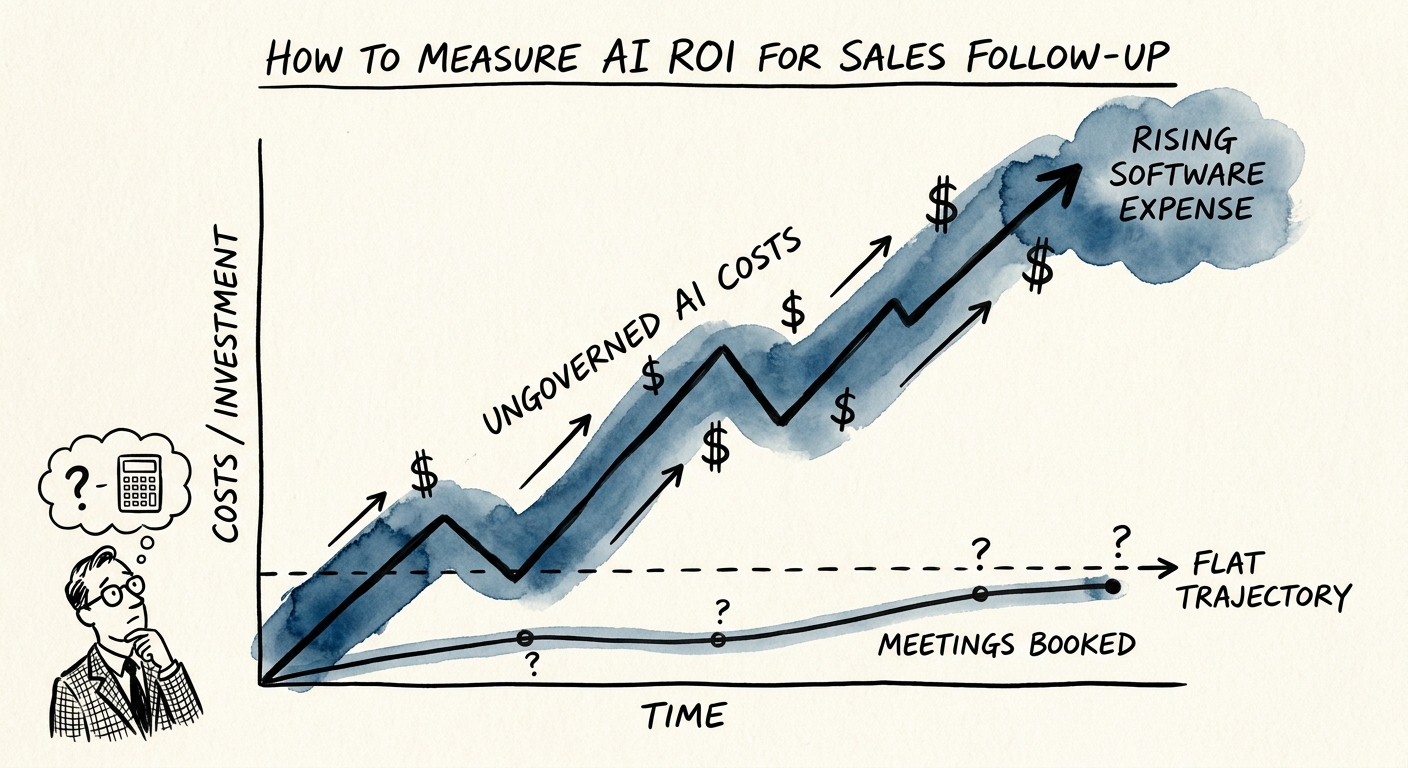
That is the whole problem with sales follow-up AI. It manufactures the one thing that is easy to count, messages sent, and hides the things that actually pay the invoice. A rep who was already on payroll, already carrying quota, and already blocked by buyer timing does not generate margin because their drafts got faster. They generate margin when a buyer who would have gone dark instead books a meeting and advances. Volume is an input. Nobody in Salesforce State of Sales research closes a deal by sending more email.
The seductive version of the ROI memo converts "saved rep hours" into a dollar number and stops there. In a quota-carrying revenue team that math is almost always fiction. The hours weren't a cost line you eliminated; the reps are still there. Worse, if the assistant ships generic recaps, fabricates a CRM next-step, or implies a price or contract term nobody approved, you have added liability while the dashboard reports a win. Start from the AI ROI measurement framework and refuse to let activity stand in for revenue.
Four numbers that separate a faster team from a better one
For a B2B software sales motion, the difference between "we send more" and "we sell more" lives in four measurements, and you need all four because each one catches a different way the tool can lie to you.
Reply quality, not reply count. Track the funnel one stage past the send: reply rate, then meeting-booked rate, then meeting-held rate, then qualified-opportunity rate. If replies climb but meeting-held stays flat, your assistant is generating polite brush-offs faster. A "no, we're set on our current vendor" arriving three days sooner is not a return; it's the same outcome with better latency. McKinsey growth and sales insights are blunt that adoption without conversion is just motion.
Speed-to-next-step, scoped to the moment that decays. In SaaS the perishable windows are specific: the 24 hours after a demo, the inbound that just filled a form, the renewal flagging churn risk. Measure time-to-relevant-response in exactly those moments, and require that "relevant" means correct context plus a real next action, not a templated nudge. A fast generic message trains buyers to ignore you, which is negative ROI you won't see on the activity chart.
Incremental qualified pipeline per rep, against a holdout. This is the only number finance trusts. Split reps or account segments into AI-assisted and control. The question is never "did the AI cohort produce pipeline" — of course it did. It's "did they produce more qualified pipeline than the matched group that worked the same accounts the old way," without the win rate eroding. If the gap is zero, you bought a faster typewriter.
Governance cost, on the same ledger. Approved messaging libraries, CRM source-of-truth rules, a review gate on anything touching pricing or contract language, and monitoring for promises the AI invented — these are not overhead you bolt on later. They are line items in the model, and per PwC responsible AI research and Bain artificial intelligence insights, the workflows that skip them are the ones that produce a clawback, not a return.
Pick one workflow, hold out a control group, then count margin
Here is what I'd do Monday with that 60-person software team. Don't roll AI follow-up across the whole motion and try to measure it afterward — you'll never untangle the signal. Pick one decaying workflow: post-demo recap is the cleanest, because the buyer intent is fresh and the next step is obvious. Baseline it for four to six weeks: current meeting-held rate, current time-to-recap, current qualified conversion. Only then turn the assistant on for half the team and leave the other half manual.
Now the ROI calculation is honest. Take the incremental gross margin from qualified opportunities the AI cohort advanced or closed beyond the control group — not total pipeline, the delta. Subtract software, implementation, enablement time, the data cleanup the tool created, manager review hours, and the compliance gates from above. If the answer is positive and the win rate held, expand to the next workflow and run the same holdout. If the only thing that moved is messages sent, you have your answer, and it's cheaper to learn it on one workflow than across the whole org. Microsoft's WorkLab research on adoption makes the same point: the gain shows up where the process supports it, not where the tool is simply switched on.
Before you build the assistant, set the rails: the sales follow-up governance guide defines where human approval is non-negotiable, and the sales follow-up workflow guide shows how to get speed without training buyers to tune you out. When your delta and your costs are real numbers, pressure-test the economics in the AI ROI Calculator.