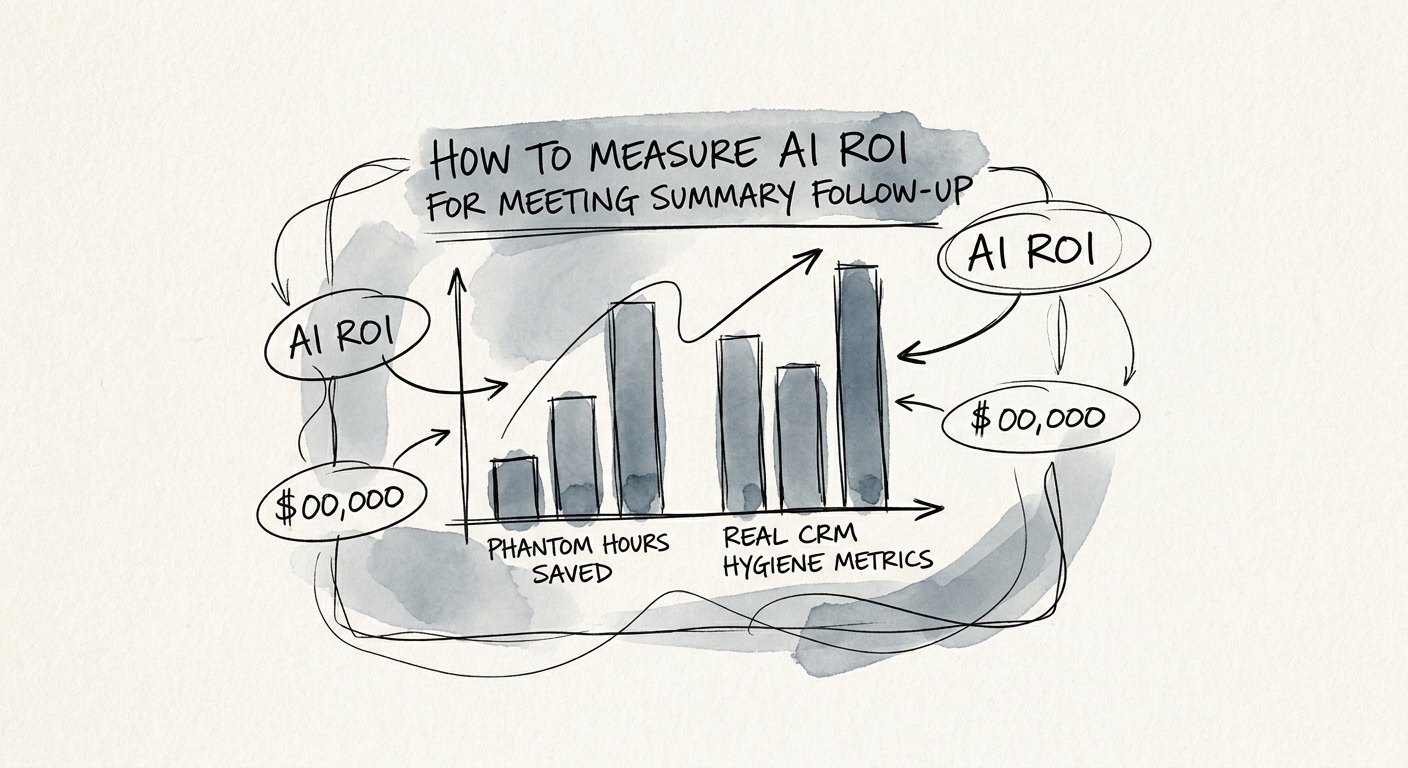
The summary was perfect. The renewal still slipped.
Picture the Monday after a quarterly business review at a 60-person B2B services firm. The AI notetaker did its job: a clean recap, eleven bullet points, three "action items" pulled straight from the transcript. It landed in the channel before the client's car left the parking lot. Everyone nodded at how good it was. Then the account manager went to four other meetings, the "action items" sat as text in a thread, and six weeks later the client mentioned — gently, on the way out — that they'd started talking to someone else.
Nothing in that summary was wrong. That's the trap. The tool measured itself by notes produced, and by that yardstick it was a triumph. The business measures itself by whether the right next step reached the right person fast enough to matter, and by that yardstick nothing happened. The Deloitte State of AI in the Enterprise 2026 keeps circling this same gap between AI that runs and AI that pays — and meeting summaries are the purest example, because the output looks like value even when no value moved.
So before you renew the seat licenses, answer one question: in the last 30 days, what percentage of accepted action items from your summarized meetings actually got done? If you can't pull that number, you're not measuring ROI. You're admiring transcription.
A scorecard your CFO will sign off on
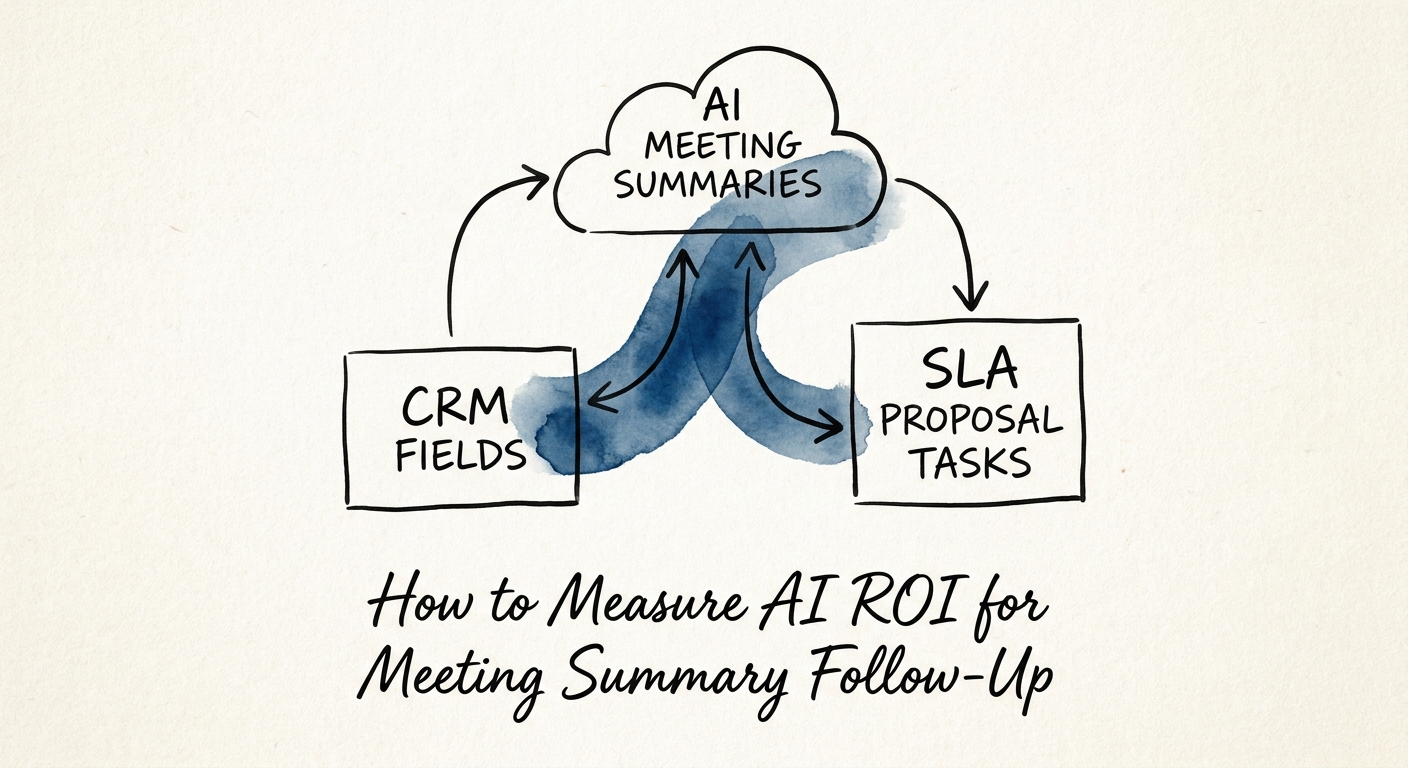
For a services business, every summarized meeting is a baton handoff — discovery to proposal, kickoff to delivery, QBR to renewal. The only ROI that counts is whether the baton arrives. So drop "hours saved" entirely; finance will (rightly) reject it, because saved minutes that don't convert into a closed task or an updated record are not money. The Federal Reserve Bank of San Francisco small-business AI analysis makes the same point for smaller firms: the win has to attach to a concrete operating gain, not a transformation slogan.
Run a two-column comparison for one quarter — meetings where the AI summary fed your follow-up workflow versus meetings where it didn't — and log four things per meeting:
- Owner assigned within 24 hours — did each action item get a name, not just appear in the recap?
- Owner accepted it — acknowledged, not just tagged. An assignment nobody confirmed is a guess.
- System of record updated — the CRM opportunity, the project task, the renewal note actually changed.
- Action completed by its due date — the only line that proves the meeting changed an outcome.
Your headline metric is that last one expressed as a rate: completed-on-time actions divided by accepted actions. Watch it move between the two columns. If the AI-fed column doesn't show faster owner assignment and a higher completion rate, the tool isn't earning its keep — and you've just learned that for the price of a spreadsheet instead of a year of licenses. The NIST AI Risk Management Framework backs treating measurement as a standing practice rather than a one-time pilot check. Once that follow-up rate holds steady for a few weeks, feed it into the AI ROI calculator to put a dollar frame around it.
Treat the transcript like the liability it is
Here's what the demo never mentions: a meeting summary is a copy of your most sensitive raw conversation. Pricing you floated, a client's contract grievance, an offhand legal comment, a salary number that surfaced in a staffing call — the AI captured all of it, and now it's sitting in a thread, a CRM note, and a knowledge base that half the company can search. In a B2B services shop, that transcript can name clients and quote terms you'd never put in writing. The CISA AI data-security best practices are the right starting point: decide who can access summaries, and which meeting types never get auto-summarized at all, before you wire the output into other systems — not after a client asks why their pricing showed up in a shared doc.
Get both halves right — a follow-up rate finance trusts, and access rules legal can live with — and the notetaker stops being a convenience and becomes operating infrastructure. Cleaner handoffs, accountability with a name on it, and an honest view of exactly where execution stalls between the meeting and the work. Start this week: pull last month's summarized meetings, tag each action item with the four checks above, and you'll have your first real follow-up rate by Friday. If you want help turning that single metric into a broader plan for where AI actually earns in your operation, that's what the AI roadmap is for.