The ticket that bounced three times
An employee submits a request: "My corporate card got declined and I need it working before a vendor call at 2pm." It lands in the general IT queue. IT sees "card" and tags it finance. Finance sees "declined" and tags it a fraud-hold question for the bank. The bank issue turns out to be a spending-limit policy set by the manager. By the time it reaches the right person, it's 4pm and the call is over. Three handoffs, four people touched it, and the employee learned that the helpdesk is a place tickets go to disappear.
That is the problem AI routing is actually trying to solve, and it is why employee helpdesk routing is one of the cleaner first AI workflows for a growing company: the work repeats, the misroutes are countable, and the cost of getting it wrong shows up in real employee time. The San Francisco Fed analysis of AI and small businesses describes AI moving into everyday small-business operations, and the OECD report on AI adoption by small and medium-sized enterprises is blunt that whether it works hinges on data readiness and someone owning the process — not on the model.
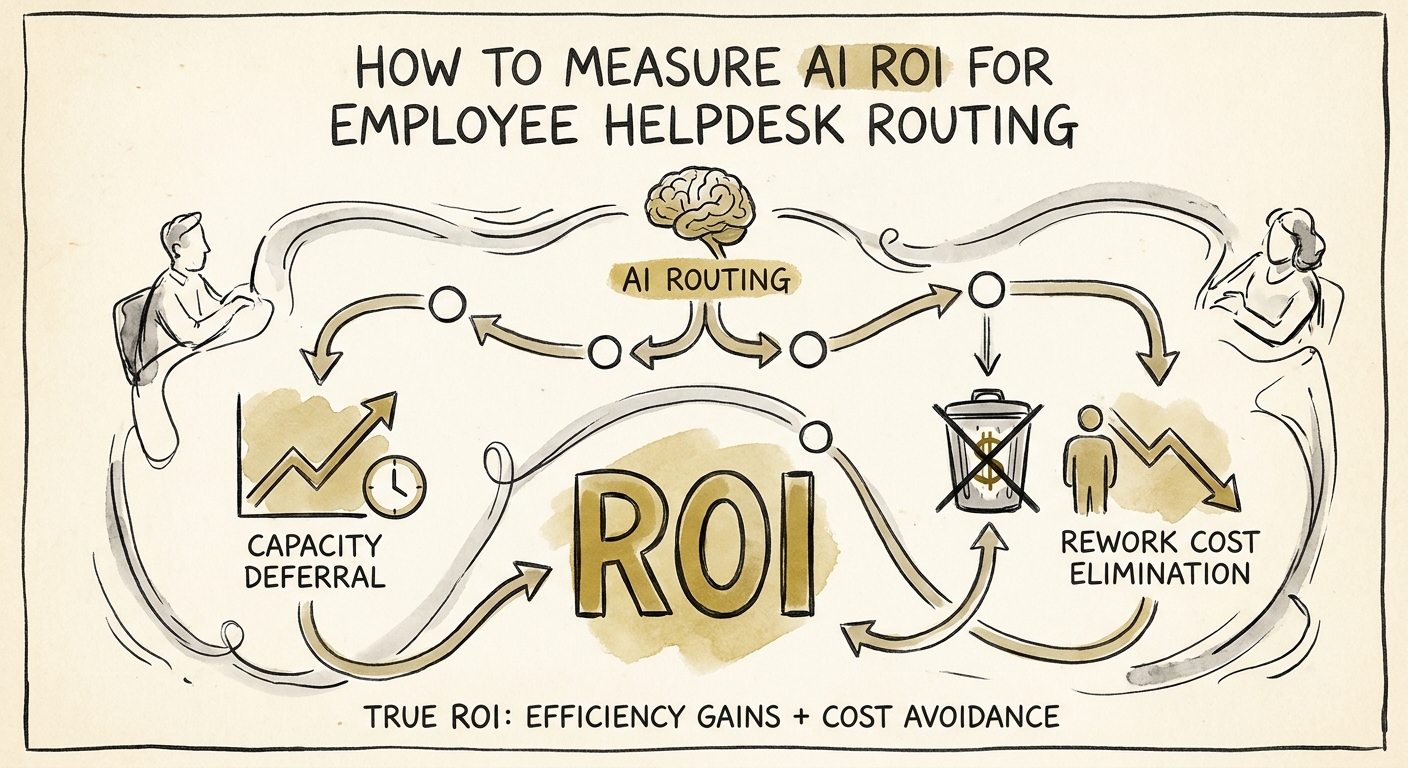
So before you pilot anything, count the thing you're trying to fix. For 30 days, log: how many tickets get reassigned at least once, how long the average reroute adds, which categories (HR, IT, finance, facilities) bounce most, how often the same question comes in three different ways, and how long someone waits for a first useful reply versus a first auto-reply. AI can read a ticket, classify it, suggest a knowledge-base answer, and draft an escalation summary — but as honest AI ROI measurement insists, the win is fewer bounces and redeployable support hours, not seconds a bot saved drafting text nobody reads.
The data problem hiding inside "just route the ticket"
Employee helpdesk routing looks harmless until you remember what's in the tickets. A payroll discrepancy. A request to reset access for someone who was just terminated. A "can you check why my benefits enrollment failed" with a dependent's medical detail in it. Routing AI has to read all of that to classify it — which means the routing layer is now touching some of the most sensitive data your company holds, and it's doing it at the moment an employee is frustrated and oversharing.
The NIST AI Risk Management Framework gives the operating shape: govern, map, measure, manage. Translated to a helpdesk, that means approved source content only, role-aware access (the facilities bot has no business reading an HR grievance), documented escalation rules per category, and a hard human-review gate on anything tagged HR-sensitive, security, or termination-adjacent. The CISA AI data security best practices matter here precisely because the easy path — paste the whole ticket into whatever tool is fastest — is how confidential employee data ends up in a system nobody approved for it.
The practical move: write down, per category, who can see what and what auto-routing is never allowed to touch. An IT password reset can be fully automated. A "I want to report my manager" ticket should be routed to a human and nothing else — no auto-summary cached, no knowledge-base suggestion fired back at the employee. If you can't draw that map confidently, the AI readiness assessment will tell you whether your source quality, governance, and ownership are ready to go from routing assistant to standing workflow.
Did the operating model get better, or just busier?
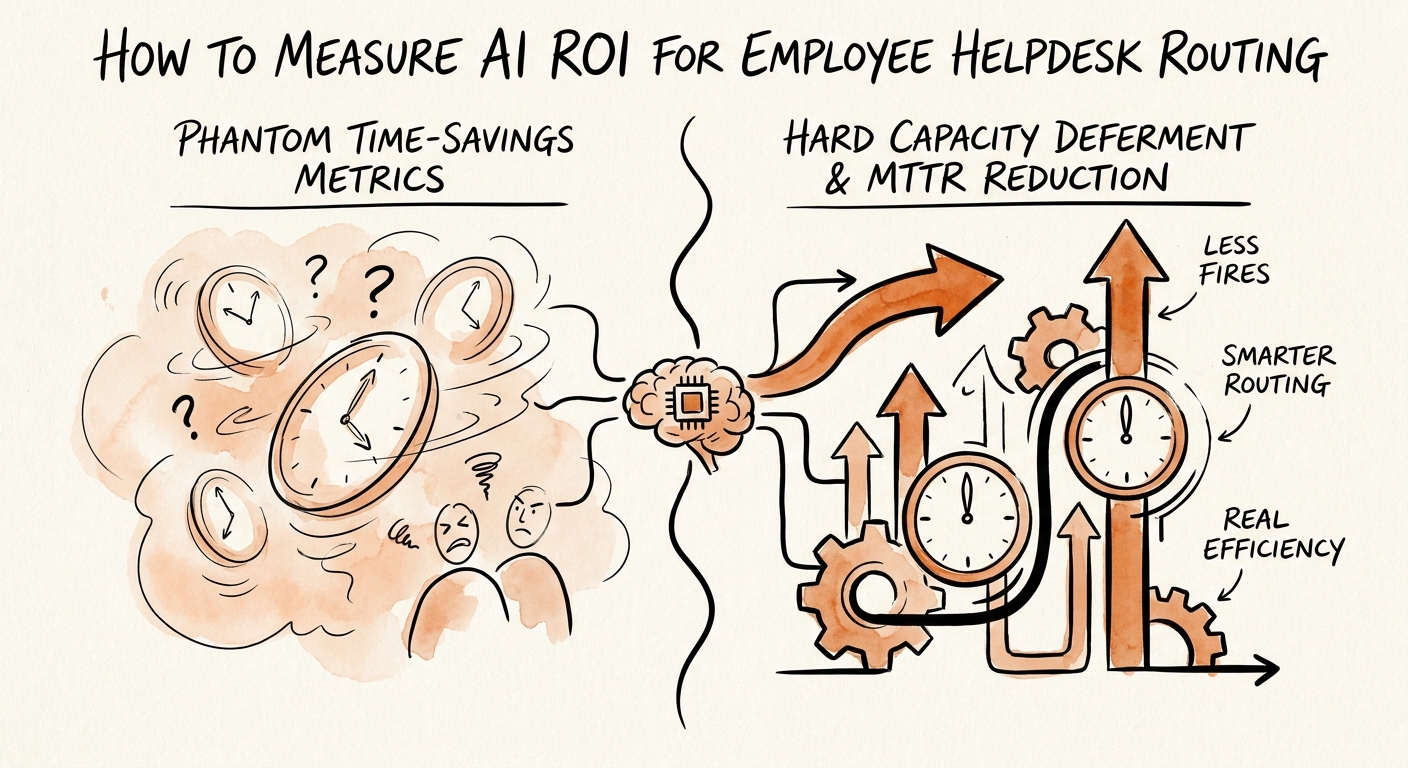
Six weeks in, the dashboard will tell you the AI is "handling" 60% of tickets. That number is a trap. The question that matters: did the reroute rate drop, did first-useful-response time fall, and did the categories that used to bounce stop bouncing? The Deloitte State of AI report keeps landing on the same point — value comes from the process actually changing, not from the tool being present. For a helpdesk, the change you want to see is concrete: cleaner intake forms, fewer reassignments, faster escalations, knowledge articles that get written because the AI surfaced the same question forty times, and a named owner for the categories that keep breaking.
Watch the trust signal too, because it's the one that doesn't show in cost-savings math. If employees start writing "ROUTE TO A HUMAN" in the subject line, your routing AI is failing in a way no deflection rate will reveal. The Gartner agentic AI project forecast is a useful brake: don't graduate from "suggest and route" to "auto-resolve and act" until cost, data quality, demonstrated value, and controls are all settled. A mishandled fraud-hold ticket is annoying. A mishandled HR-sensitive one is a problem you'll be explaining in a conference room.
Your Monday move is small and specific: pick one ticket category that bounces the most — usually access requests or expense/card issues — and scope a pilot on just that queue. Define the data sources the AI may read, the escalation rule, and the two numbers you'll judge it on (reroute rate and first-useful-response time). The 90-day implementation plan turns that single queue into a real rollout decision instead of a perpetual experiment.