"Are we AI-ready?" is the wrong question
Walk into a 75-person services firm and ask if it's AI-ready, and you'll get a meeting that goes nowhere. The honest answer is "ready for what?" That same firm can be ready to draft meeting summaries tomorrow and dangerously unready to let a bot answer customer billing questions — and both are true at the same hour, in the same building, with the same data stack.
That's the flaw in company-wide maturity grades. They average a dozen unrelated facts into a single label, and the label can't tell you what to do Monday. The RSM middle-market AI survey shows plenty of momentum, but momentum isn't readiness. Readiness is evidence about a specific workflow: does usable source data exist, does someone own the inputs, who is allowed to see what, and who catches a bad output before it reaches a customer.
So score the workflow, not the firm. And end the score with a verb, not an adjective. "Intermediate maturity" tells a 40-person company nothing. "Clean the CRM field hygiene first, then automate the renewal-reminder workflow" tells them exactly where the week goes.
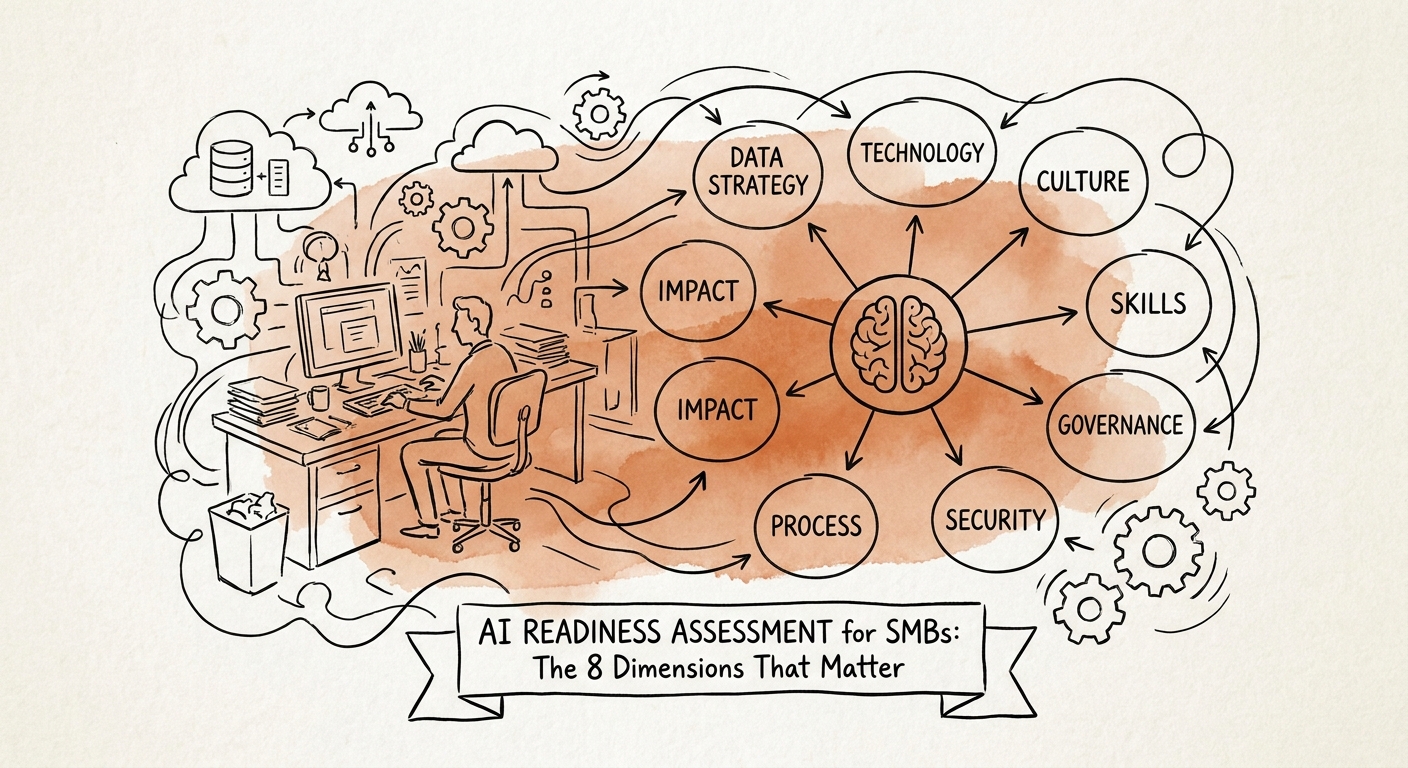
Eight dimensions, each backed by something you can point at
Pick one candidate workflow — say, a 30-person home-services company that wants AI to draft service-call follow-up emails. Now score eight things, and for each one demand evidence you can physically point at, not a gut feel:
1. Value. What measurable result moves — fewer missed follow-ups, faster invoicing? 2. Data quality. Open the actual records. Are the customer notes current and complete, or is half the field blank? 3. Source access. Can the tool reach approved inputs without you handing it the keys to everything? 4. Systems fit. Does it live inside the tools people already open, or does it create a new tab nobody checks? 5. Privacy risk. What in this workflow must stay human-reviewed or never leave your walls?
6. Adoption. Will the dispatcher actually change how she works, or route around it by Friday? 7. Review design. Name the person who accepts, rejects, corrects, or escalates each output — by role, today. 8. Measurement. How does the owner inspect this in 30 days without a data project? The OECD SME AI adoption report keeps landing on organizational readiness — not model quality — as the binding constraint, and the San Francisco Fed small-business AI analysis echoes that the gap is rarely the technology. That's why every dimension here demands proof, not opinion.
A low score isn't a failure grade — it's a tripwire. It's what stops you from automating a workflow that has no named owner, or pushing customer billing notes into an unmanaged tool, or training staff on "approved use" you haven't defined yet.

Each score pattern points to a different verb
The eight scores aren't an average — they're a router. High value plus high readiness across the board: build it, this quarter. High value but one dimension is bleeding — data quality, say — the verb is clean, not build; you fix the field hygiene first or the bot confidently emails the wrong customer. High value but the privacy dimension lights up: the verb is govern; write the approved-use rule and the review step before any tool touches the data. And the trap everyone falls into — low value but trivially easy to automate: the verb is defer. Easy is not a reason.
Sequencing matters because usage outruns process almost every time. The Deloitte State of AI report documents how fast adoption sprints ahead of the workflow redesign that's supposed to support it, and Gartner's agentic AI forecast expects a large share of projects to be scrapped — most of them not because the model failed, but because nobody scored the boring dimensions first. Readiness scoring is the cheap insurance against being in that statistic.
Here's your Monday move: take your loudest AI idea, write the eight dimensions down the left side of a page, and score each one only if you can name the evidence. The dimension you can't back with proof is your first project — and it usually isn't the AI. To run a fast first pass on a candidate workflow, use the AI Opportunity Score. It exists so a leadership team can decide whether to build, repair, or wait — before anyone signs an order form.