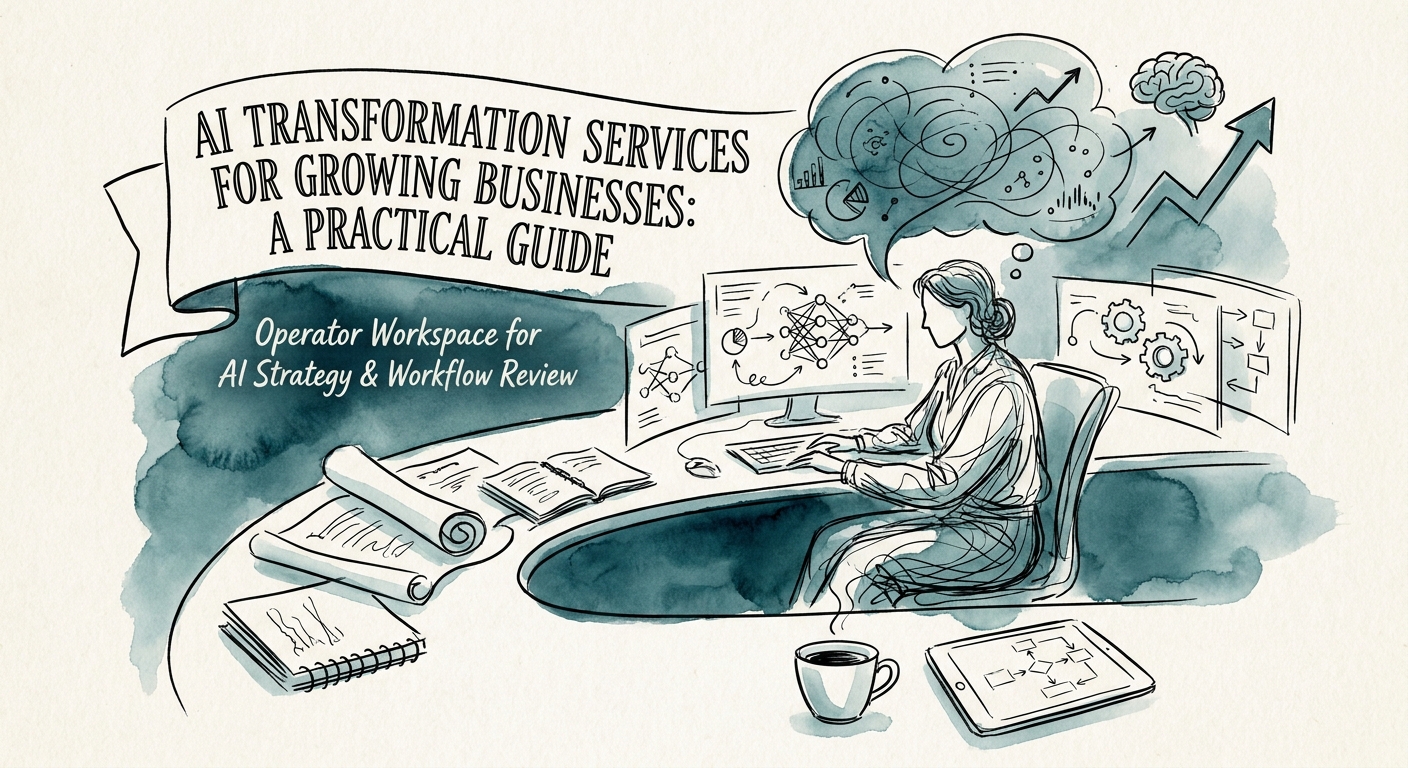
The demo always works. The Tuesday after never does.
Picture a 120-person company. Somebody on the leadership team saw a slick demo, and now there are sixteen individual AI subscriptions on the credit card, a Slack channel full of clever prompts, and exactly nothing that has changed how a single workflow runs. The tools work. The enthusiasm is real. And six months in, nobody can name one process that got faster, cheaper, or more accurate.
This is the actual problem for businesses in the 50-300 employee band, and it is not a lack of AI ideas. The RSM middle-market AI survey shows usage is already broad across the middle market. Adoption isn't the bottleneck. The bottleneck is that nobody owns the messy middle: deciding which workflow to rebuild first, getting the data owner to agree on what the tool can touch, telling the people whose jobs change what "good" now looks like, and proving the thing actually moved a number.
That work sits in the gap between IT, operations, and the executive who signed the invoice. At a 30-person shop, one motivated person can sometimes muscle it through. At 150 people, with three departments, a compliance worry, and a manager who quietly thinks this is a fad, it needs someone whose only job is sequencing those decisions in the right order. That is what "transformation services" should mean. It is operating work, not a shopping trip through a vendor catalog.
What "discovery to shipped workflow" actually looks like
Say a 90-person services firm wants AI in their proposal process. A useful engagement does not start with a tool recommendation. It starts by mapping where the proposal actually slows down, who currently signs off, what client data is fair game and what is off-limits, and whether the source material is even clean enough to feed a model. The opportunity map ranks candidate workflows by value, readiness, and risk, so you build the one that's both high-payoff and actually feasible, not the one that demoed nicely.
Then the part most efforts skip: a working workflow, in production, with the boring scaffolding that makes it survive. That means an agreed source of truth the tool draws from, a review queue so a human approves output before it reaches a client, a short instruction library so output is consistent across the team, and a named owner. The OECD SME AI adoption report keeps returning to the same point: small and mid-sized firms succeed on practical support and organizational readiness, not on having access to better models. Everyone has the same models.
The reason this matters for your size specifically: a 200-person company has just enough process to be worth automating and just enough politics to sink an unowned pilot. The San Francisco Fed small-business AI analysis notes how thin the margin for wasted effort is at this scale. You don't get unlimited swings. So the build has to land enablement too: the manager knows how to spot a bad output, the user knows when to escalate instead of shipping it, and leadership knows the one metric that says this worked.
The 90-day test, and the meeting that keeps it honest
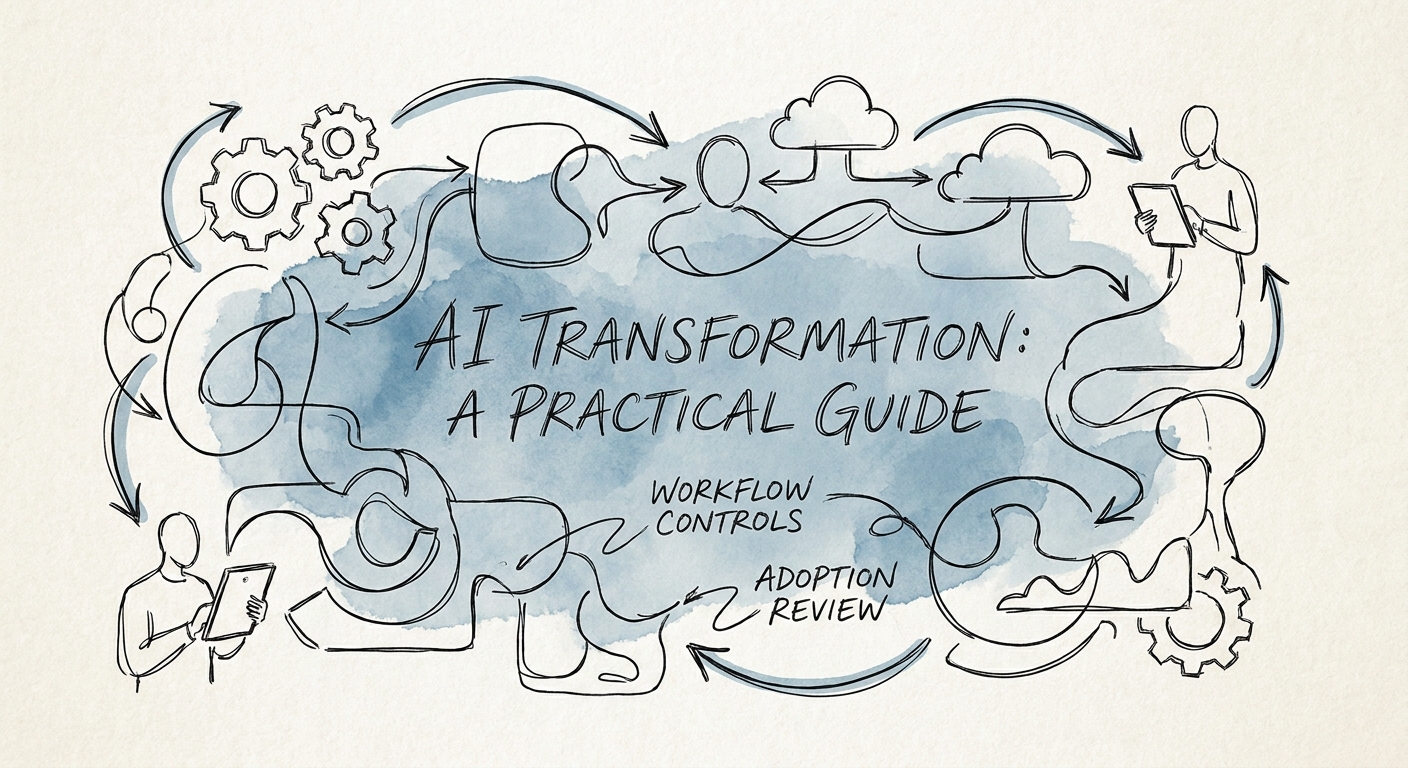
Here is the line that separates a transformation from a planning exercise. By day 90, at least one workflow is in controlled daily use, with an owner, review rules, a trained team, and a number you can read out. Not a roadmap. Not a "we identified twelve opportunities" slide. One thing that real people use on a real Tuesday and that you can prove changed.
The first 30 days set the baseline: what tools are already in the building, which workflows are worth the effort, who owns the source data, and where policy is genuinely unclear versus just unexamined. Days 60-90 are for shipping. And the executive cadence is what keeps it from drifting: every review asks five questions: what shipped, what changed, what did users actually adopt, what new risk showed up, and which ideas we should now kill. That last one matters most. Gartner predicts over 40% of agentic AI projects will be canceled by end of 2027, and the Deloitte State of AI report traces stalled value straight back to AI scattered across pilots nobody is managing. Killing the dead ideas is how the live one gets enough oxygen to ship.
Monday action: list every AI tool currently being paid for in your company and write one sentence next to each naming the workflow it changed. The blanks are your real starting point. When you want a sequenced operating path instead of another impressive demo, that's what the AI Transformation Blueprint is for. We bring the same sequencing discipline that ran a 28,000-user migration with zero downtime, applied at your scale. Build the AI roadmap when the business needs a path, not a pilot graveyard.