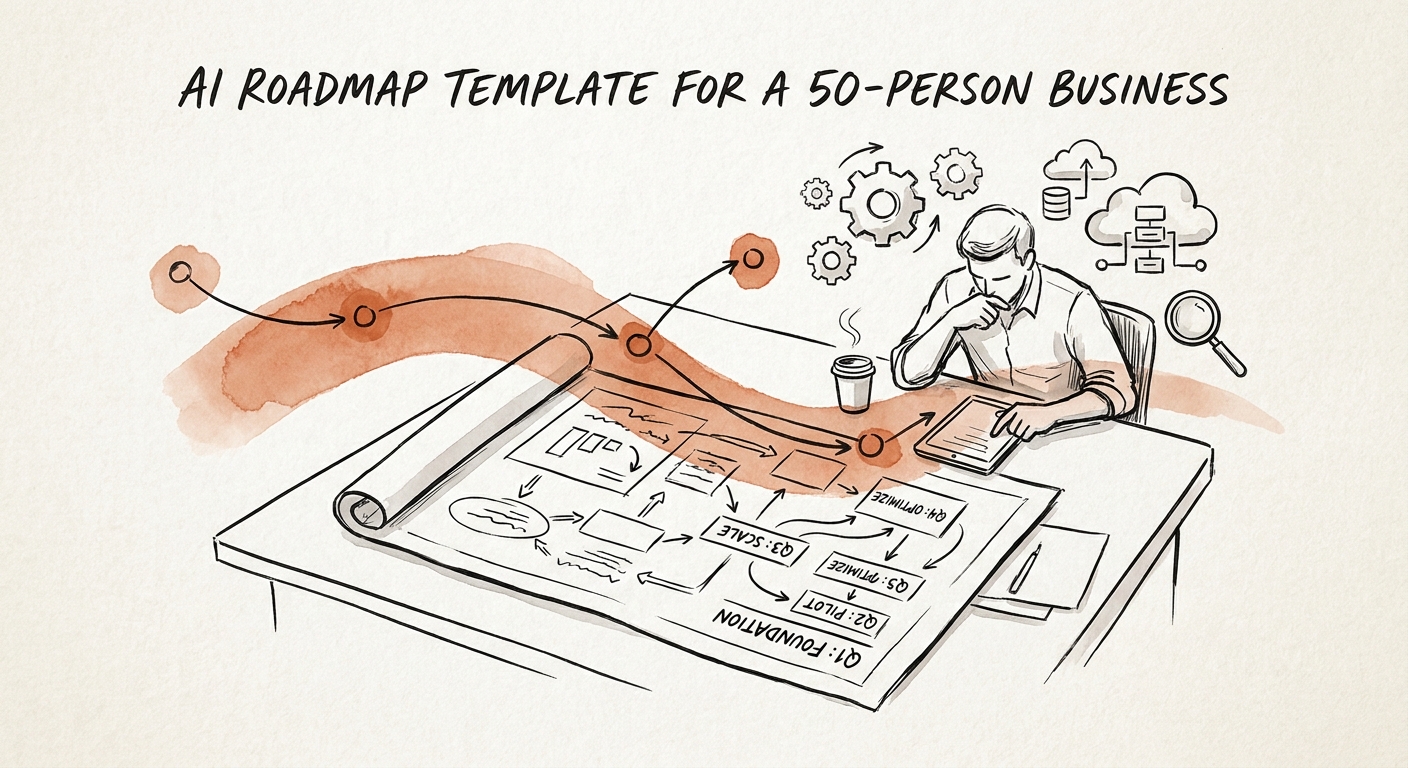
Fifty people is the awkward middle, and that's the whole problem
Picture the company. Sales runs on a CRM somebody half-configured two years ago. Operations lives in spreadsheets and one person's head. Finance closes the books in QuickBooks plus three manual workarounds. Support answers tickets in a shared inbox. There is no IT department — there's a guy named Dave who's also the head of ops, and a managed services contract for when the wifi dies. That's a 50-person business, and it's exactly the size where an AI roadmap goes sideways.
Too small to have spare capacity. Too big for the owner to personally watch every workflow. Five departments now generate their own "we should use AI for this" ideas, and every one of them sounds reasonable in isolation. A 30-person shop is small enough that the founder just decides. A 200-person company has a head of operations with budget and a project manager. At 50, you're stuck in between: enough surface area for AI to sprawl across sales, ops, finance, support, and leadership, but no dedicated person to own any of it. The RSM middle-market AI survey shows companies your size are adopting fast — the question was never whether to start, it's whether you finish anything.
So a roadmap for this size company isn't a vision document. It's a staffing constraint written down. It names the single workflow you build first, the four you're explicitly not touching this quarter, and the human who owns each decision — because the moment two things run in parallel, both stall on the same overloaded person.
The 90-day sequence — and the part everyone skips
Here's the template. Ninety days, four moves, one workflow live at the end.
Days 1–10: Walk the floor. Not a survey — actual conversations. List what AI tools people already pay for or quietly use (someone is pasting customer data into a free chatbot right now; find them). List the core systems. Then list the five places work backs up the worst. At a 50-person company that's usually proposal turnaround, ticket triage, or month-end close. You're hunting for friction with a clear before-and-after metric, not for the flashiest demo.
Days 11–20: Set the floor on rules. One page. What customer data can touch an AI tool, who reviews AI-drafted customer messages before they send, and which sources an AI is allowed to answer from. You don't need a policy committee. You need to stop the obvious own-goal before you scale anything.
Days 21–30: Pick exactly one. Score your friction list on two axes — how much time it bleeds weekly, and how clean the data feeding it is. Pick the highest-time, cleanest-data workflow. Everything else goes on a "not this quarter" list, in writing, so it stops re-litigating itself in every meeting.
Days 31–60: Build it with a named owner. One person owns the workflow, the source rules, the review path, the training, and the one metric that says it worked. Days 61–75: run it with a small user group and count four things — output accepted, output corrected, exceptions kicked back to a human, and how many people actually use it versus revert to the old way. Days 76–90: scale it, fix it, kill it, or move to the next one. You decide on evidence, not enthusiasm.
The part teams skip is the "not this quarter" list. The OECD SME AI adoption report keeps landing on the same finding — small companies stall on readiness and capacity, not on ideas. A 50-person business has more ideas than it can staff. The roadmap's job is subtraction.
The monthly review that keeps it honest
Thirty minutes, once a month, with the owner and the workflow's named owner in the room. Six questions: What did it cost? Who actually changed how they work? Where did a human have to correct the output, and why? Which data source caused the most grief? What did we stop? And what's the one next decision?
That fifth question is the one most companies never ask. A roadmap that only adds work is a backlog wearing a costume. A real one retires low-value ideas, parks the messy-data workflows until someone owns the data, and forbids buying a tool before the workflow it serves is defined. At your size, a stopped initiative isn't a failure — it's capacity you just handed back to a person who needed it. The Gartner warning that a large share of agentic AI projects get cancelled isn't a reason to avoid AI; it's a reason to make the kill decision on purpose, on a schedule, instead of letting projects rot.
One workflow, owned, live, and measured in 90 days beats five pilots that all died waiting on the same person. When you've proven the cadence works and you're ready to sequence AI across more than one function without breaking the people running it, the AI Transformation Blueprint is the next step — it builds the multi-workflow sequence on the same discipline. Build the AI roadmap before you greenlight another pilot.