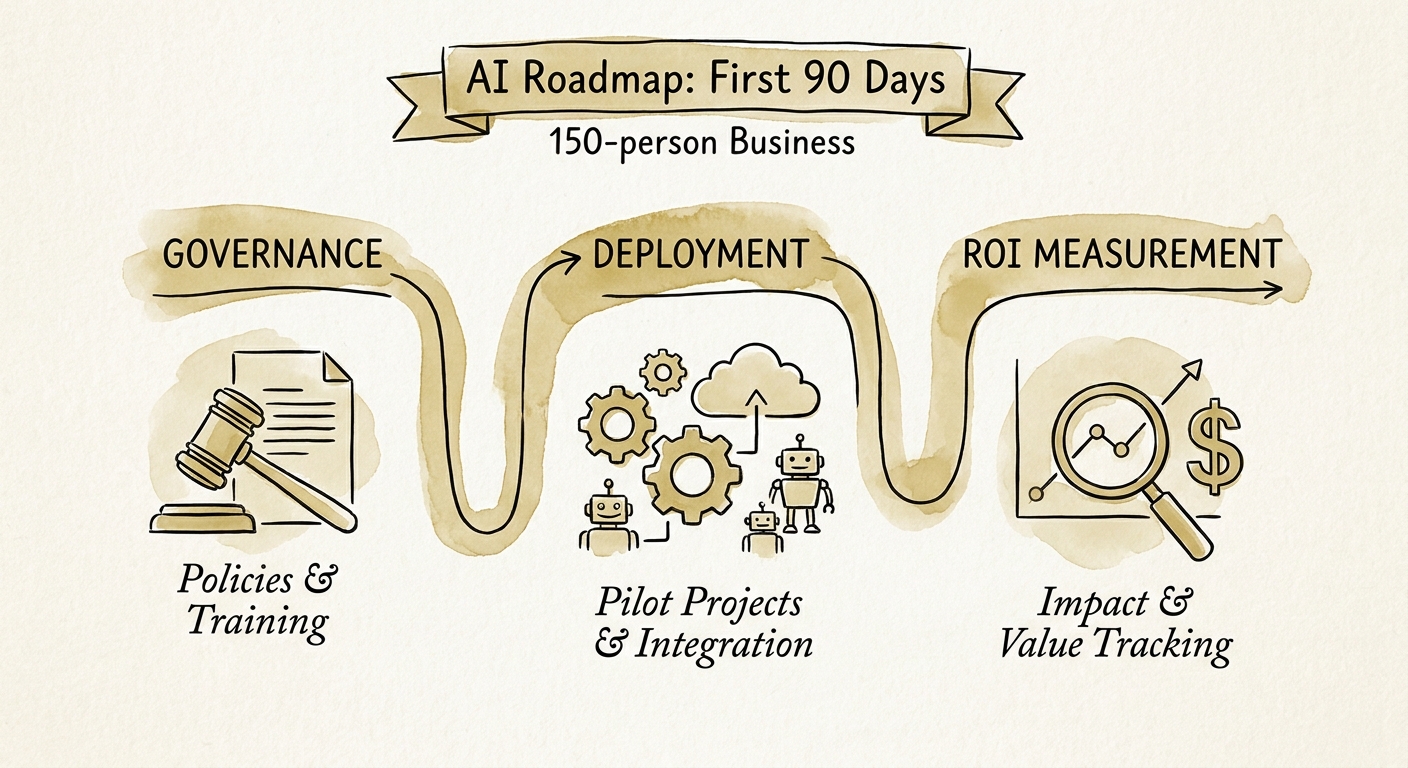
Why 150 is the worst size to wing it
A 20-person shop can run an AI experiment in a Slack channel and nobody notices if it flops. A 2,000-person enterprise has a transformation office to absorb the failures. A 150-person company has neither. You have three or four departments that don't share data cleanly, a layer of middle managers who each think their workflow should go first, and exactly zero org-wide tolerance for the quarter where "the AI thing" visibly broke quoting or routed a customer ticket into a black hole. When that happens, it isn't a learning — it's the story everyone tells for a year.
So the first 30 days are not about tooling. They're about picking the one workflow that earns trust. The RSM middle-market AI survey, the San Francisco Fed analysis of AI and small businesses, and the OECD report on AI adoption by small and medium-sized enterprises converge on the same unglamorous point: the adoptions that stick start where the inputs, the owner, and the result are all already legible. Not the flashiest workflow. The most observable one.
A concrete first-month test: list every workflow a manager could name in one sentence, then cross out any where you can't say who owns the source data and what "done correctly" looks like. Whatever survives — say, turning a sales rep's notes into a same-day quote, or routing inbound support tickets to the right queue — is your candidate. Rank what's left with the AI use-case scoring model on value, risk, and readiness, and commit to one.
The middle 30 days: build the trust scaffolding while the blast radius is still small
Here's the trap at 150 people. You have just enough budget to buy seats for the whole company and just enough hierarchy that a VP will ask you to. Resist it. The thing that kills a mid-market rollout is not a weak model — it's the day someone discovers the assistant answered a customer using a pricing sheet that was retired in March, and now nobody trusts a word it produces.
The fix is a small operating model around your one workflow, built before launch, not after the incident. Borrow the structure from the NIST AI Risk Management Framework and the CISA AI Data Security Best Practices, then answer five questions in plain language for that single workflow: Which sources is it allowed to read? Who reviews output before it reaches a customer or a decision? What gets logged so you can reconstruct what happened? What is the rule for an exception? And what is the kill switch — the condition under which a human pauses the whole thing?
For a 150-person company, those answers fit on one page, and the reviewer is usually a named individual, not a committee. That's an advantage — use it. A workflow where the support lead personally signs off on the first two weeks of AI-suggested ticket routing builds more organizational trust than any vendor security deck. Keep the build sequenced with the 90-day AI implementation plan so the controls land before the users do.
The final 30 days: prove it moved a number, then earn the second workflow
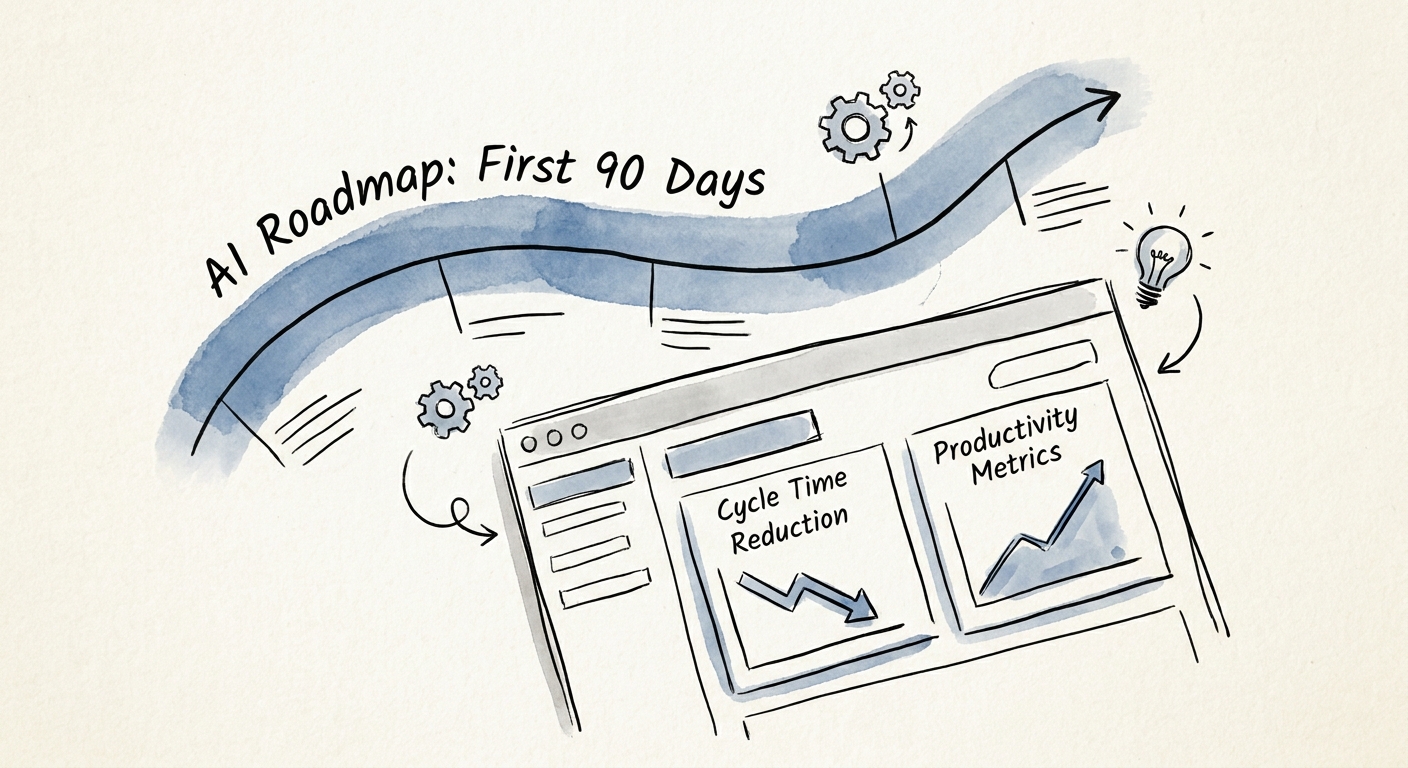
The last month is where most mid-market AI efforts quietly die — not in failure, but in fog. The pilot "works," everyone's vaguely positive, and six months later you can't say whether it changed anything. Deloitte's State of AI in the Enterprise 2026 keeps hammering the same gap: scattered experiments that never convert into operating value. At your size, the antidote is brutally specific measurement on the one workflow you launched.
Pick the number that workflow was supposed to move and watch it against the prior baseline. If it's quoting: how many hours from request to quote sent, and how many quotes still need a rep to rewrite them. If it's ticket routing: what share land in the right queue on the first pass, and how often a human has to reroute. Track adoption honestly too — a tool people quietly route around is a failed pilot wearing a success badge. Then make a real decision at day 90: scale it, revise it, or kill it. Saying "kill it" out loud is what makes the next pilot credible.
What you want by day 90 isn't a slide that says the pilot worked — it's a pattern your team trusts enough to point at the second workflow. Measure it with AI ROI measurement without fake savings so the wins are real ones, and when you're ready to map the full sequence, build the AI roadmap from there.