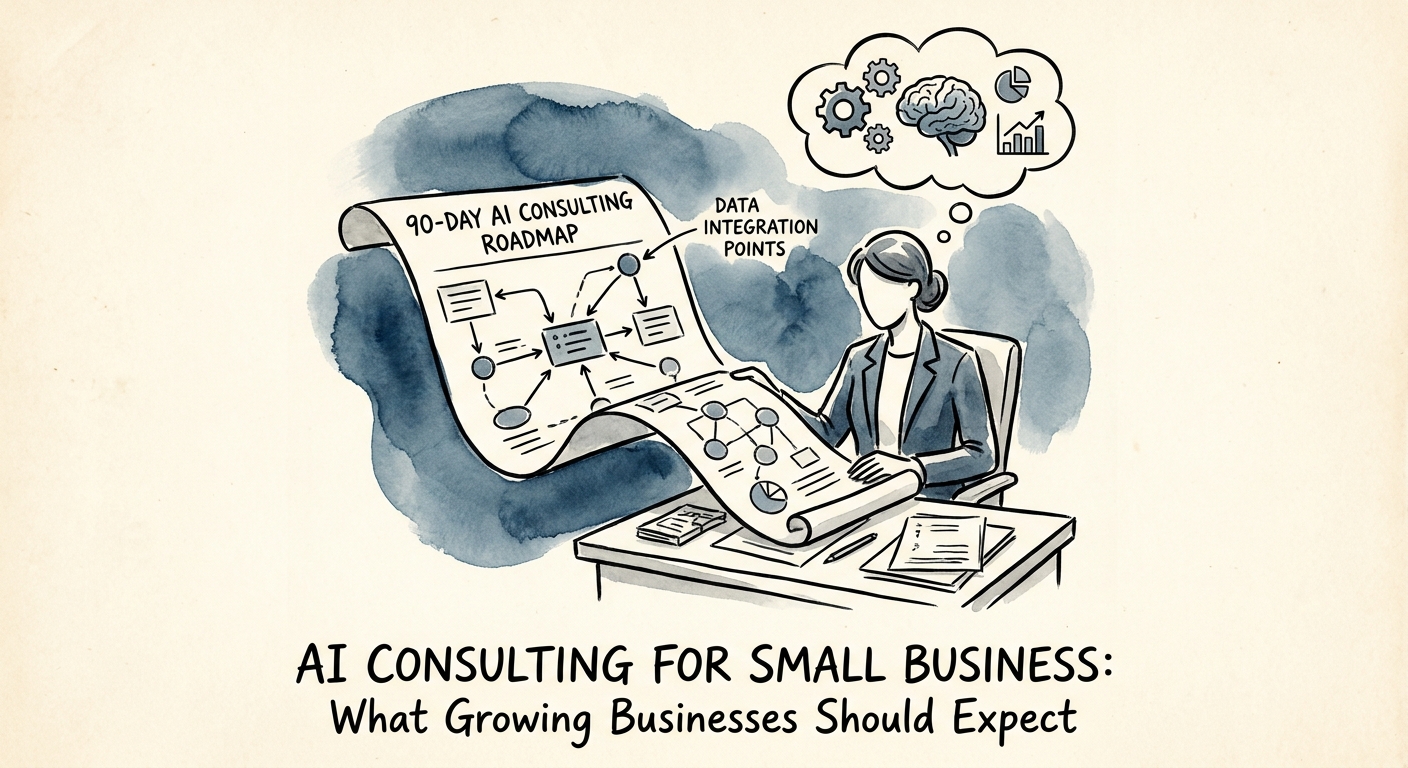
The deck that costs you six billable weeks
Picture a 35-person professional services firm — accounting, design, recruiting, marketing, legal-adjacent, pick your flavor. A consultant walks in, runs a discovery interview, and six weeks later hands the partners a glossy "AI transformation roadmap": maturity model, opportunity matrix, a future-state vision slide with a lot of arrows. The partners nod. Nothing changes on the next engagement. The associates are still pasting client notes into a chatbot when no one is looking.
That outcome is so common it should be priced into your expectations. The firms that get value from AI consulting do not start with strategy. They start with one repeatable task that a senior person currently does by hand and resents — drafting the first version of a proposal, summarizing a discovery call into a scope document, reconciling a client's messy intake form against your standard engagement letter. Concrete, recurring, and tied to either billable leverage or write-off risk.
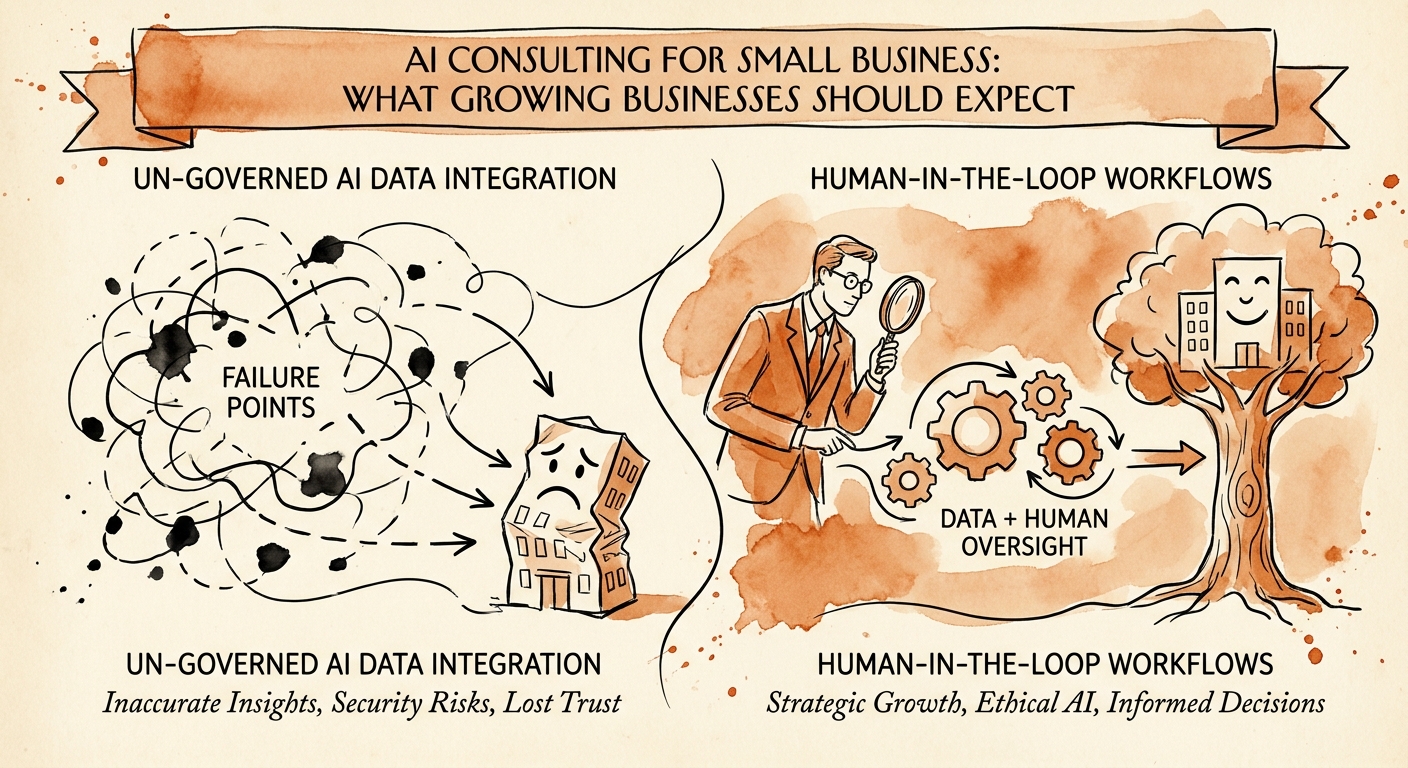
What separates a useful engagement from theater is whether the consultant treats your work as the input. In a services firm the "process" is rarely written down — it lives in the head of the partner who has done 400 engagements. A real consultant pulls that knowledge out, maps the handoffs, finds where the source facts live (your practice management system, the client's documents, last year's deliverables), and names who signs off before anything reaches the client. If the proposed workflow ends with an associate copying privileged client material into a blank chat window, you have not bought automation. You have bought a confidentiality incident waiting to happen.
Pressure-test the scope against AI consulting cost for small business before you sign. For a firm your size, a tightly-owned first workflow beats a broad program every time — because you can actually tell whether it worked.
The five things you should be able to hold in your hand
By the end of a serious first engagement, you should be able to point to five tangible things — not slides, artifacts your team can use without the consultant in the room.
One: a current-state map of the chosen workflow, written down for the first time, including the partner judgment that usually goes unspoken. Two: a ranked backlog of candidate use cases scored on value, feasibility, confidentiality risk, and how hard it'll be to get your most senior people to actually adopt it. Three: a source-and-permissions map — which client data the workflow touches, what's privileged, what your engagement letters and the client's agreements allow. Four: explicit human-review rules naming who reviews output before it leaves the firm. Five: a measurement plan that compares the new workflow against the way it's done today.
Adoption is where services firms break, and the failure mode is specific. The demo summarizes a discovery call beautifully. Then the workflow meets a real engagement: the client's intake documents are inconsistent, the associate doesn't trust the AI's read of a nuanced scope question, and the partner — who is the firm's quality reputation — never reinforces using it. MIT's research on GenAI in business describes exactly this gap between pilots that look good and deployments that survive contact with the work. The RSM middle-market AI survey shows mid-sized firms wrestling with the same readiness questions, and Gartner expects a large share of agentic AI projects to be canceled — most of them for reasons that have nothing to do with the model.
Data readiness is usually the gate. If your matter records are inconsistent, document access is loosely controlled, or your "methodology" is tribal knowledge held by two partners, the consultant should slow down and fix the inputs first. In a firm that sells expertise, a workflow that confidently produces a wrong client-facing answer is not a productivity gain — it's a malpractice vector. We treat AI consulting as operating design: the model is one part; workflow fit, source control, who-reviews, and whether partners reinforce it decide whether it lives.
The 90-day plan that proves one workflow
Ninety days is enough to ship one workflow and know whether it earned its keep — and short enough that you can't hide behind "we're still strategizing." Month one: confirm the workflow, write down today's baseline (how many hours does an associate spend drafting that proposal now, and how often does a partner rewrite it?), clean the minimum inputs, and name the reviewer. Month two: build it and test with a small group — two associates and one partner who'll be honest. Month three: put it into live engagements, watch adoption, and decide whether to expand, fix, or kill it.
Good first candidates in a services firm: drafting the first cut of a proposal or SOW, turning a discovery call recording into a structured scope document, generating client status updates from project notes, triaging inbound RFPs against your qualification rules for which ones are worth pursuing, or pulling answers out of your own past deliverables so a new hire doesn't reinvent work the firm has already done three times. Each has a clear trigger, a defined output, a named reviewer, and a number you can measure.
Before you expand, run the comparison honestly. Did associates save real hours, or did partners spend the saved time re-reviewing AI output? Did the quality hold up to your standard? Did anything privileged leave an approved system? If the answer is fuzzy, the fix is better operating design — not more AI surface area. To rank that first workflow, use the AI use-case scoring model; to keep the rollout bounded, follow the 90-day AI implementation plan. When the partners want a structured read before committing, start with the QuickStart AI Audit.
