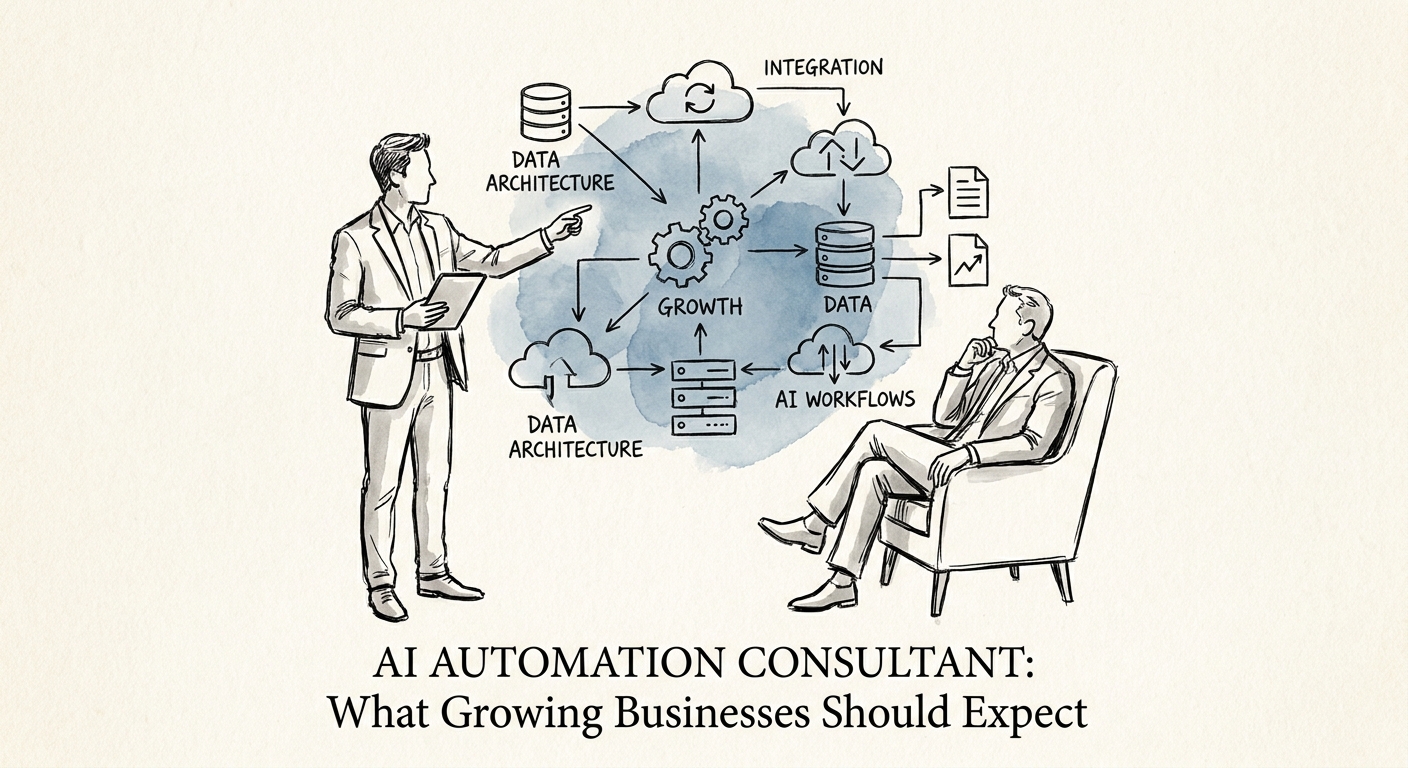
Ask one question and watch what happens
Picture a 60-person managed-services firm. The owner brings in an AI automation consultant, and somewhere in the first hour asks: "Walk me through the support-ticket triage workflow you'd build first — every step." A weak consultant pivots to model capabilities, the size of the context window, what the latest release can do. A good one starts naming things that exist inside your business: the queue in your ticketing tool, the three tags your dispatchers already use, the SLA clock, the engineer who gets paged at 2am. That gap — abstraction versus your actual plumbing — tells you most of what you need to know before the proposal arrives.
Technology-services firms are deceptively hard to automate well, because the work looks repetitive but hides judgment. Ticket triage, scope-of-work drafting, account-health summaries, renewal-risk flags, onboarding follow-ups — each one has a step where a human has to decide something a model shouldn't decide alone. The consultant's job is not to make that step disappear. It's to do everything around it: pull the inputs, draft the output, route it to the right person, and update the system of record once a human signs off. MIT Sloan's research on GenAI in business describes the divide bluntly — a wide gap between pilots that impress and systems that change how money moves through a company.
So the real expectation to set is narrow: one workflow, end to end, running in your stack. Not an AI strategy. Not a tool roundup. One thing your dispatchers or account managers touch every day, made faster or more consistent, with a human still holding the pen on anything that touches a client promise, a contract scope, or a security obligation.
The five things that separate a build from a deck
A real engagement leaves you with five concrete artifacts, and you should be able to point at each one when it's done. A current-state map of the workflow as it actually runs today — not as the org chart says it runs. A scored shortlist of candidate workflows ranked on value, feasibility, risk, and how cleanly you can measure the result. A data plan that names exactly which systems the automation may read (your ticketing tool, your CRM, your docs) and which it must never touch (client PII you're contractually fenced off from, anything under an NDA). Explicit review rules: who approves, what they're checking, what happens on an exception. And a measurement cadence that compares the pilot to a baseline you captured before flipping it on.
That fourth item — review rules — is where technology-services firms get burned. Your business runs on contractual commitments. If an automation drafts a scope of work or a renewal quote and it ships without a named human checking it, you haven't saved time, you've created a liability that surfaces three weeks later in a client escalation. Gartner expects over 40% of agentic AI projects to be canceled by 2027, and the failure is rarely the model — it's the absence of the boring scaffolding around it.
Human Renaissance treats this as operating design, not a model deployment. Pick the constraint, clean the inputs, set the review standard, wire the output back into the tool your team already lives in, train the people who'll use it, then watch the numbers for a few weeks. The model is one component of maybe seven. McKinsey's State of AI work and the RSM middle-market AI survey both keep landing on the same point: value shows up where workflow, governance, and ownership are designed together, not where the smartest model gets bolted on.
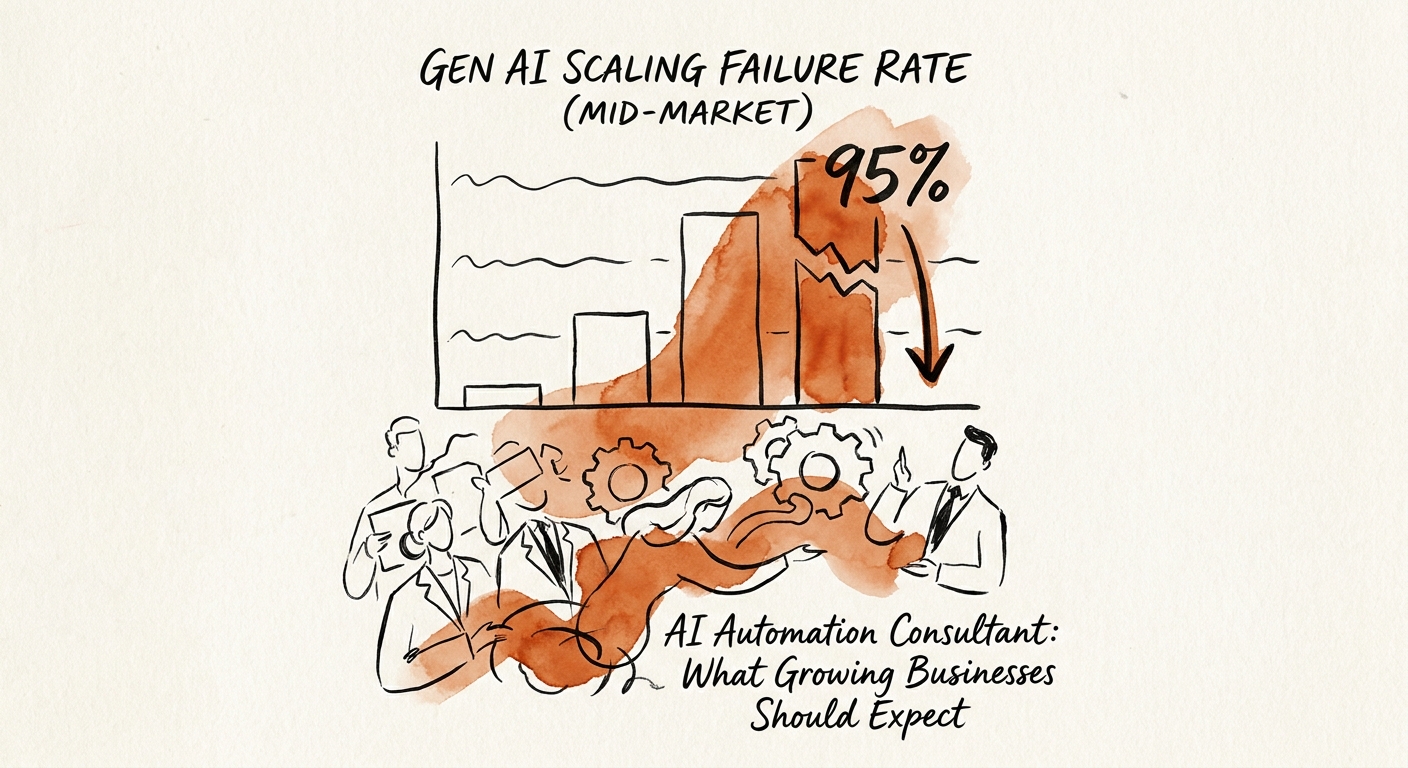
How to vet one before you sign
Run the end-to-end test on a single workflow before money changes hands. Hand the consultant your messiest candidate — say, support triage at a firm where tickets arrive by email, portal, and the occasional panicked phone call — and ask them to describe the trigger, the inputs, the transformation, the output, the review point, the system update, the exception path, and the one metric you'll watch. If they can narrate all eight using nouns from your business, they understand the work. If they stay at the altitude of "the AI handles it," they don't, and the engagement will stall the week after the demo.
Set the bar for the first build at: small enough to ship in a quarter, important enough that you'd review it yourself every week. For a tech-services shop that usually means triage summaries, account-research briefings, or a first-draft scope generator — each with an obvious approval gate and a baseline you can measure against. PwC's CEO survey shows leaders feel the pressure to move on AI; the discipline is moving on one thing, not ten.
Pressure-test the operating risk with why AI experiments fail after the demo, use the AI use-case scoring model when you're choosing between candidates, and book a QuickStart AI Audit when you want a bounded read on what to build first. The right consultant leaves you more specific than they found you: you'll know which workflow changed, why it went first, what data it used, who approves it, and what the next one is.
