
Ten people means nobody has a spare Tuesday
Picture the firm: ten people, maybe two partners, an office manager, and seven people who are billable most of the day. There is no IT department. There is no "innovation budget." When someone takes a half-day to test a new tool, that half-day comes straight out of client work or out of their evening. That is the real constraint on AI readiness here, and it is the one most readiness checklists ignore.
So throw out the 40-question maturity survey. A firm this size cannot afford to assess itself across "data strategy" and "AI governance posture" in the abstract. The OECD report on AI adoption by small and medium-sized enterprises makes the point plainly: smaller firms still need process ownership, clean source material, skills, and basic governance before tools turn into actual business value. But "need" does not mean "build a program." It means answer a handful of questions about exactly one task.
The broader market is moving — the RSM middle-market AI survey shows adoption climbing fast across the middle market. That is pressure, not a mandate. A 200-person firm can run pilots in three departments at once. You can run one. So the only readiness assessment that matters for you fits on one page and ends with a single workflow named.
The test: can a partner sign it without re-doing it?
Here is the filter that actually works at ten people. Walk through your week and find the writing tasks that are repetitive, text-heavy, and currently eating senior time: the first-draft project status note, the post-call client recap, the "pull what we know about X" research dig, the proposal boilerplate that gets reassembled for every pitch. Now apply one question to each candidate: when the assistant produces a draft, can a partner glance at it and sign off — or do they have to rebuild it from zero? If they rebuild it, you have not saved time, you have added a step. Cut it from the list.
Say it is the client-update draft. Before you call that workflow live, write down six things on an index card: who owns it (a named partner, not "the team"), which sources the assistant is allowed to read (last meeting notes and the project tracker — not the partner's whole inbox), who reviews before it goes out, what happens on the weird edge case, where the input and output get logged, and how you will know in three weeks whether it saved real hours. That card is your governance program. The NIST AI Risk Management Framework formalizes this same loop — map, measure, manage, with accountability staying visible — and the index-card version is the honest small-firm translation of it.
The trap at this size is the side-channel data problem. A 10-person firm's knowledge often lives in one partner's head, a shared drive nobody has cleaned since 2023, and a Slack channel. Feed an assistant that swamp and the draft will confidently cite a stale rate card or a client who churned. So the source boundary is not a compliance nicety here; it is the difference between a useful draft and an embarrassing one in front of a client you cannot afford to lose.
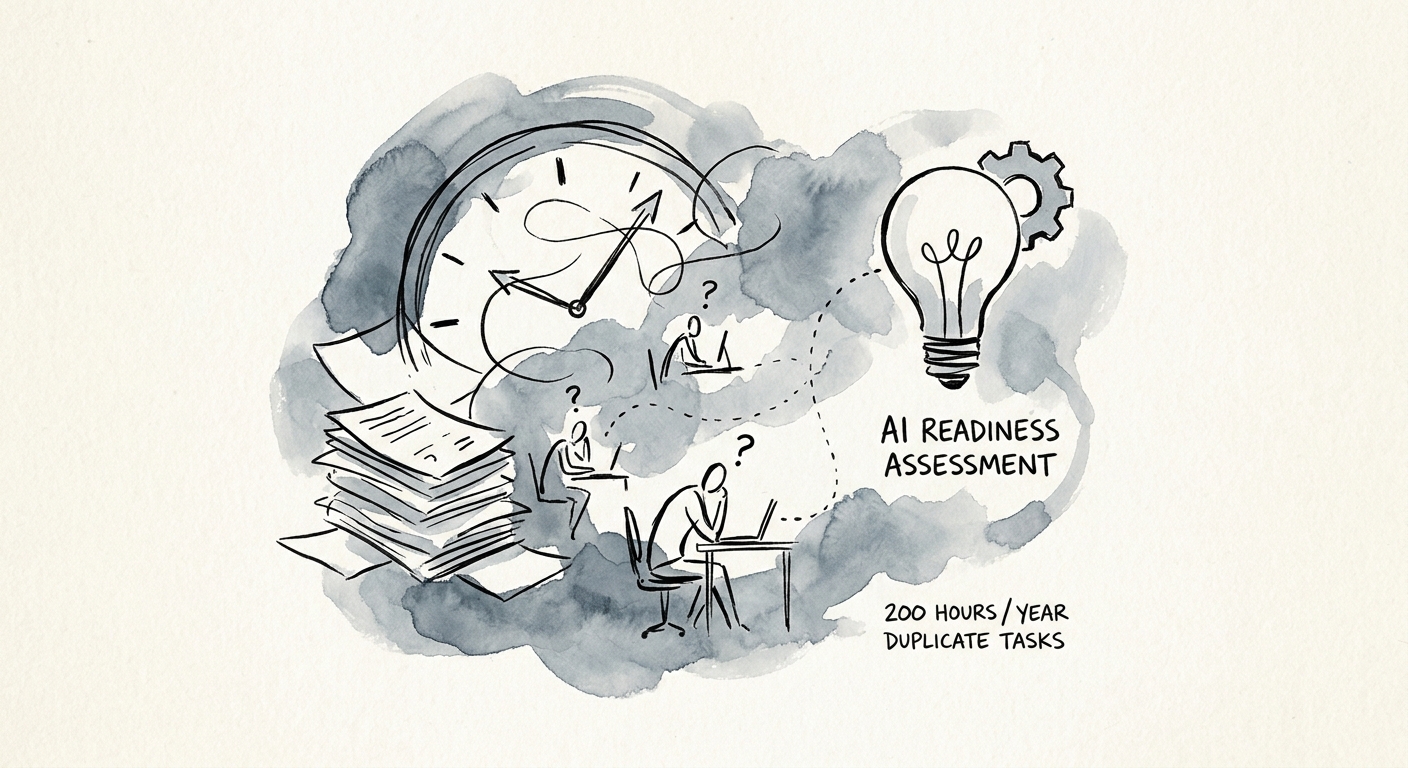
Launch one, prove it, then earn the second
The decision at the end of the page has exactly three outcomes, and you should be able to reach it in a single sitting. Either: this one workflow is ready, launch it Monday with the named owner and the review step. Or: it is the right workflow but the source material is a mess, so spend the first week cleaning the inputs and launch the week after. Or: nobody senior actually owns the output, in which case kill it now before it quietly becomes a tenth-priority distraction that never works.
Resist the pull toward the shiny version. The Gartner agentic AI project forecast warns that a large share of autonomous-agent projects get canceled when cost and value never line up — and that failure mode is far more likely at a tiny firm with no one to babysit a misfiring agent. You do not need an autonomous coordinator. You need one assistant that drafts, one human who reviews, and a number at the end of the month. The Deloitte State of AI report frames the real graduation question well: can one use case move out of experimentation and into a steady, controlled way of working? For you, "yes" to one is worth more than "maybe" to five.
Once that first workflow has paid back its setup time — measured, not assumed — you have earned the right to add a second, and you will already know how to scope it. Turn the index card into a dated plan with the 90-day implementation plan, and if the readiness picture is still fuzzy, start from the SMB AI readiness assessment and narrow it to the single workflow your firm can actually staff.
