The trap at exactly this size
A 100-person company sits in an awkward middle. You are past the stage where the founder can just see what everyone is doing, and you are nowhere near big enough to stand up a transformation office with a Chief AI Officer and a steering committee. So AI shows up sideways. Your head of sales is pasting prospect lists into a chatbot. Finance is drafting board commentary with a tool nobody approved. A support rep found something that summarizes tickets, and now half the queue runs through an account leadership has never seen. None of this is on a roadmap. All of it is already live.
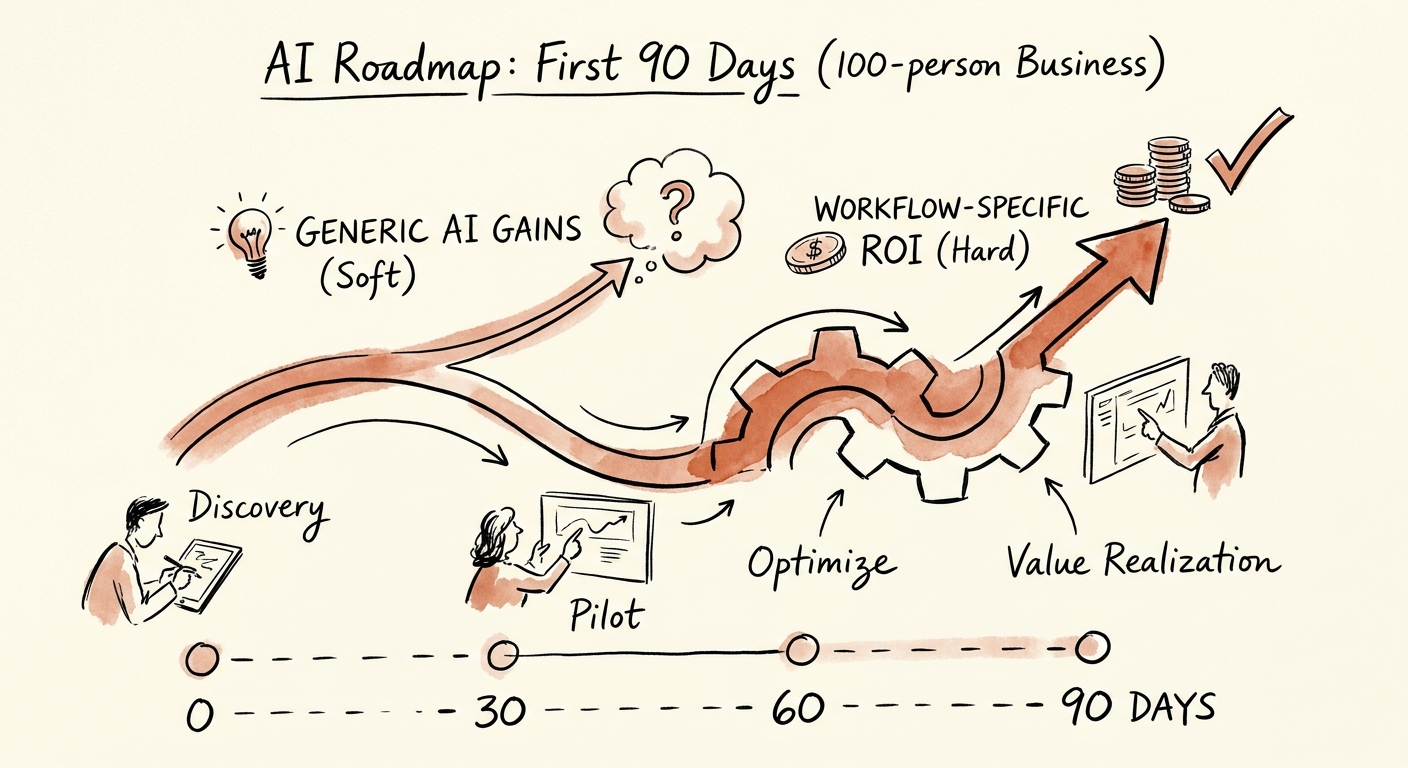
That is the actual starting condition, and it changes what the first 30 days should be. Not a license rollout. Not a vendor bake-off. A census. Walk each function and write down three things: where people are already using AI, what data they are feeding it, and who would notice if the output was wrong. You will usually find the company has more AI in production than the executive team realizes, just none of it governed and none of it measured.
The reason to start here instead of with a tool decision is well documented. Microsoft WorkLab has tracked the rise of unsanctioned, employee-led AI use; PwC's responsible AI research frames the data and approval gaps that creates; and MIT Sloan Management Review's coverage keeps landing on the same split: adoption without governance is a liability, but governance with no real workflow behind it produces nothing anyone uses.
So days 1 through 30 buy you exactly two things: an honest map of what is happening, and one written rule for what is allowed. Pair an acceptable-use policy template with a readiness assessment so the policy is grounded in your real systems, not a generic download.
Days 30 to 60: resist the five department heads
Here is what kills the second month at this size. You have roughly five function leaders, and the moment AI gets executive attention, each one wants their own win. Sales wants research automation, finance wants reporting, ops wants the weekly rollup, support wants ticket triage, the COO wants document intake. Say yes to all of them and you have five half-built pilots, no owner with real skin in any of them, and a quarter from now nothing in production and everyone disappointed.
Pick one. The right one has three traits: a clear input, a review step a human already performs, and a single owner who can tell you on sight whether the output is good or garbage. A 40-person agency might pick proposal drafting because one person reviews every proposal anyway. A 120-person distributor might pick order-document intake because the data is structured and the error is obvious. The point is that the owner becomes your measurement instrument — they already know what "right" looks like, so you do not have to build a quality rubric from scratch.
Before you commit, take a baseline you can defend later: current cycle time, hours of review effort, rework rate, and whatever business number the workflow actually touches. Then design it so the AI prepares the work, the source it pulled from stays visible, and the owner approves the final version. McKinsey's State of AI work, IBM's workflow automation guidance, and Bain's AI insights all point the same direction: the value comes from changing how one operating process runs, not from handing 100 people a general assistant and hoping. If you cannot decide between candidates, rank them with the AI Opportunity Score rather than letting the loudest leader win.
Days 60 to 90: the kill decision is the whole point
Most 90-day plans treat the final month as a victory lap. It is not. It is a verdict. You ask four blunt questions about the one workflow you built: Did review load actually drop against the baseline? Did quality hold or improve? Was anyone still using it a week after the novelty wore off? And did the number the owner cares about move? If the honest answer to those is no, the correct move is to stop, fix the workflow, or swap in a better use case. Scaling a pilot that nobody used after week one just multiplies the problem across the org chart.
If it worked, lock it down so it survives without you. That means a written standard operating procedure, the approved source systems named explicitly, the review and escalation rules in plain language, and the success metric posted where the owner sees it. The test is simple: can this workflow run next Tuesday with no executive in the room? If it needs you to keep intervening, it is a demo, not an operating capability.
For a company this size, a strong 90-day finish is deliberately small: one governed workflow in production, one scorecard, one policy people actually follow, and a short ranked list of adjacent workflows to try next quarter. That is momentum without turning AI into an unmanaged program with five owners and no accountability. Pressure-test the economics with the AI ROI Calculator, and if you want an operator running the path from map to production workflow, look at the 90-Day AI Implementation Sprint.