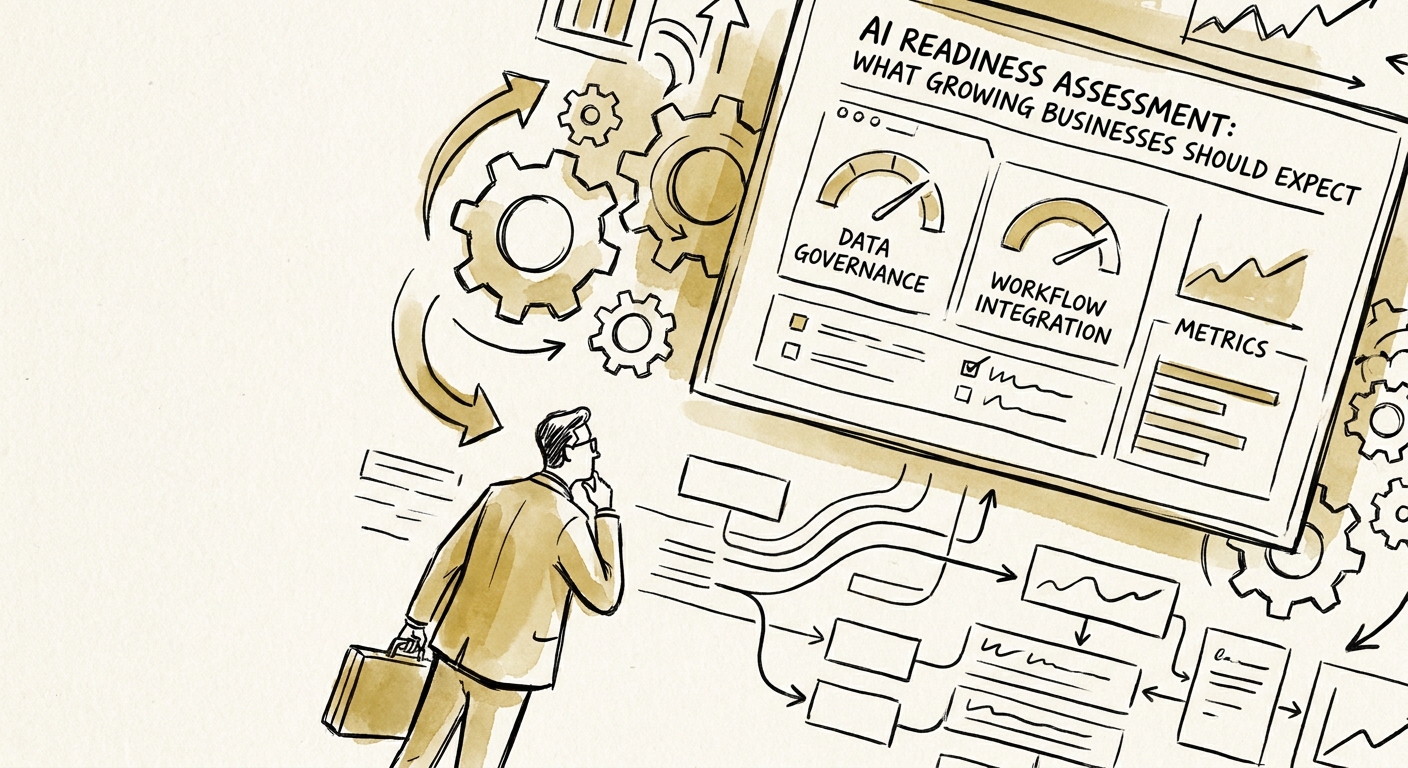
The demo worked. The Tuesday didn't.
Here's the pattern I see in growing businesses, almost word for word. Someone in leadership watches a vendor demo where the AI drafts a flawless proposal in nine seconds. Budget gets approved. Three months later the same tool is producing proposals that quote last year's pricing, reference the wrong client, and pull a paragraph from a template nobody's used since 2023 — and now a senior person is spending more time correcting AI output than they used to spend writing from scratch.
The model wasn't weak. The business pointed a capable tool at scattered documents, undefined ownership, and inconsistent data, then expected it to fix all three. AI didn't break the workflow. It just ran the broken workflow faster and made the mess visible.
That's the gap a readiness assessment is supposed to close. It's not a technology survey. It answers one narrow, expensive question: of everything this company does, which single workflow can be improved safely, measurably, and within a quarter — and which ones will quietly burn the budget if you touch them now? If leadership wants a fast first screen of where the time and margin are leaking, the AI Opportunity Score is a ten-minute starting point. When you need a governed path to that first live workflow, that's the QuickStart AI Audit.
Five things I score before I'll greenlight a single workflow
A readiness assessment isn't a feeling. It's five concrete checks, and a workflow that fails any one of them is not your first project — no matter how good the demo looked.
1. Source quality. Open the folder the AI would actually read from. If it contains three versions of the same template, an expired policy, a deal example with a real client's numbers still in it, and files that should never surface in a search, the AI will faithfully reproduce all of that. Garbage retrieval, garbage output. This is where most assessments end and most projects should restart.
2. Workflow repeatability. Have two of your strongest people do the same task — say, scoping a project — and watch. If they take two completely different paths to the same result, there's no decision logic to hand the AI yet. You have to write down how the good ones think before you can automate the thinking.
3. Data access. The workflow probably needs CRM records, support history, contracts, or finance data. The question isn't whether that data exists — it's which systems can be queried safely today and which need cleanup first. "We have it in Salesforce" and "the AI can use it" are not the same sentence.
4. Review ownership. Name the person — an actual name — who approves the output, handles the exceptions, and decides when the workflow is allowed to expand. "The team" is not an owner. No owner, no launch.
5. Measurement. Do not count saved minutes as cash; saved minutes that get reabsorbed into more meetings aren't a result. Pick the operating number that actually moves: faster intake, fewer rework loops, cleaner forecasts, shorter time to first value. The 8-dimension SMB readiness assessment goes deeper on the broader operating checks, and why AI experiments fail after the demo walks through the exact failure this scoring is built to catch.
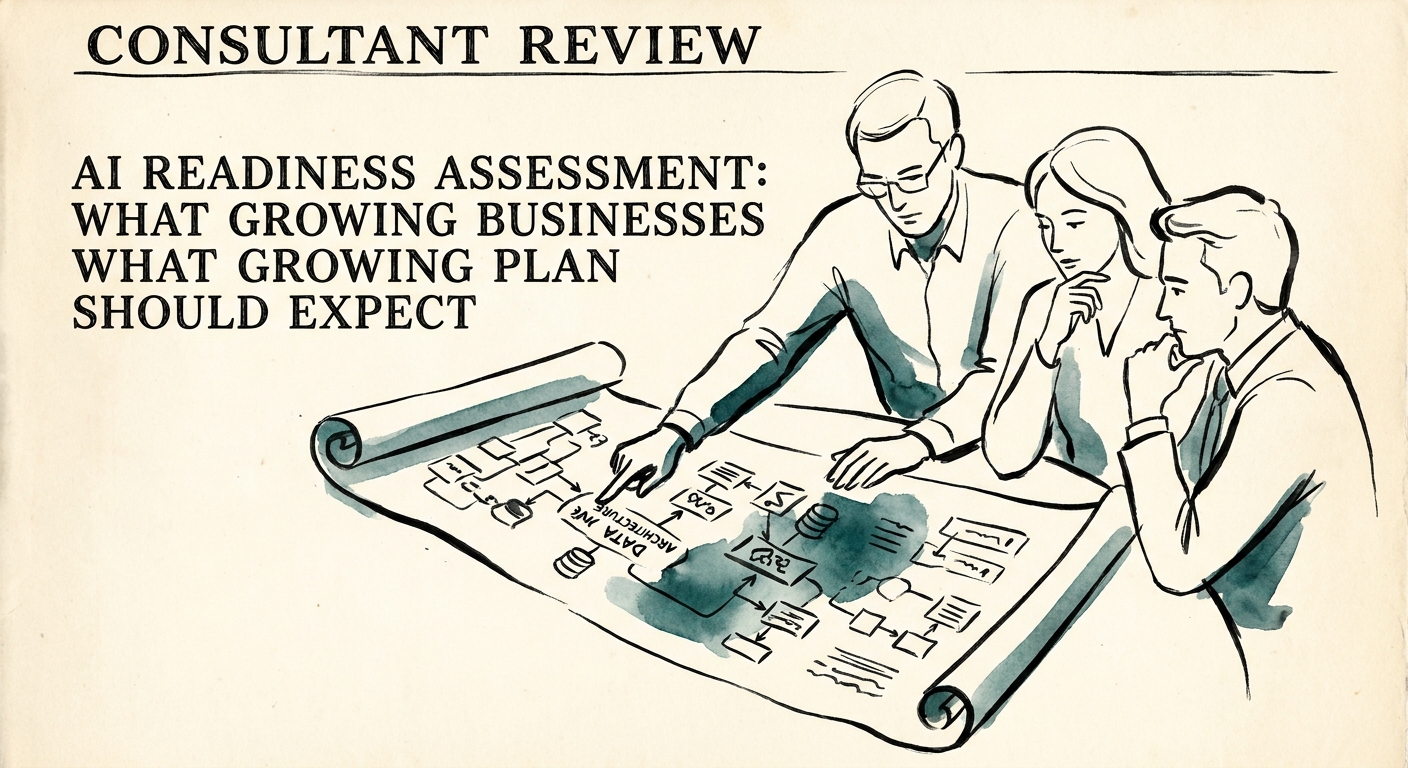
What a good assessment hands you — and what it tells you to leave alone
The deliverable is not a menu of AI possibilities. It's a ranked decision: this workflow first, here's the source material we have to clean before we start, here are the systems in scope, here's the named human review standard, and here's the one number that will prove it worked. If the first project can't be described in those five terms in a single paragraph, it isn't ready for implementation spend — and a serious assessment will tell you that out loud instead of selling you the project anyway.
For most growing businesses, the right first target is boring on purpose: a bounded workflow with clean inputs and a clear owner. Proposal prep, service-desk escalation, customer-feedback synthesis, collections follow-up, sales-call summaries, document intake. Repetitive enough that AI earns its keep, contained enough that one person can govern it.
The part people skip is the "not yet" list — and it's the most valuable page in the document. High-risk customer communication, legal interpretation, personnel decisions, pricing exceptions, anything that changes a live system: these need stronger controls before AI is allowed to act rather than draft. The assessment sequences them. The goal isn't to slow AI down. It's to spend your first 90 days proving one governed workflow end to end, so that when you scale, you're scaling something that works instead of multiplying something that doesn't. Monday's move is the cheapest one: open the folder your AI would read from, and read it the way a stranger would.