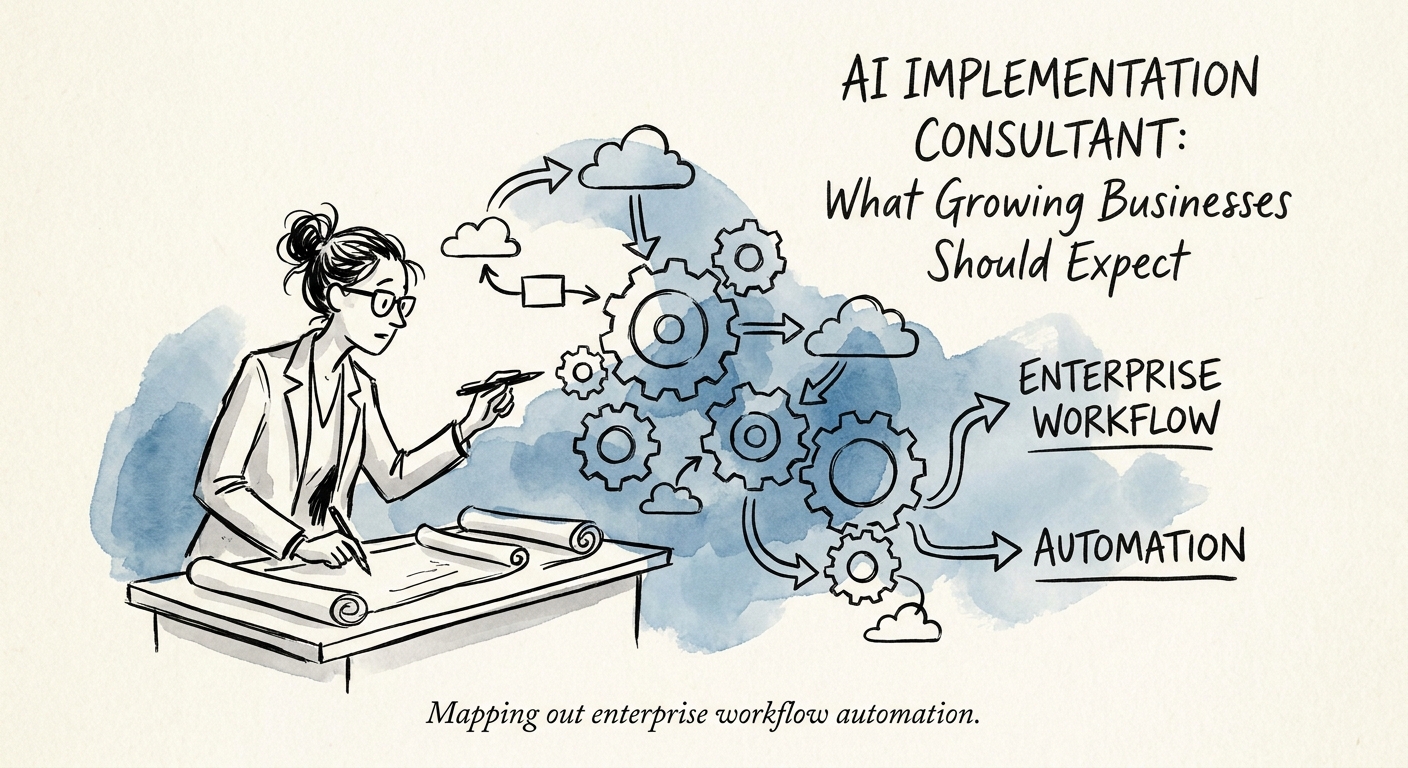
The demo looked incredible. Six weeks later, nobody was using it.
Here is the pattern I've watched play out more times than I can count at growing B2B services firms. A consultant shows up, runs a polished proof-of-concept that drafts a flawless client proposal in eleven seconds, and the room is sold. Money moves. Then the thing gets deployed into the actual business, where the source data is messy, three people have to approve anything that touches a client, and the account managers quietly go back to their old templates because the tool's output needs a fifteen-minute cleanup nobody budgeted for. The capability didn't fail. It was never wired into how the work moves.
The difference between a consultant who sells you a demo and one who installs a working capability shows up in the first conversation. The real ones don't ask "which model do you want to use." They ask how a proposal actually gets built today, who signs off before it leaves the building, where the request sits for two days waiting on someone, and which number your leadership team would point to in a board meeting to say "this worked." If they're not chasing those answers, they're not implementing. They're guessing, and you're paying for the guess.
The published research keeps landing on the same uncomfortable point. McKinsey's State of AI research, the IBM Institute for Business Value, and PwC's responsible AI work all point to the same thing: the value lives in adoption, governance, and operating discipline — not in the model. A consultant who skips those conditions can build you something genuinely impressive that changes nothing about your business.
The plan should name eight things, or it isn't a plan
An implementation plan you can actually hold someone to fits on a page or two and answers eight questions in plain language. (1) Which single workflow are we changing — named, not "operations." (2) What's the baseline metric today, measured before we start, not estimated. (3) Where does the data come from, and is it trustworthy enough to build on. (4) What systems does this have to connect to — your CRM, your ticketing tool, your accounting stack. (5) What are the security and permission constraints. (6) Who approves the exceptions when the AI gets it wrong. (7) Who owns the thing after the consultant leaves. (8) What's the explicit rule for moving it into production — and what we're deliberately not automating. That last one matters more than people expect: clear limits are how you stop scope creep and how you keep your team from rejecting the tool the week after launch.
For a services business specifically, the first workflow should be narrow enough to govern and valuable enough that someone notices. Proposal drafting, account research before a renewal call, support-ticket triage, collections follow-up, onboarding documentation for new clients, internal knowledge search so a junior person can answer a question without interrupting a senior one. Pick one. Each of these has a number attached — turnaround time, win rate, days-to-collect — that you can measure before and after without inventing anything.
Then force the sequencing. Use a 90-day AI implementation plan as the clock. The first stretch validates readiness and locks the workflow. The middle stretch builds or configures one controlled pilot — not five. The final stretch trains the people who'll actually use it, watches whether they do, hardens the governance, and makes an honest call on whether it earns the right to scale. Ninety days is long enough to prove something real and short enough that you can't hide a failure in it.
How to tell judgment from fluency in the room
Anyone can talk about AI now. What you're actually screening for is operating judgment, and you find it by asking what happens when things break. How do they handle source data that's half-wrong? What's their move when adoption is low six weeks in? How do they design permissions so the tool can't surface a client record the wrong person shouldn't see? How do they catch a confident wrong answer before it goes to a customer? The consultant you want is the one who'll tell you a use case isn't ready and walk away from the easy fee. Say a 60-person agency wants AI writing client-facing strategy decks on day one — the right answer is "not yet, here's the unglamorous data and approval work that has to come first," not a contract.
Then make the economics say their name out loud. Not "hours saved" — that's the phrase that hides a weak case. Real numbers: software cost, configuration, integration time, data cleanup, the human review time the tool still requires, and ongoing maintenance after launch. Set that against a metric your leadership already trusts and already watches. If saving ten hours a week doesn't connect to a faster billing cycle, more proposals out the door, or a senior person freed for client work, the savings are theoretical and the ROI case is hollow.
Run the math yourself before you sign anything with the AI ROI Calculator, and when you've genuinely got a governed workflow ready to build, move into the 90-Day AI Implementation Sprint. The test of a good implementation consultant is simple: when they leave, you own a working capability and the people who run it — not a tool you can't maintain and a dependency you can't end.