The deck that costs $40,000 and changes nothing
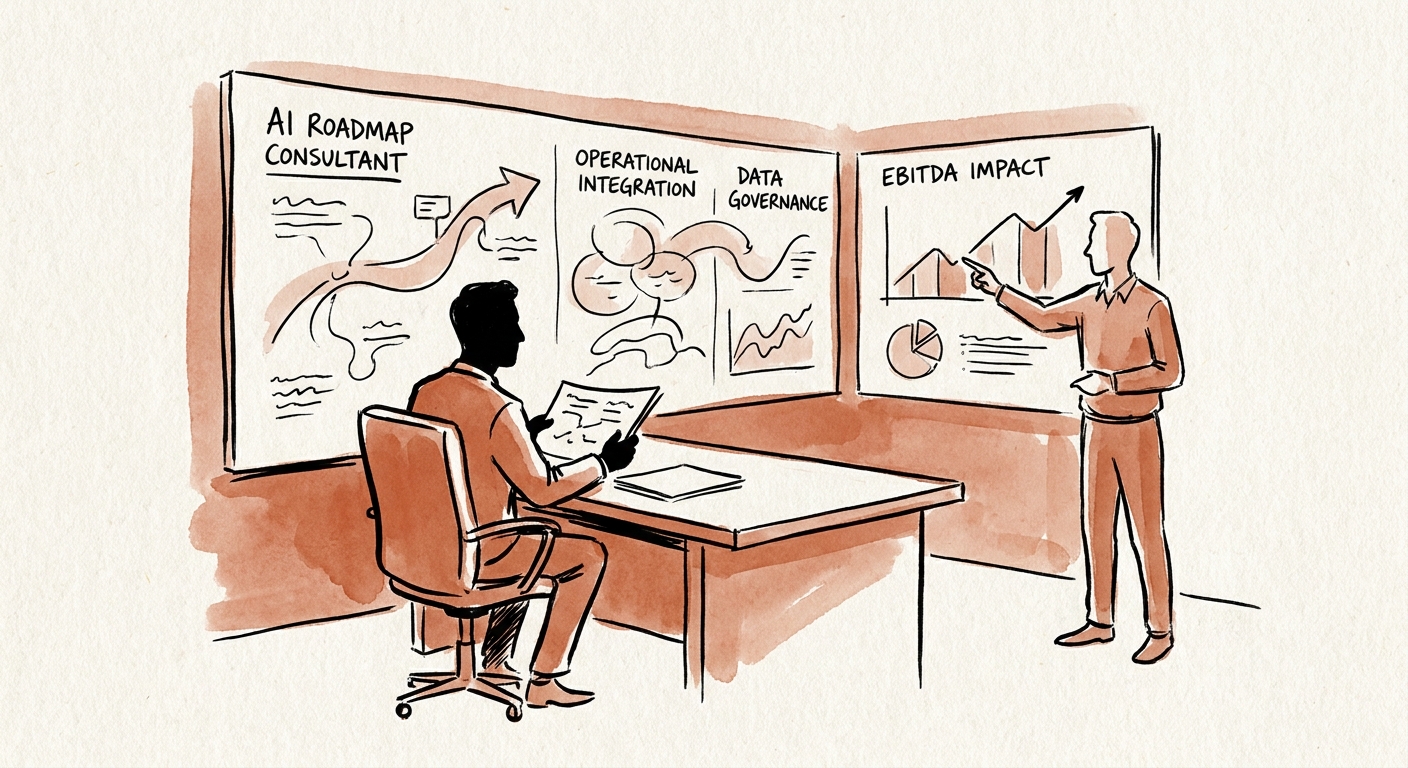
Here is the failure mode every growing business should recognize. You hire an AI roadmap consultant. Six weeks later you get a forty-slide deck: a maturity curve, three "horizons," a list of eleven use cases color-coded by impact and effort, and a quadrant chart with your logo in the top-right corner. It reads beautifully. Leadership nods. And then nothing happens, because nobody can answer the only question that matters: which workflow do we touch first, who owns the output, and how will we know it worked?
That gap is not a presentation problem. It's the difference between strategy and a plan. Research from McKinsey's State of AI work, the IBM Institute for Business Value, and the PwC Responsible AI survey keep landing on the same uncomfortable point: the value comes from redesigning the work, assigning someone to own the result, getting people to actually use it, and putting controls around it. Model access is the cheap part. A consultant who spends your engagement choosing between vendors and skips the workflow redesign has sold you the easy 20% and left the hard 80% on the table.
Five questions that separate a roadmap from a wish list
You don't need to be technical to vet this. You need to make the consultant defend their sequencing in the language of how your business actually runs. Run these five tests on whatever they hand you:
1. Can they name the first workflow — and why it's first? Not a category ("customer service"), a workflow: "the inbound quote requests that sit in a shared inbox until someone has time to triage them." A defensible first pick has visible pain, source data that doesn't move around, a human who already owns the review, and a measurable cycle time. If everything is "high priority," nothing has been prioritized.
2. Did they inspect your systems, or just interview your executives? A real diagnostic looks at where the data lives, who has permission to see it, what the exception rules are, and where one team hands off to the next. The NIST AI Risk Management Framework is useful here precisely because it treats risk as something you map, measure, and manage continuously — not a checkbox you tick once at launch. If the roadmap never mentions your permission model or your handoff points, it was written from the outside.
3. Did they tell you what to fix before automating? Some of your processes aren't ready. The honest consultant will point at a workflow and say "clean up the intake form first — half these fields are free text and AI will faithfully summarize garbage." A roadmap that automates a broken process just makes the breakage faster.
4. Does each item have an owner and a metric? "Reduce manual effort" is not a metric. "Cut quote turnaround from two days to four hours, owned by the ops lead" is. Every line should name a person and a number.
5. Did they show you a workflow-level scorecard before recommending a platform? The order matters. The scorecard — where AI can safely summarize, classify, draft, route, or retrieve, and where it can't yet — comes first. The tool recommendation falls out of that. If the platform pick came first, the roadmap was reverse-engineered to fit a vendor relationship.
Start small, on purpose, and earn the right to scale
Say you're a 60-person services firm and the roadmap surfaces a tempting idea: an agent that handles inbound customer questions end to end. Resist it as a starting point. Bain's research on agentic AI transformation is a useful reality check — agents need real operating design around their tools, permissions, monitoring, and what happens when they hit an exception. That's a second or third move, not a first one. Your first workflow should produce a reviewable queue a human signs off on, so you learn how AI behaves on your data and your edge cases before you let it touch anything customer-facing or revenue-sensitive.
The practical move before you commission a big roadmap: prove the sequencing logic on one workflow first. Run the AI Opportunity Score to pressure-test which workflow earns the first slot, or a short QuickStart AI Audit to confirm the data and ownership are real. When leadership genuinely needs the wider plan, that's when an AI Transformation Blueprint is worth the spend — because now it's anchored to something you've already watched work, not a quadrant chart with your logo on it.