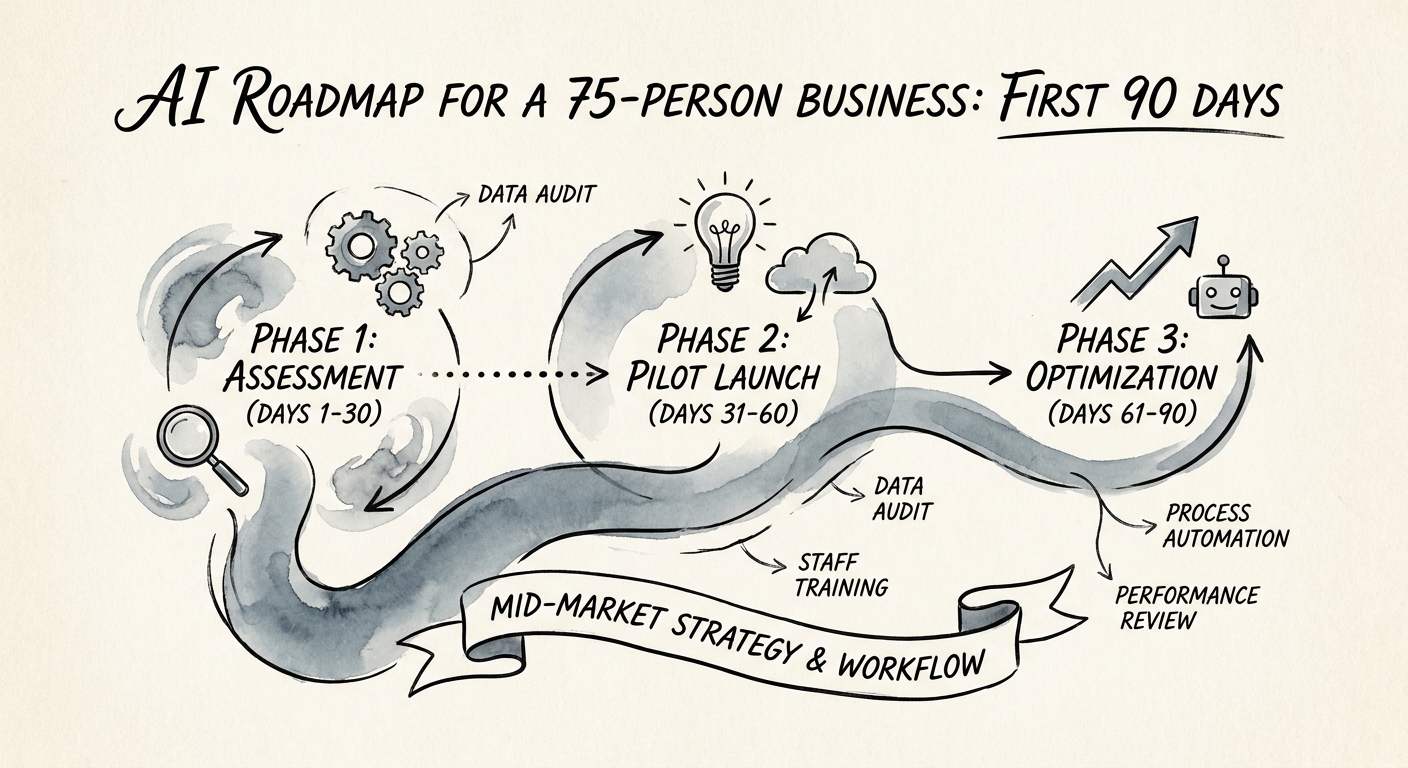
The 75-person trap nobody warns you about
Seventy-five people is the worst possible size to do AI badly. At fifteen, someone just opens ChatGPT and figures it out — if it breaks, three people notice. At five hundred, there's a platform team, a data lake, and a budget line that absorbs a few false starts. At seventy-five you have neither. You have four department heads who each bought a different AI tool on a company card, no one who owns "how we use this," and a founder who keeps getting asked for a roadmap they don't have time to build.
So the roadmap you actually need is not a tour of the vendor landscape. It is a funding sequence: which single workflow gets redesigned first, and how you'll know it worked. McKinsey's State of AI research and the IBM Institute for Business Value keep landing on the same unglamorous point: the value shows up when you redesign the work and connect the data, not when you adopt the model. At your size that means picking a workflow small enough that one person can own it end to end — intake, triage, draft, handoff — and refusing to start anywhere else until that one pays off.
Rank the work, then watch the second column
Here's the ranking exercise that takes an afternoon and saves you a quarter. List your repeatable workflows down the left — the things that happen the same way every week. Then score each on five columns: how much pain it causes, how clean the underlying data is, how much damage a wrong answer does, how easy it is for a human to catch that wrong answer, and the dollar value of fixing it.
The mistake at 75 people is sorting by the pain column. The workflow everyone complains about is usually the one with the messiest data and the highest blast radius — say, a customer-facing quote that's wrong 8% of the time and costs you a deal. Sort by the second and fourth columns instead. The best first workflow is boring: high-volume, clean inputs, an output a human reviews before it leaves the building. An internal first-draft of a proposal beats an autonomous email responder every time, because when the draft is wrong, your AE catches it in ten seconds and nobody outside the company ever sees it.
Bolt governance onto that same first phase — don't schedule it for "later," because at your size later is when the habits have already hardened. The NIST AI Risk Management Framework gives you the four verbs to run against your one workflow: map it, measure how it behaves, manage what goes wrong, govern who's accountable. For a 75-person company that collapses to five lines on a page — workflow owner, data owner, reviewer, the one exception rule, the one weekly number. The PwC Responsible AI survey makes the timing case: permissions, customer-data boundaries, and approval rules are cheap to set when one team uses one tool, and expensive to retrofit once five teams use nine.
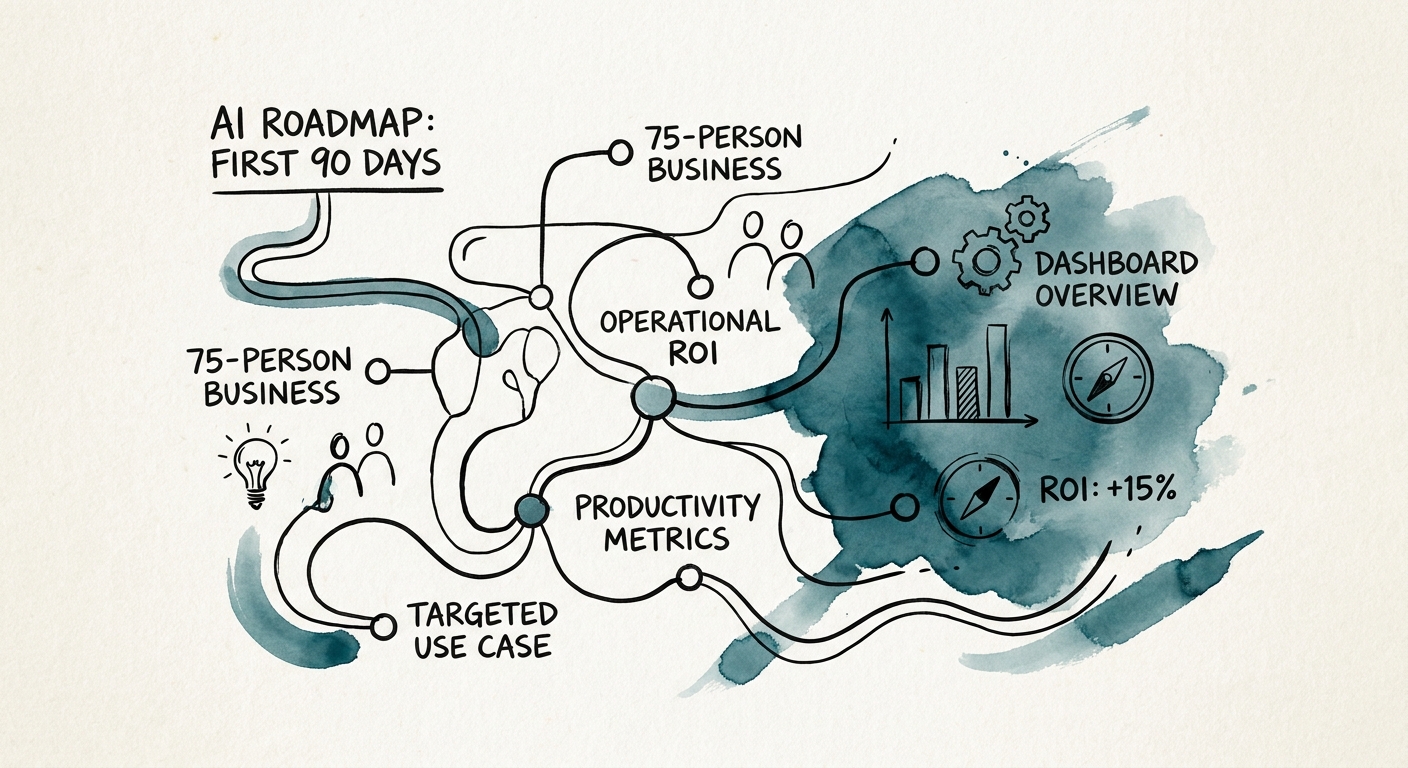
One funded workflow buys the right to the second
Resist the agent. The pitch you'll hear is an autonomous system that runs a whole function while you sleep, and Bain's agentic AI research is blunt about the price of that ambition: real agents need tool access, scoped permissions, live monitoring, and exception handling — an operational apparatus a 75-person company does not have lying around. Begin with the constrained version. A bounded workflow that produces a reviewed output, used daily by the team that owns it, gives you the one thing your next phase actually requires: proof that adoption stuck.
That's the whole roadmap at this size — one workflow funded, run for 90 days, measured against the one number you picked. If usage holds and the metric moves, you've earned the budget and the credibility to redesign the next workflow. If it doesn't, you've spent one quarter and one tool instead of a year and a platform. On Monday, open a doc and write your five-column table for the dozen workflows you can name from memory.
Use the AI Opportunity Score to rank those candidates fast, then reach for the AI Transformation Blueprint once your first workflow has proven it deserves a successor.