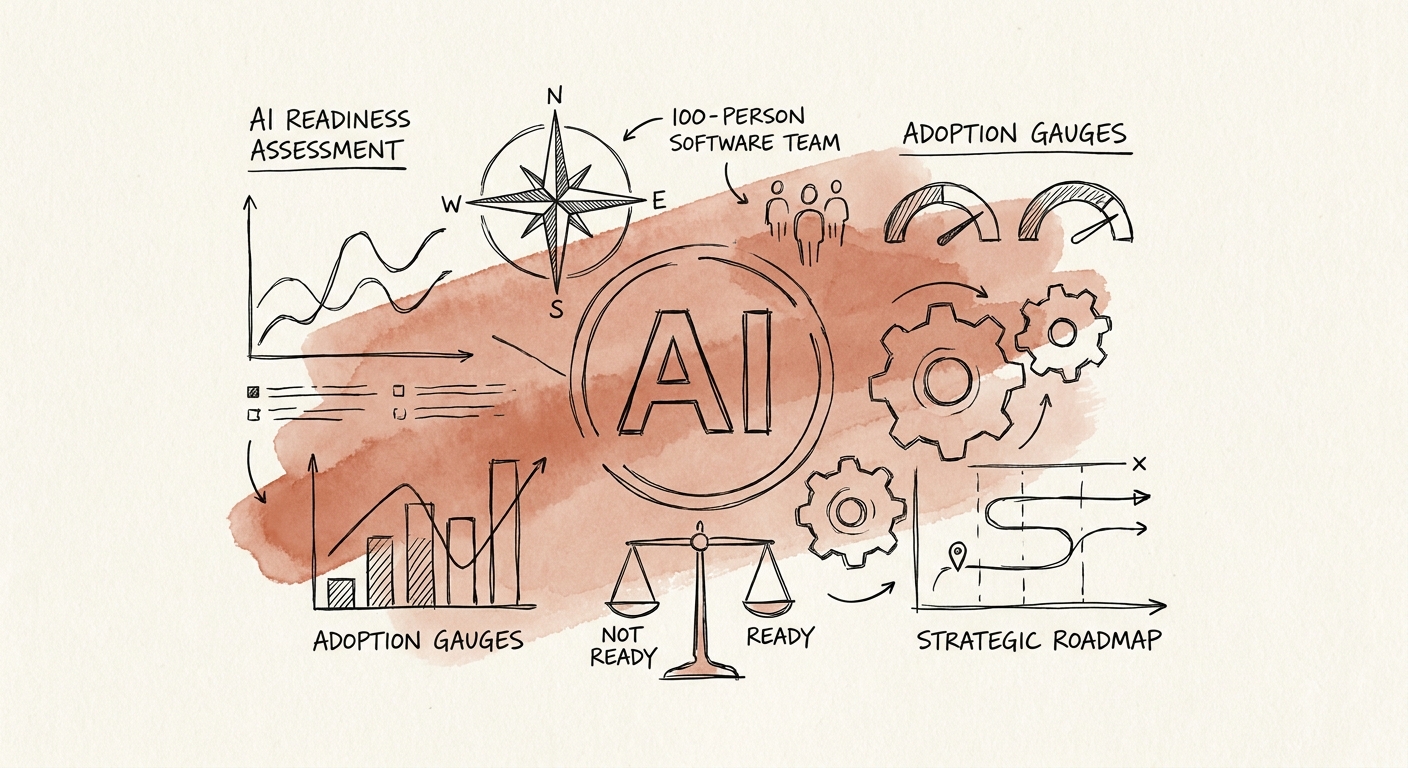
Your readiness problem isn't the model — it's that every client is a different room
Picture a 100-person implementation shop running, say, forty active client environments at once. The senior consultant who knows how Client A's integration was wired is on a flight; her configuration notes live in a ticket thread, a shared drive folder, and her head. A junior wants to ask an AI assistant "how did we handle the SSO mapping for this kind of deployment?" — and the honest answer is that the assistant has no clean way to know which client's pattern it should pull, or whether it's even allowed to look.
That is the readiness question for an implementation partner, and it is not "which model is best." It's whether a given workflow has a stable, owned source that respects the wall between one client's data and the next. The RSM middle-market AI survey and the San Francisco Fed analysis of AI and small businesses both point at the same gap: adoption stalls when AI isn't tied to the actual mechanics of everyday work. For you, the everyday work is multi-tenant by nature.
So before scoring tools, score each candidate workflow on four things: does it draw from a stable source, does it have a named owner, does it produce a measurable outcome, and does it have a review point? Project-status notes, ticket triage, config documentation, knowledge search, quote support, onboarding — rank them on those four, not on how impressive a demo looks. The eight-dimension readiness assessment gives you the full scoring rubric to run your top candidates through.
The data boundary is the thing that ends careers, so design it first
Most businesses adopting AI worry about a bad answer. An implementation partner has a sharper failure mode: the assistant that helpfully drops Client A's network diagram, retention terms, or admin credentials into a deliverable headed to Client B. That's not an embarrassing chatbot answer — that's a breach notification and a churned logo.
This is why CISA's AI Data Security Best Practices belongs at the front of your design, not the compliance appendix. You handle client configurations, tickets, data mappings, access notes, and timelines across dozens of tenants. Any AI workflow has to inherit your existing permission model — if a consultant can't see Client B's drive today, the assistant working on their behalf can't either. Practically: per-client source isolation, retrieval scoped to the engagement the user is staffed on, and retention rules that match what's in the statement of work.
The NIST AI Risk Management Framework gives you the operating spine for this: define the context, measure the risk, manage the controls. Translated for delivery ops, that's a defined set of sources per engagement, a named reviewer before any output reaches a client, output logs you can hand to a security questionnaire, and an exception path for the edge case. Start everything internal. An assistant that drafts internal status notes can ship Monday; an assistant that touches client-facing artifacts earns that privilege only after the boundary holds under testing.
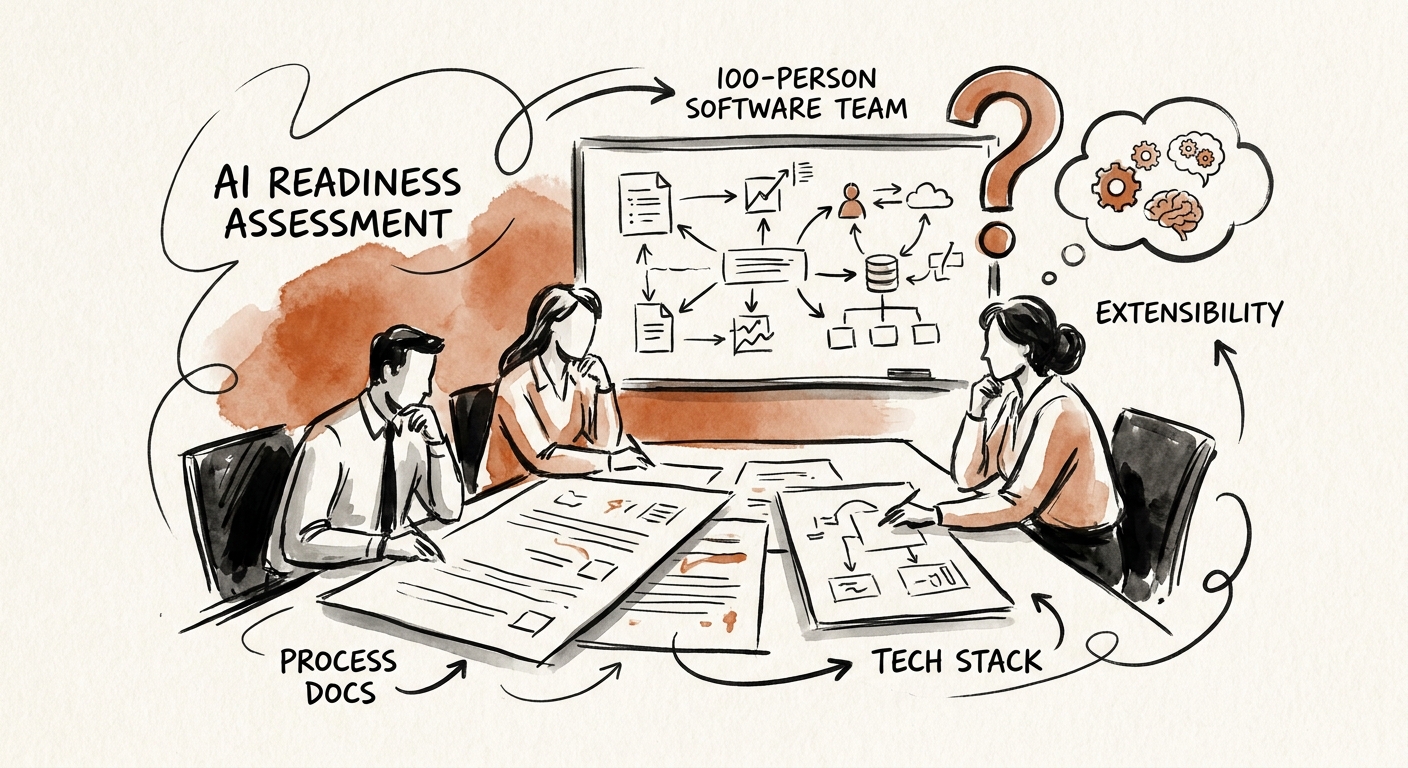
Pick one workflow you can prove in 90 days — make it the boring one
Deloitte's State of AI in the Enterprise 2026 keeps hammering one point: the value shows up when AI moves out of pilots and into managed production. At 100 people you don't have the slack to run six experiments. Pick one workflow narrow enough to launch and measure inside a quarter, and resist the urge to make it the flashy client-facing one.
The best first bet for an implementation partner is usually the workflow that already eats your senior people's evenings: turning a week of ticket activity and project notes into a clean client status report. It's internal until you choose to send it, the source data is yours, the boundary risk is contained to a single engagement, and the time savings are obvious to measure. Other strong candidates: service-desk escalation triage, implementation QA packets, and internal knowledge search across past deployments. Whichever you choose, instrument it from day one — cycle time, rework rate, adoption among the team it's for, and the reviewer's burden. If the reviewer ends up rewriting every draft, you don't have a workflow, you have a second draft generator.
That instrumented first workflow is what turns a readiness score into an operating decision. The 90-day implementation plan walks the steps from a scored candidate to a governed, measured workflow your delivery org actually keeps using.