Your readiness data is already sitting in your SOWs
Walk into most 150-person software implementation firms and the AI conversation starts in the wrong room. Someone has booked a platform demo, and now every practice lead is being asked to "bring use cases." Two weeks later you have forty ideas, no owner, and a renewal quote for seats nobody scoped. Meanwhile the actual readiness signal — the thing that tells you where AI will pay — is sitting untouched in your statement-of-work library, your project retrospectives, and your utilization reports.
Implementation partners are a specific animal. You don't sell your own software; you deploy someone else's, against a fixed scope, on a billable clock, inside a client's environment you only half control. That shapes where AI helps. The repeatable pain isn't "write marketing copy." It's the consultant who spends Thursday afternoon turning discovery notes into a requirements doc, the PM reconciling change-order scope against the original SOW, the deployment lead drafting the same configuration runbook for the fifth client this quarter. AI use is already climbing fastest in firms your size — the Census Bureau's May 2026 review puts it at 32% of firms with 100 to 249 employees. The question for you is narrower than "should we adopt AI." It's: which of these recurring delivery tasks has clean input documents, a frequent enough occurrence to matter, and a lead who can own the output?
Score the workflow, not the demo
Here's the readiness scorecard I'd hand a delivery COO. Take your top eight recurring delivery workflows and rate each on four axes. Source quality: does the work start from structured material — SOWs, ticket history, vendor config templates — or from a client conversation nobody wrote down? Permission sensitivity: does it touch client PII, contract terms, or production credentials? Review burden: how much human checking does a wrong answer require, and who does it? Economic value: does fixing it move billable utilization, gross margin per project, or rework hours — or just feel nice? The OECD's SME work is blunt about why this matters: adoption lives or dies on data readiness, skills, and management capability, not model access. The firms that turn AI into operating leverage run implementation as a management system.
Run the scorecard and the winner usually isn't the flashy client-facing chatbot. For an SI partner it's frequently the internal one: drafting the first-pass requirements document from discovery notes, or generating the deployment runbook from the vendor's config and the SOW. High source quality, contained permissions, a delivery lead who already reviews this output anyway. Then put guardrails on it before you connect anything. Use the NIST AI Risk Management Framework to draw the line between low-risk drafting and anything that changes a client commitment without sign-off. Use CISA's AI data security guidance to keep client environments, contracts, and credentials inside logged, access-controlled systems — non-negotiable when half your work happens in tenants you don't own. The output of this exercise is a ranked backlog, a named governance owner, and a 30-60-90 plan. Not a wall of clever prompts.
The gap between a good demo and a moved margin number
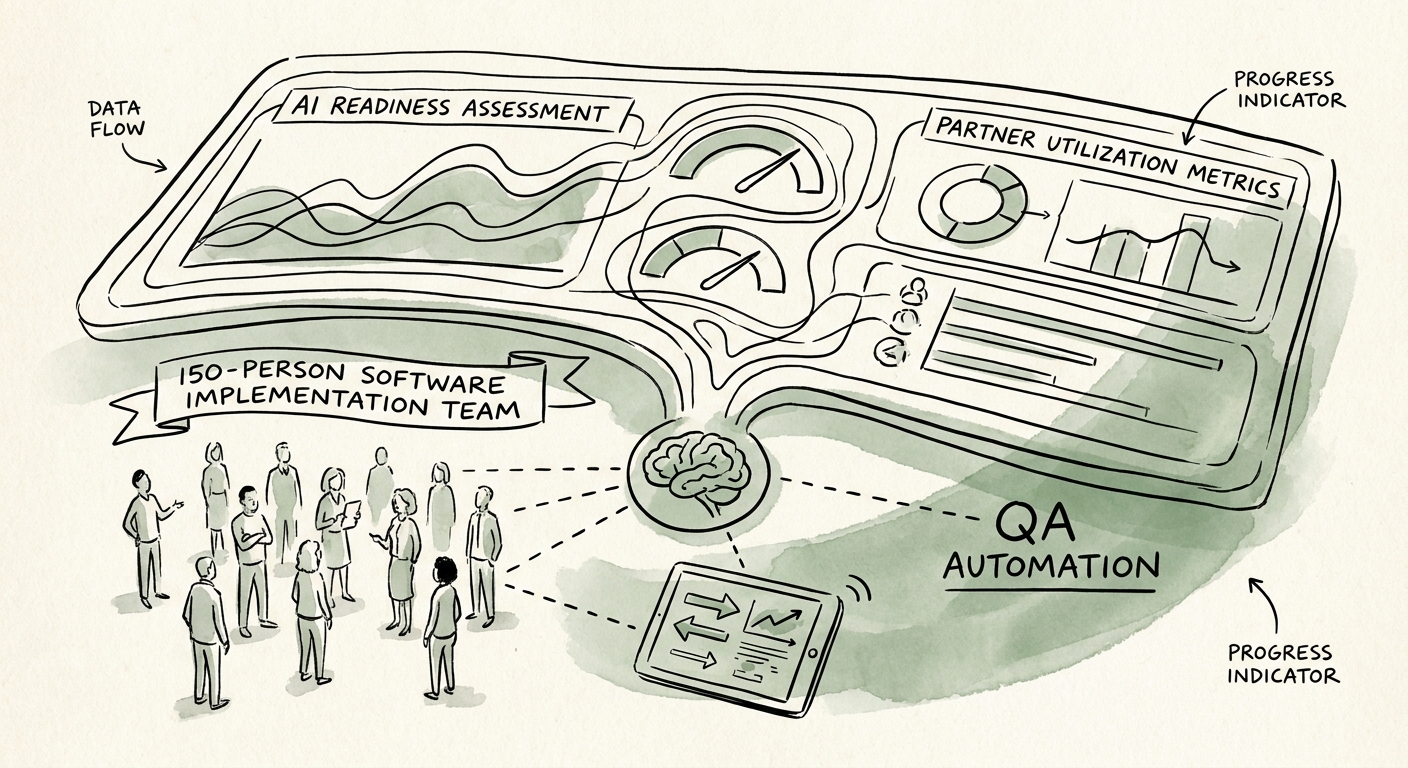
This is where most implementation partners stall, and the data says so. Deloitte's 2026 State of AI research found only a quarter of leaders had moved 40% or more of their pilots into production. The reason is rarely the model. It's that nobody captured a baseline before the demo dazzled everyone. So before your requirements-drafting pilot writes its first paragraph, write down the numbers it has to beat: hours from discovery to approved requirements doc, rework rate when the client sends it back, consultant hours reclaimed for billable work, and the exception path when the draft gets something wrong. Say a 150-person shop running 30 active projects shaves three non-billable hours off requirements drafting per project — that's real recovered utilization you can defend in a partner meeting. Without the baseline, you just have a tool people like and no proof it changed the P&L.
Keep the first production workflow narrow, governed, and visible enough that leadership learns from it in real time. We use the pilot-to-production distinction to stop teams from mistaking a good demo for an operating change. From there, the AI Transformation Blueprint turns that first readiness assessment into a sequenced roadmap across knowledge systems, workflow automation, governance, and the ROI math that survives a budget review. Start Monday: pull your last ten SOWs and ask which delivery task you'd most like to hand to a junior who never gets tired. That's your first candidate.
