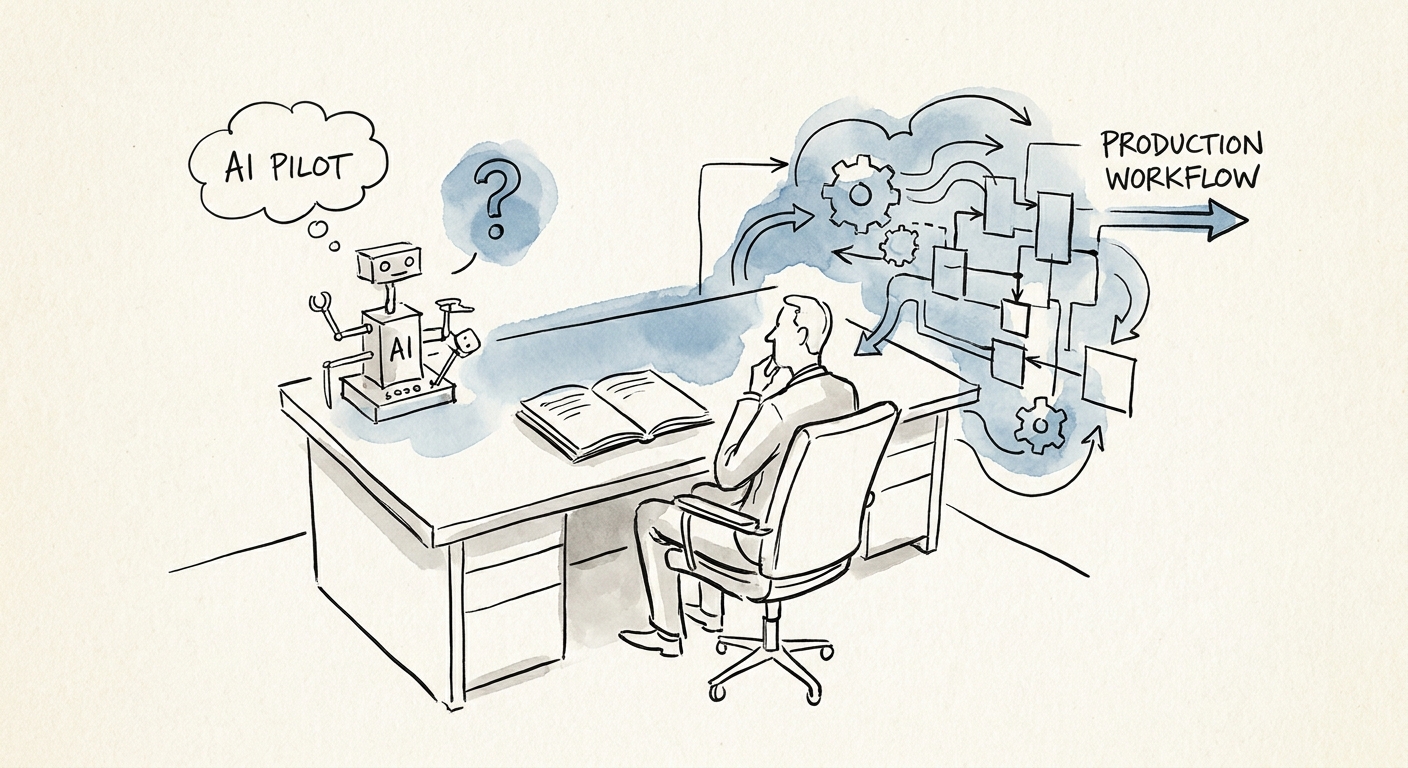
The pilot worked because you weren't really testing it
Picture a 40-person services firm. Someone in operations wires up an AI tool to draft client responses, feeds it a dozen clean examples, and the demo lands. Leadership sees it, nods, says "roll it out." Three weeks later support tickets are up, two clients have gotten confidently wrong answers in writing, and nobody can say who approved the output that went out the door.
Nothing failed in the model. What failed is that a pilot and a production workflow are different animals wearing the same coat. The pilot ran with one motivated person, a handful of records they personally vetted, and the freedom to quietly fix anything weird before anyone saw it. Production strips all three away. Now it's twenty people, the messy back-half of your CRM, customers applying pressure, and a manager who has to defend the output in a review.
The RSM middle-market AI survey shows adoption momentum is real across the mid-market — but momentum is not the same as a workflow that holds. The question that separates the two isn't "can the model produce a good answer." Of course it can; that's why the demo worked. The real question is the one nobody asked in the demo: who owns this the moment the answer is incomplete, risky, or flat wrong? If the honest answer is "the one person who built it," you don't have a workflow. You have a pilot with a wider blast radius.
The seven things that have to exist before you flip the switch
Before you widen access, run the rollout through a readiness gate. Not a meeting — a checklist someone has to actually clear. Seven items, each answering a question that only matters once real people are using it:
- An evaluation set. Twenty-to-fifty real cases with known-good answers, so you can measure quality instead of vibing it. The pilot skipped this because the builder eyeballed every output.
- Source permissions. The tool should only see data it's allowed to see. In the pilot it had whatever the builder had access to. That doesn't generalize to a sales rep who shouldn't see finance records.
- Output review rules. What gets sent automatically, what needs a human glance, what's blocked entirely. Write it down before someone improvises it.
- Logging. Who used it, what it suggested, what got accepted or rejected. Without this you can't learn from mistakes and you can't prove what happened when a client complains.
- A rollback path. How you turn it off in an hour, not a week, when something's wrong.
- A named support owner. One person whose job is "when this breaks, you call me." Not a committee.
- A value measure leadership can inspect. One number — hours saved, response time, error rate — that someone reviews after month one.
The tell that you're not ready: users are doing manual workarounds. They copy data by hand, ask a manager where to save the output, or invent their own review step because none was given. A pilot tolerates that. Production cannot — every manual workaround is an undocumented process that breaks the moment the person who invented it is out sick. The OECD SME AI adoption report draws the line cleanly between casual experimentation and core business use. That line is exactly this: when the system becomes part of how work actually moves, the boring controls stop being optional.
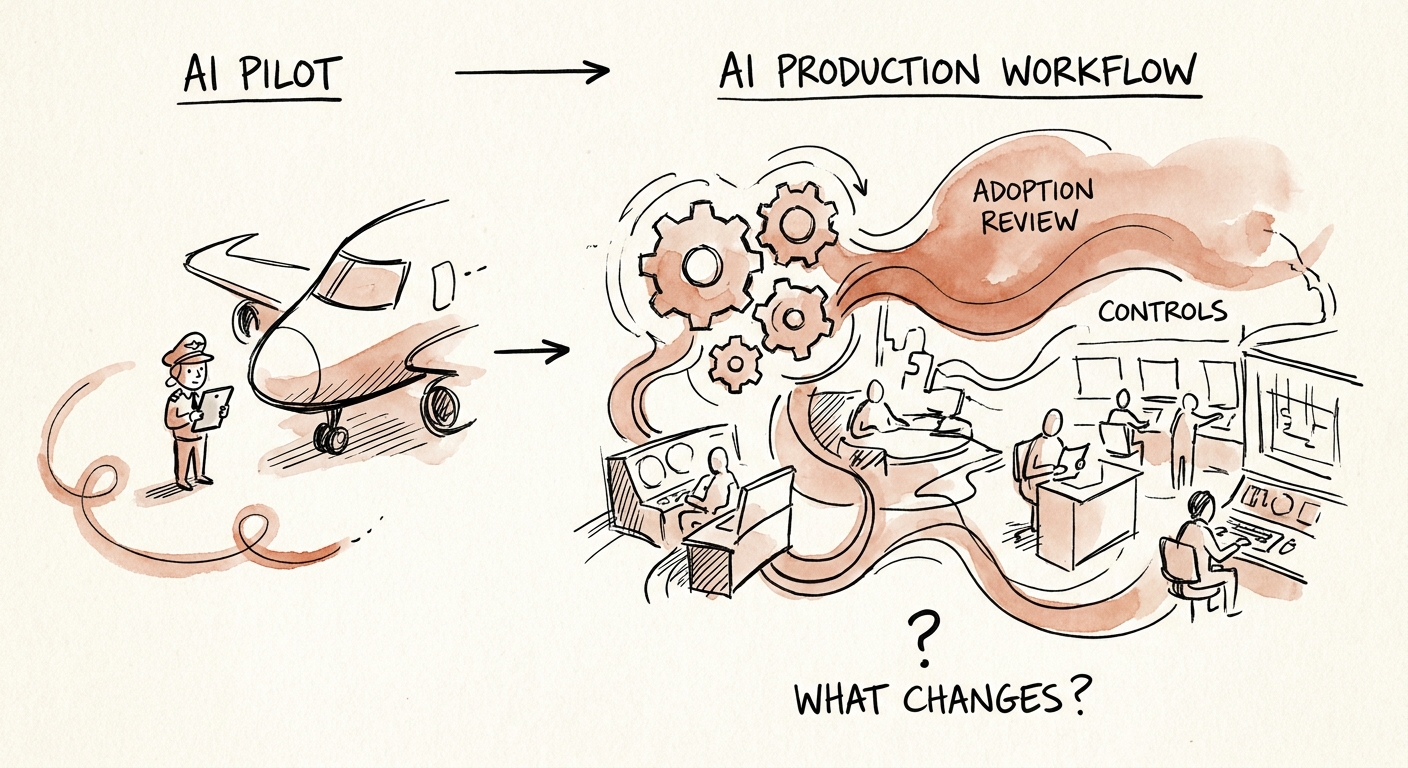
The first ninety days are where pilots quietly die
Gartner forecasts that over 40% of agentic AI projects will be canceled by 2027 — and most of them won't die from a dramatic failure. They'll die from drift: nobody watching, exceptions piling up, adoption quietly cratering until someone notices the tool hasn't been used in a month. The fix is unglamorous and it's a cadence, not a launch event.
Run it on the clock. Every week for the first month: review the exceptions, sample a batch of outputs, count accepted versus rejected suggestions, and check who's actually using it. Define your stop conditions before launch, not after the first bad client email — what error rate or adoption floor means you pause and fix. At thirty days, ask one question: is this being used the way it was designed? At ninety, ask the harder one: scale it, change it, or kill it? The Deloitte State of AI report flags a common trap — organizations bolt AI on without changing the underlying process. These controls are how you prove the process actually changed: the team knows the new steps, managers can point to evidence, and leadership sees a result instead of a story.
If your demo is promising but the operating model around it is still blank, that's the gap to close — and it's a fixable one. Our 90-Day AI Implementation Sprint exists to turn a working demo into a workflow that survives Tuesday: the owners, the controls, the review cadence, the recovery path. The same implementation discipline that unblocked a $3M stalled initiative in 30 days is what gets a pilot across the line into production. When the demo impresses, move from pilot to production deliberately — not by flipping a switch and hoping.