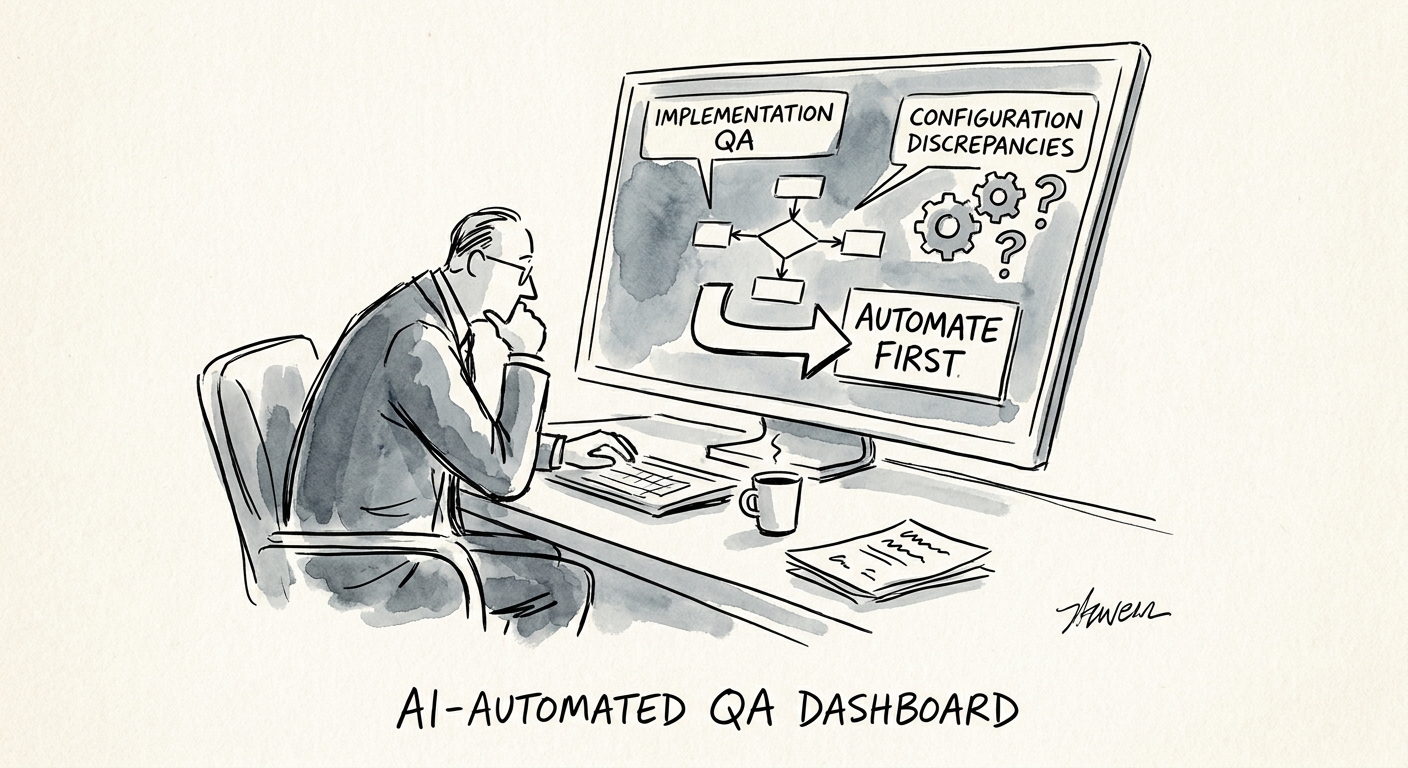
The defect you pay for twice
Picture a 60-person managed-services shop on a Thursday. An implementation lead marks a customer onboarding "complete," it ships, and three days later the client emails: the SSO config was never applied, the runbook is missing two steps, and the agreed reporting cadence isn't set up. Now you're doing the work a second time, the project manager is on an apology call, and the renewal conversation just got harder. Nobody was negligent. The deliverable just went out the door without anyone cross-checking it against what was actually promised.
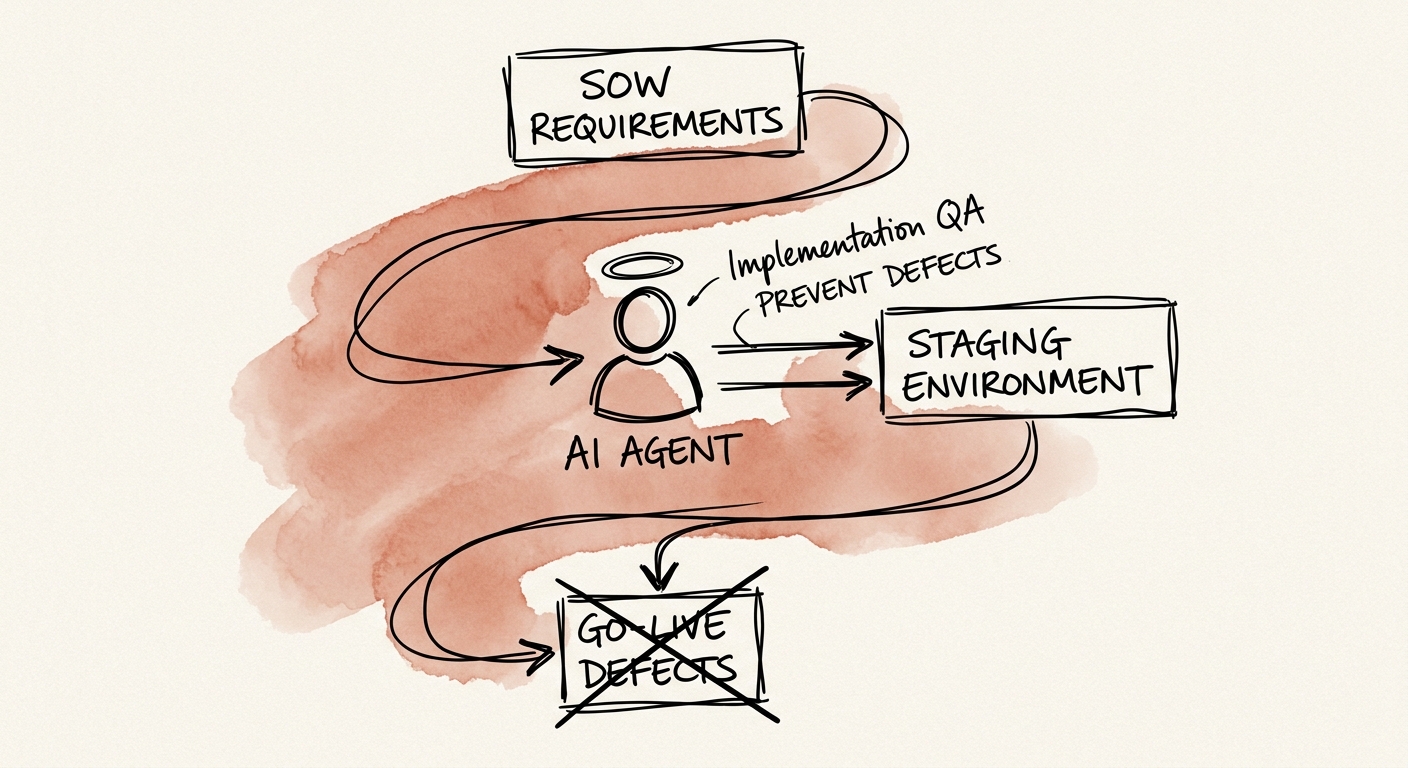
That is the cleanest first target for AI in a delivery organization, and the reason is specific: implementation QA is one of the rare delivery tasks where the answer key already exists. The statement of work, the acceptance criteria, the configuration checklist, the recurring "things we always forget" list — those are written down. AI is good at the boring, high-stakes job of reading a completed delivery packet and asking, "Does every line in the SOW have matching evidence in what we're about to send?" It is bad at deciding whether an ambiguous client promise is met. Start where the rules exist; that boundary is the whole game.
This isn't a generic productivity bet. OECD research on AI adoption by small and medium-sized enterprises and Deloitte's State of AI reporting converge on the same point: AI returns value when it's wired into a real workflow with a measurable baseline, not when it's bolted on as a demo. For a delivery team, the baseline is rework hours and escaped defects. Both are countable. Pick one implementation lane — say, the customer onboarding flow you run forty times a quarter — and make that the only thing the QA assistant looks at first.
Build a flagging machine, not an approval machine
The structure that works is narrow and unglamorous. The assistant ingests three things: the requirements source (SOW, acceptance criteria, config checklist), the completed deliverable, and a short list of your known recurring misses. It outputs a QA note with one row per finding: the requirement, the source document it came from, the section of the deliverable where the evidence should be (and isn't), the owner, and why it's flagged. That's it. It never marks anything "approved." A human delivery owner clears or rejects each flag. You are building a machine that says "look here," not a machine that signs off.
Two guardrails keep this safe in a services context, because implementation QA reaches straight into client environments, config files, defect logs, and contractual language. First, scope the data. The CISA guidance on securing data used to train and operate AI systems is the right reference for one decision: which client artifacts the assistant may read, and which stay walled off in the human review path. A QA assistant does not need standing access to every customer tenant to check one onboarding packet. Second, define the flag rules explicitly. The NIST AI Risk Management Framework is useful here for deciding what the assistant is permitted to raise, how a low-confidence flag gets handled, and the line where a finding stops being a QA note and becomes a delivery-owner judgment call.
Then treat the flags as data about your own operation. If the assistant keeps catching the same missing artifact across half your onboardings — the SSO config, every time — the fix isn't a bigger AI deployment. The fix is a better handoff template so that step can't be skipped. The QA layer earns its keep twice: once by catching the defect, and again by telling you which part of your delivery process is structurally broken.
Count escapes, not flags
The trap is measuring activity — "the assistant raised 200 flags this month" — instead of outcomes. The numbers that tell you whether this worked are: QA cycle time per deliverable, the rate of deliverables that reached a client with a missing artifact (your escape rate), accepted-flag vs. rejected-flag ratio, rework hours avoided, and reviewer time spent. A high reject ratio means your flag rules are too loose and you're just generating a new review queue. A falling escape rate with stable reviewer time is the signal that you bought real quality, not theater.
And hold the line on what stays human. When two requirements conflict, or the client's promise was written vaguely on purpose, the assistant should surface the mismatch and draft the note — it should never decide that the project is ready to ship. In delivery, "good enough to send" is a commercial decision with a client relationship attached. That's the owner's call, every time.
So make Monday's move small and real: pick your highest-volume implementation type, write down its acceptance criteria and your three most common escaped defects, and run the QA assistant against the last ten completed deliverables to see what it would have caught. Tie the result back to delivery economics — fewer escapes, faster clean handoffs, less margin bled to rework — the way we lay out in measuring AI ROI without fake savings. If the pilot doesn't move the escape rate, you've learned something cheap. If it does, you've found the workflow to build out next.
