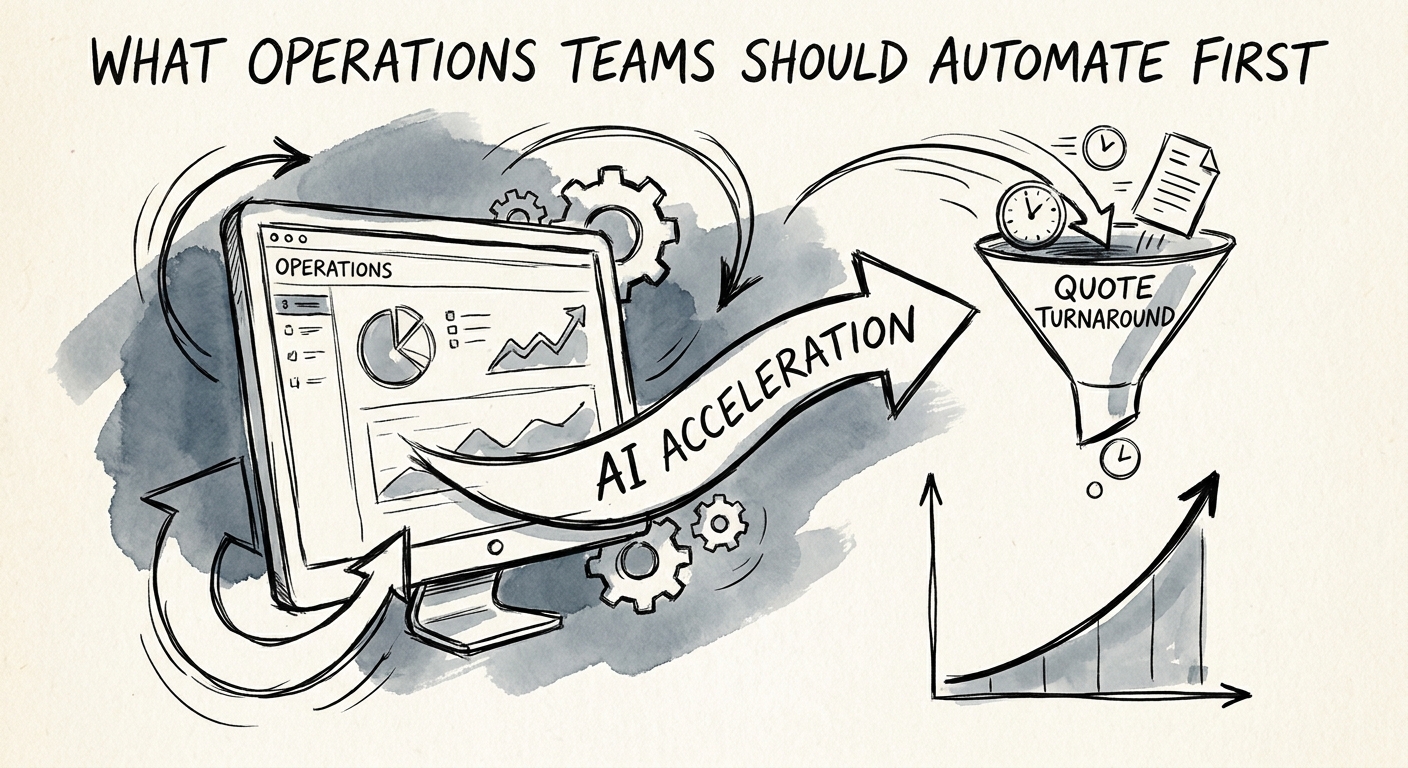
The eleven-hour gap nobody owns
Here is the moment quote turnaround actually breaks. A buyer emails Tuesday morning: "What would 14 seats plus onboarding run us?" The salesperson doesn't know the onboarding tier, isn't sure whether the volume discount kicks in at 10 or 15, and has no idea if the implementation team has capacity in the requested window. So the request sits — in a Slack thread, a forwarded email, a "let me check and get back to you." By the time a number goes out, it's Wednesday afternoon and the buyer has already pinged two competitors.
That gap — request received to price delivered — is rarely a thinking problem. It's an assembly problem. The pricing rule exists. The capacity calendar exists. The discount authority exists. They just live in five different places, and stitching them into one customer-ready answer is exactly the kind of dull, repetitive assembly that AI is good at and humans are slow at. That's why quote turnaround is a stronger first candidate than the flashier stuff: the inputs are knowable, the failure modes are visible, and the win — hours back per request — shows up in the first week.
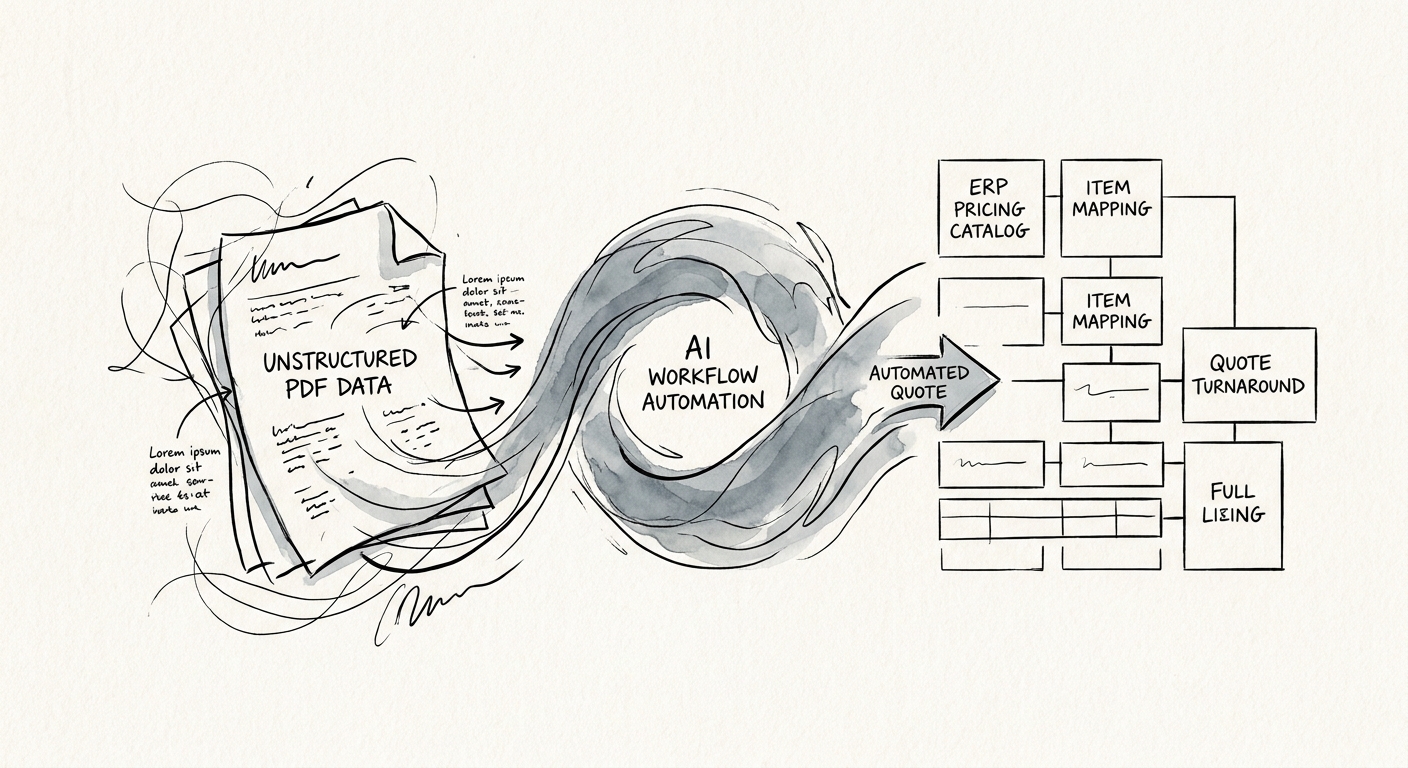
The point of the pilot is not to let a model price your work. It's to let a model build the packet — pull the right configuration, apply the matching price rule, check capacity for the requested dates, and surface anything that needs a human — so the person with pricing authority spends two minutes approving instead of forty minutes hunting. Salesforce State of Sales research consistently shows reps losing selling time to non-selling tasks; Deloitte's State of AI in the Enterprise 2026 makes the same point about where enterprise AI actually pays off. Both only matter if you translate them into one concrete handoff: assembled draft in, approved or corrected out.
What most teams get wrong: they automate the price, not the packet
The tempting mistake is to point the model at history and say "predict the quote." Now you've got a system that confidently outputs a discounted, capacity-promising number with no human between it and the buyer — and in B2B services, that's how margin walks out the door quietly. The discount that should have required a manager's sign-off gets applied automatically because three similar deals had it. The "yes, we can start the 3rd" promise gets made because the model never saw that the delivery team is already booked solid that month.
So draw the line at packet assembly. The AI prepares: request source, the configuration it inferred (and what it's unsure about), the price rule it matched, the discount threshold and whether this request crosses it, a capacity or availability check for the promised window, and a named exception owner for anything outside policy. It does not invent a custom commitment and it does not move pricing authority. The NIST AI Risk Management Framework is useful here precisely for forcing that sorting conversation — which quote decisions are low-risk auto-assembly, and which (off-standard discount, expedited delivery, custom scope) must escalate to a human before anything leaves the building.
Then instrument it so you can see whether it's working. Track quote-cycle time, missing-input rate, exception volume, reviewer correction rate, discount-policy adherence, and missed customer deadlines. The signal you're watching for is correction rate trending down — fewer human fixes per packet over time. If reviewers keep overriding the same price logic or the same delivery assumption week after week, the model isn't the problem; your pricing rule or capacity feed is stale. Fix the source before you expand scope to proposals, PO follow-up, or renewal quotes.
Run the 90-day version, then audit the corrections
For the first 90 days, scope it to one quote type with clean inputs — pick the request shape your team handles most often and argues about least. Compare four numbers against your pre-pilot baseline: time-to-quote, share of AI-prepared packets accepted by the reviewer without edits, correction rate, and how long exceptions sit before someone resolves them. Then add the question that separates a real win from a vanity one: did faster quoting change win quality, or did it just push sloppy assumptions downstream into delivery and billing? A quote that closes fast and blows up at implementation is a loss with a delay built in.
The highest-value habit is the weekly correction review. Pull every packet a human had to fix and ask why. Corrections cluster — a missing configuration option the catalog never captured, a price list that's two quarters old, a discount authority nobody documented, a delivery constraint sales genuinely cannot see. Each cluster is a fix that belongs in pricing operations, not in a prompt. That's the part teams skip, and it's where most of the durable value is.
Two guardrails before any of this scales. First, treat quote inputs as sensitive: customer-specific pricing, margin assumptions, and negotiation context shouldn't sit in a broadly accessible assistant — let the CISA AI data-security best practices shape who can see which fields and what gets logged. Second, the exit test: operations and sales both agree the packets are faster and the corrections are fewer. To put real numbers on the time saved, run the AI ROI Calculator; to weigh quote turnaround against the next bottleneck in your queue, use the AI Opportunity Score. Speed is the easy half. Keeping pricing discipline while you get it is the half that decides whether this was worth doing.