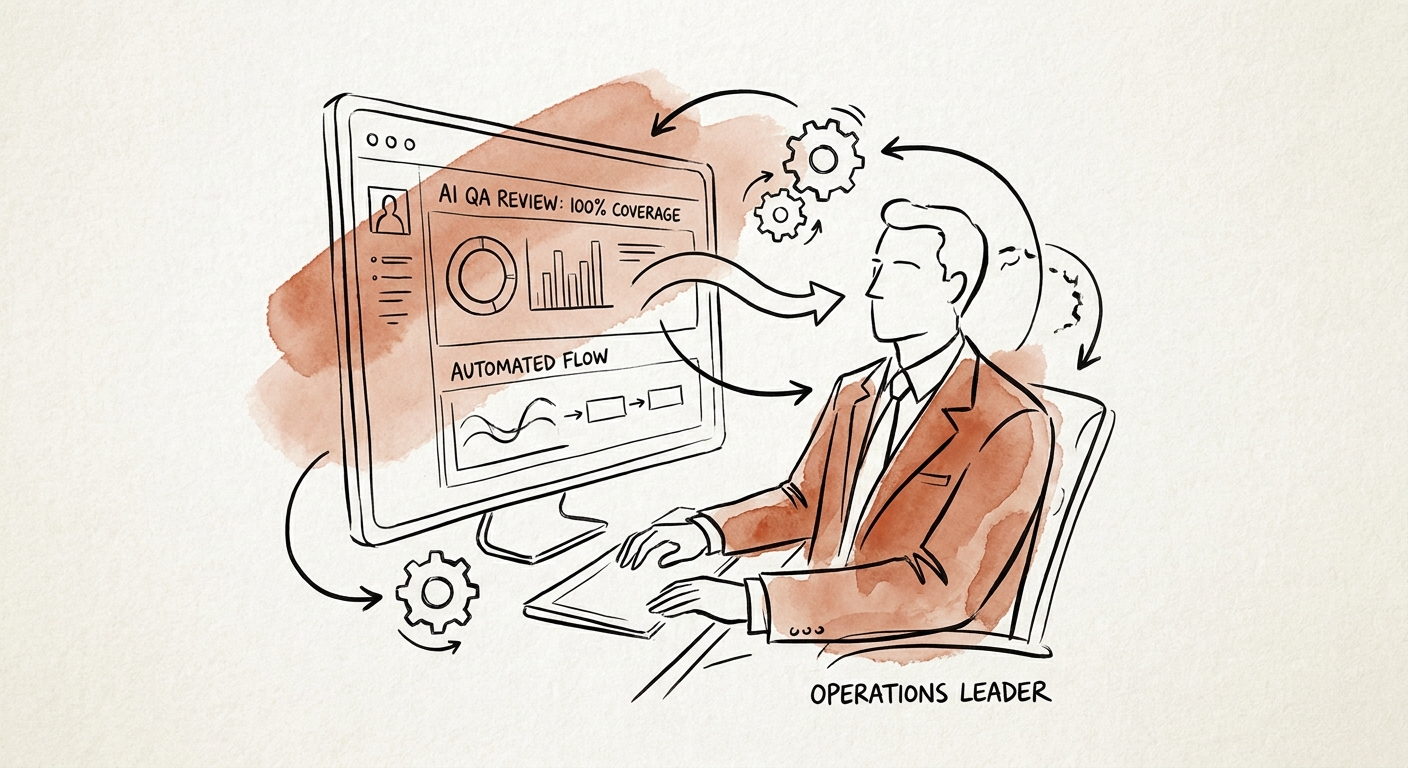
Your QA reviews 5% of the work and reports on 100% of it
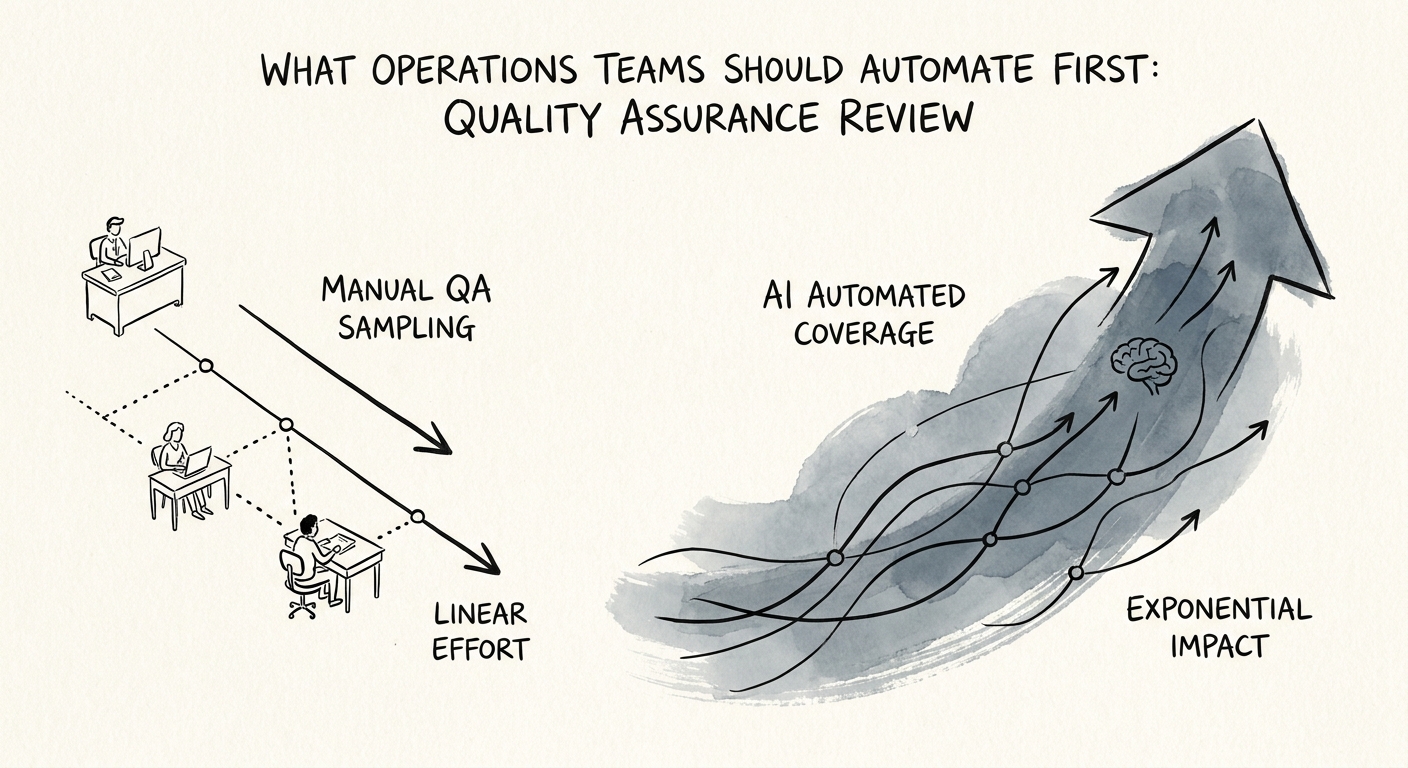
Picture a 60-person managed services firm. A team lead pulls twelve closed tickets every Friday, reads them against a checklist, scores three on tone, and signs off on the week. That's the entire quality program. The other 1,200 tickets that closed that week — the ones with a skipped escalation, a missing change-approval note, a customer whose actual question never got answered — none of them were ever looked at. The sample wasn't a sample. It was a guess wearing a clipboard.
This is why I tell operations leaders that quality assurance, not customer-facing chat, is usually the smartest place to point AI first. You're not handing the model the keys to anything. You're not asking your technicians to change a single step of how they work on Monday. You're taking a review process that already runs on a sliver of the record set and letting it read the whole set against the same rubric the team lead already uses. The blast radius is tiny; the visibility gain is enormous.
The cost-of-quality literature has made this point for decades — the expensive failures are the ones you never caught, and the longer they hide the more they compound. The ASQ cost of quality resources frame it as the difference between the cost of finding a problem and the cost of living with it. Manual sampling optimizes for the first number while quietly inflating the second. If you're weighing where to start, run QA review against your other candidates with the AI Opportunity Score before you commit a quarter to it.
Score the checkable things first. Leave "tone" for version three.
Here is the mistake I see teams make on their first QA build: they try to automate the hardest judgment first. They want the model to rate empathy, professionalism, "did the customer feel heard." That's the part of QA that's genuinely subjective, genuinely contested in calibration meetings, and exactly where a fresh automation loses the room's trust the fastest.
Flip it. In a B2B services operation, a huge share of your real quality failures are binary and verifiable. Did the ticket include the required compliance disclaimer before close? Was the correct internal knowledge-base article linked? Did the engineer log the change-window approval? Did the response actually resolve the issue the customer wrote in about, or just the easier one next to it? Was a manager sign-off captured on the refund? None of those require the model to understand your business. They require it to check a record against a rule — which it does tirelessly across all 1,200 tickets, not twelve.
That sequencing is what builds the trust to go further. Gartner's customer service quality assurance insights describe how teams expanding QA coverage shift the manager's role from spot-grader to exception-handler — and the software-quality world made the same move years ago, automating the deterministic checks first and reserving humans for judgment, a pattern documented in Deloitte's software quality engineering research and in PwC's application testing work. Design it the same way: the model screens every eligible record, flags the misses and the low-confidence cases, and a human decides whether it's a coaching issue, a broken process, or a tooling gap. The model never closes the loop alone.
Run a two-week test on one record type — then look at what it caught
Keep the first build almost embarrassingly narrow. One record type — say, closed support tickets. One rubric — the five objective checks you already argue about least. One source system — your ticketing tool, not a stitched-together export. One owner who can say "yes, that flag is real" or "no, that's a false positive." Run it silently for two weeks against tickets you've already closed, then sit down and read what it surfaced against what your Friday sample missed. That comparison is the entire business case, and it takes an afternoon.
When you size the return, don't stop at "fewer hours grading tickets." The bigger numbers live downstream: rework you avoid because the missing approval got caught the day it happened instead of in an audit, customer trust you keep because the unanswered question got reopened, training that finally targets the failure that actually repeats. Track exception rate, review cycle time, time-to-corrective-action, the patterns that recur week over week, and the rework you prevented. McKinsey's operations automation research is blunt about this — the value shows up in capacity freed and errors caught upstream, not in a headcount line.
Once the rubric and the source system are clear, the build itself is straightforward — AI Workflow Automation is the path to scope it. If the question on the table is purely financial — what does this save versus what does it cost — model review time, rework reduction, and reclaimed management capacity in the AI ROI Calculator before you greenlight a single build.