The recap everyone praised and nobody acted on
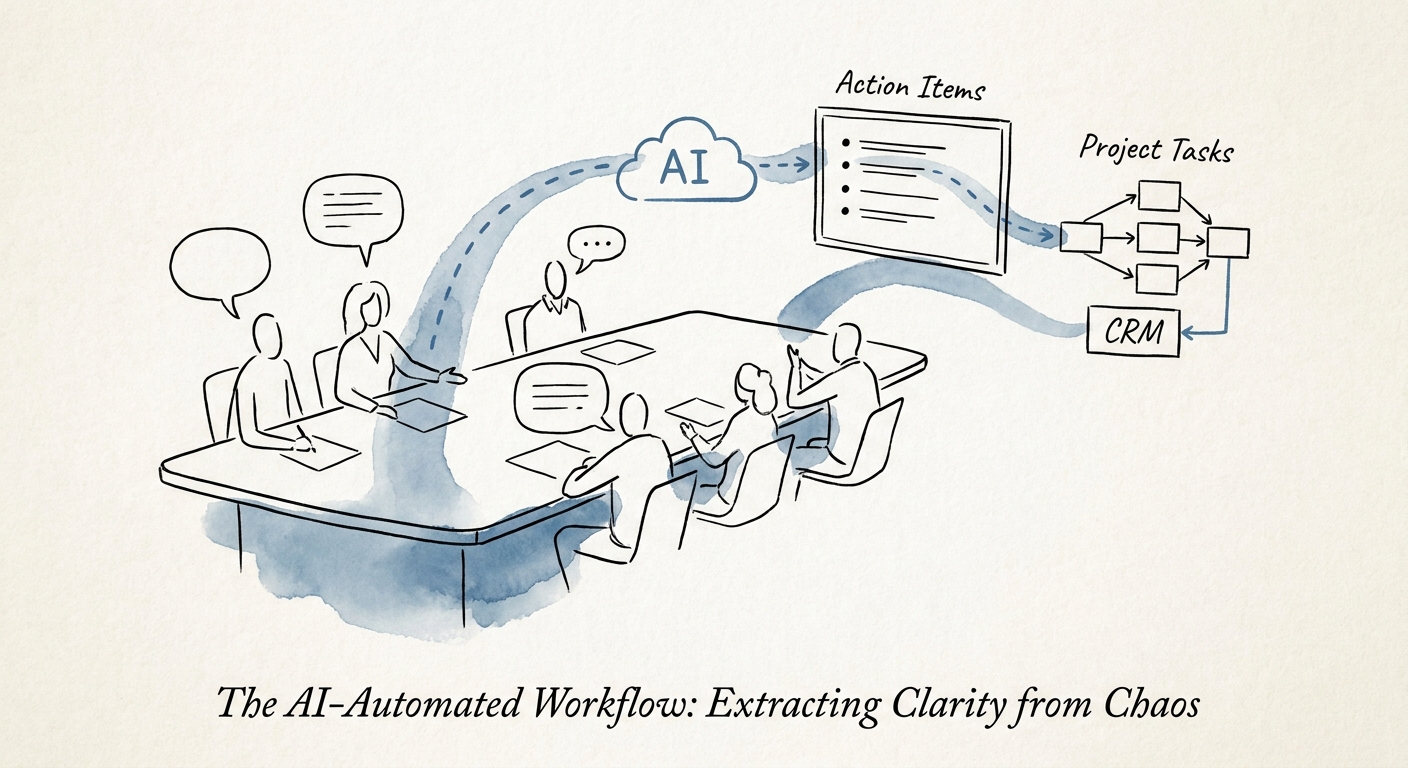
Picture the Monday operations review at a 60-person B2B services firm. Eleven people, forty-five minutes, eight decisions. Two days later someone asks, "Did we ever follow up with the Henderson account?" and the room goes quiet. The notes existed. They were even good notes. But "we should loop back on Henderson" never became "Priya owns the Henderson escalation, due Thursday." That gap, between a recorded decision and an accepted obligation, is where operations teams quietly bleed throughput. It's also exactly the gap a meeting-summary AI is suited to close, which is why it's the first workflow most ops teams should automate.
Here's the trap, though. The seductive output of meeting AI is a fluent paragraph that reads like minutes. That's the wrong target. A polished recap that lists "discussed staffing, reviewed pipeline, talked about Henderson" produces zero follow-through. The output you actually want is uglier and far more useful: a row per commitment, each with an owner, a due date, the affected account or process, and a flag for anything the meeting left unresolved. If the AI can't name who accepted a commitment, it should say so loudly rather than smooth it over.
The capacity math is what makes this worth doing first. The Federal Reserve Bank of San Francisco's analysis of AI and small businesses frames the constraint plainly: smaller operating teams don't have a spare coordinator to chase action items, and the Deloitte State of AI in the Enterprise 2026 read is that the workflows delivering value are the dull, repeatable ones, not the demos. Meeting follow-up is about as dull and repeatable as it gets. Start with one recurring rhythm: the weekly ops review, or your customer implementation standup. One meeting, one cadence, one human approving the action list before anything leaves the room.
Owner and due date are the only fields that earn the summary's keep
Run a simple test on every line the AI produces: can you point at a person and a date? If not, it isn't a commitment, it's a topic. Topics don't close. So make your follow-up packet refuse to hide them. The schema I'd hold the tool to is six columns: commitment text, owner, due date, affected account or process, system update (CRM field, ticket, nothing), and an escalation flag. The moment you force those fields, a "fluent" summary stops being able to launder a decision that nobody actually took.
What you'll find in week one is uncomfortable and exactly the point. A meeting that generates twelve "actions" but only three named owners doesn't have a tooling problem. It has a decision-discipline problem, and the AI just made it visible. That's a feature. When the same standup keeps producing ownerless items, the fix isn't a better prompt, it's a tighter agenda and a facilitator who closes each topic with "who owns this, by when?" before moving on.
The NIST AI Risk Management Framework is relevant here because meeting follow-up carries real context and accountability risk: an AI that invents an owner or quietly drops a due date isn't saving you time, it's manufacturing false confidence. Measure the things that prove follow-through, not readability. Track owner-completeness and due-date completeness on the AI's first pass, how many lines your reviewer has to correct, and the trend in overdue items week over week. If reviewer corrections aren't falling and overdue commitments aren't shrinking, the summary is decorative.
Wall off the transcript, then prove it in 90 days
Service-firm meetings are not low-stakes recordings. A single ops review can touch a client's churn risk, a margin-eroding scope creep, an underperforming team member by name, and pricing you've promised not to disclose. Before a transcript ever feeds an AI workflow, decide who can see the output, how long it's retained, and which meeting types are off-limits by default. The CISA best practices for securing data used to train and operate AI systems are the right starting frame for access, retention, and logging rules. Treat client-account and personnel discussions as the strictest tier: tighter review, narrower distribution, or kept out entirely until you trust the pipeline.
Then make the pilot earn its place with a real before-and-after. Pick your one meeting and, for 90 days, compare two numbers: the share of commitments that actually closed by their due date before the AI, and the share after. Watch the secondary signals too, time from meeting-end to an approved action list, how many items get flagged "no clear owner," and whether reviewer corrections taper off. The honest win looks like fewer dropped Henderson accounts, not a tidier paragraph.
One concrete Monday move: before each new ops review, set the prior week's AI action list next to the agenda. Every commitment that rolled forward untouched, every task with no date, every decision you can't trace back to who said it, becomes a process fix the meeting owner owns. Resist the urge to let the tool spawn more tasks than your team can actually govern, more isn't the goal, closed is. Once this one meeting reliably converts talk into owned, dated, closed commitments, you've got a defensible case to extend the same discipline to weekly reporting or scheduling. If you want a structured way to rank meeting follow-up against those adjacent workflows, the AI Opportunity Score is built for exactly that comparison.