The misroute is the whole reason to start here
Walk a support queue on a busy Tuesday and you will find the same tax everyone pays: a billing question sitting in the integrations bucket for six hours, a churn-risk account flagged "low priority" because the customer was polite, three tickets that bounce between two teams before anyone owns them. None of that is a knowledge problem. Your agents know where those tickets belong. It is a triage problem — the first thirty seconds of every ticket, repeated a few hundred times a day, done by tired humans pattern-matching on subject lines.
That is precisely why ticket triage is the best opening move for AI in a customer operations team, and a better one than the flashier ideas (auto-drafted replies, deflection bots). The Salesforce State of Service research keeps surfacing the same pressure — response speed, consistency, and rising volume against flat headcount. Triage attacks the upstream cause instead of papering over it. And the reason to trust it first is structural: every decision it makes is checkable within the hour. A ticket landed in the wrong queue is the most legible mistake in your entire operation. You do not need a six-week study to know it was wrong; the receiving team tells you in a reply.
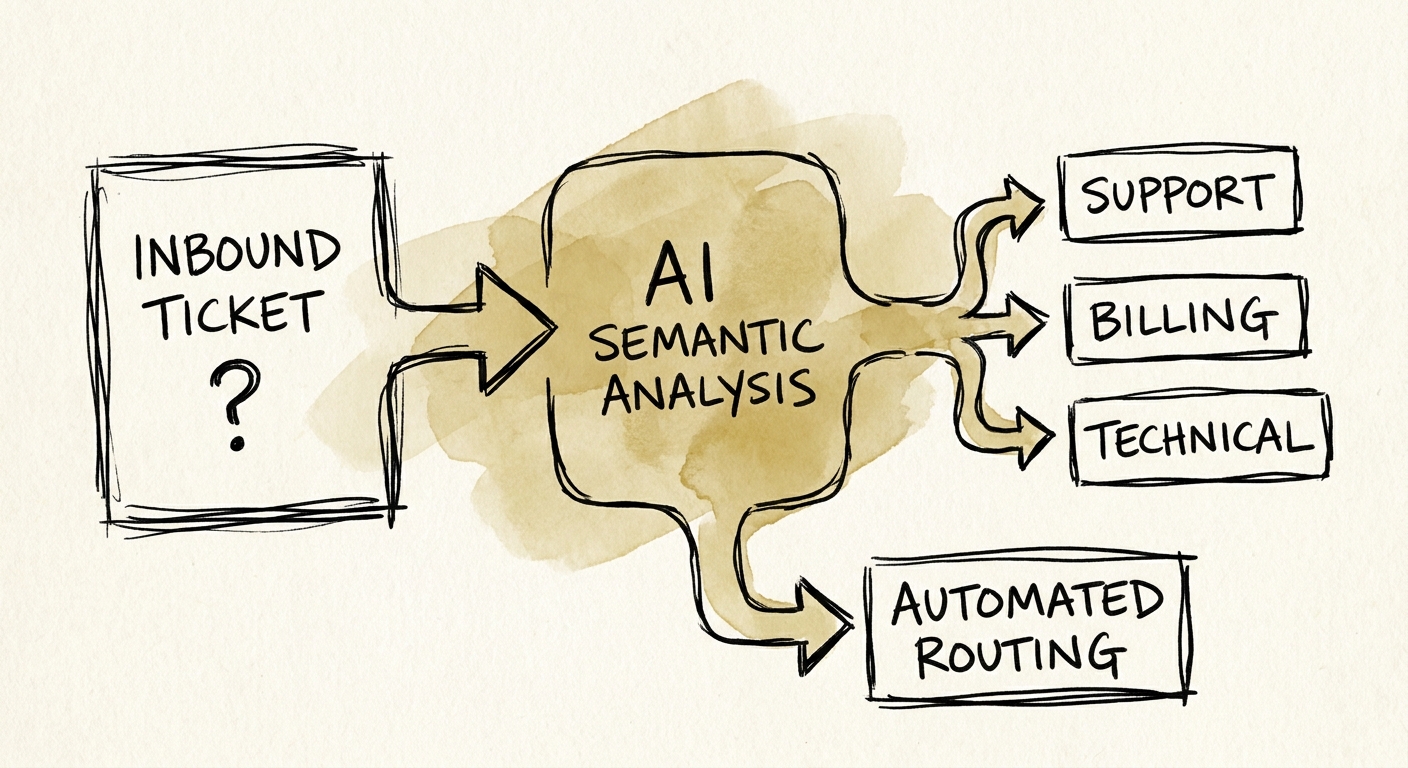
Scope it narrowly. The workflow reads the inbound ticket, assigns a category, names the likely owner, asks for the one piece of missing information that always stalls that category (order number, environment, account ID), and raises a flag when it smells like escalation. It does not close tickets. It does not promise the customer a resolution date. It does not reply on your behalf. It hands a cleaner ticket to a human faster. If you want the use-case framing before you wire anything, start with the ticket triage first-use-case guide.
Decide what a wrong guess costs before you wire the path
Triage failures are not all equal, and your escalation design should reflect that. Say a 60-person SaaS support org runs four queues. A billing ticket misfiled as a how-to question costs you a slightly slower answer — annoying, recoverable. A security incident misfiled as a feature request costs you an SLA breach and possibly a disclosure clock. Those two errors deserve completely different handling, and the model should never be allowed to treat them the same way. Map each category to a blast radius: low (reroute and move on), high (route plus alert a named human), and never-automate (regulatory, legal threat, exec escalation — those go straight to a person, full stop).
Then build the human-in-the-loop path around the high-cost cases, not the easy ones. The point of keeping a person in the loop is not to second-guess every routine reroute; it is to make sure the rare expensive miss is caught the same day. Concretely: log every classification with the model's confidence, auto-route anything above your threshold in the low-blast-radius categories, and force a human confirmation on anything tagged high-priority or below confidence. That confirmation queue is your early-warning system — if it fills with corrections in one category, that category is not ready and you pull it back to manual.
Triage also moves customer data around, and a misroute can become a privacy problem when a summary lands in front of a team that should not see the underlying record. The CISA AI Data Security Best Practices guidance is the right reference here: the triage step must inherit the source record's permissions, redact regulated fields (payment data, health information, anything under contract restriction) before it generates a routing summary, and never surface a sensitive ticket to a queue whose members lack access to the original. Treat the routing summary as data with the same sensitivity as the ticket it describes.
Measure reroute rate, or you are measuring nothing
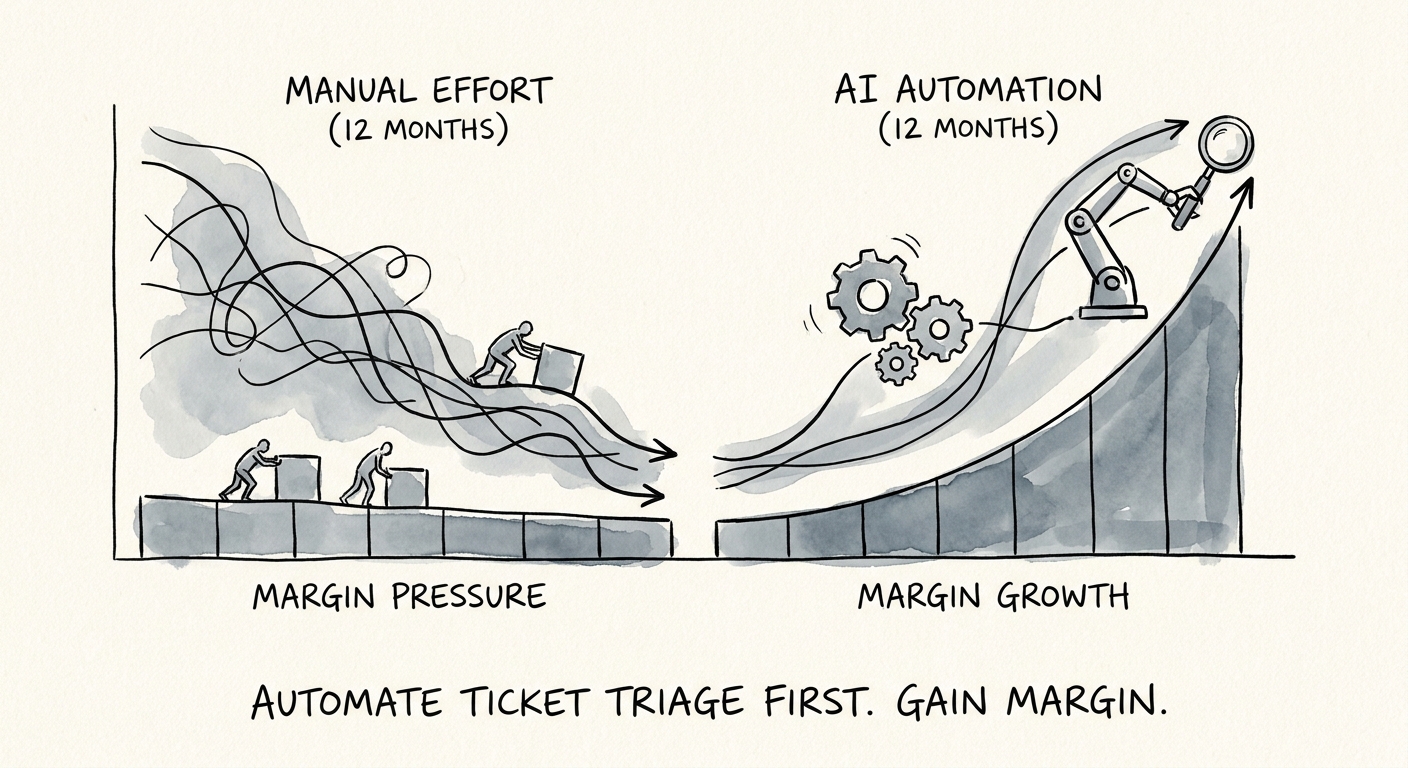
The trap with triage is the one that looks like success: the queue gets visibly tidier, first-response time drops, and everyone declares victory — while the misrouted tickets quietly pile rework onto the teams downstream. A clean-looking queue that hands second-line agents a stream of "this isn't ours" tickets has not saved time; it has moved the cost somewhere you stopped looking. So instrument the failure modes, not the vanity metric.
Track six numbers from day one: first-response time (the obvious one), reroute rate (how often a triaged ticket gets moved again by a human — this is your real accuracy signal), missing-info rate (how often the agent still has to ask the customer for the thing triage should have requested), escalation accuracy (did the high-priority flags actually correlate with real escalations, or did it cry wolf), correction rate by category (which queues you can trust and which you cannot), and time-to-true-resolution (because a fast first touch on a wrong-owner ticket is slower overall, not faster). The RSM middle-market AI survey and the NIST AI Risk Management Framework both point the same direction: tie the system to one workflow, then govern and measure it against outcomes rather than activity.
Here is your Monday: pick the single highest-volume queue, pull last month's tickets, and label each one with where it should have gone versus where it landed. That misroute baseline is your honest starting line and the number you hold the automation to — if it cannot beat your humans on reroute rate inside 90 days, it is not ready to expand to a second queue. To keep the business case tied to real operating gain rather than a tidier-looking dashboard, run it through AI ROI measurement without fake savings.
