The expensive part of a ticket isn't the answer
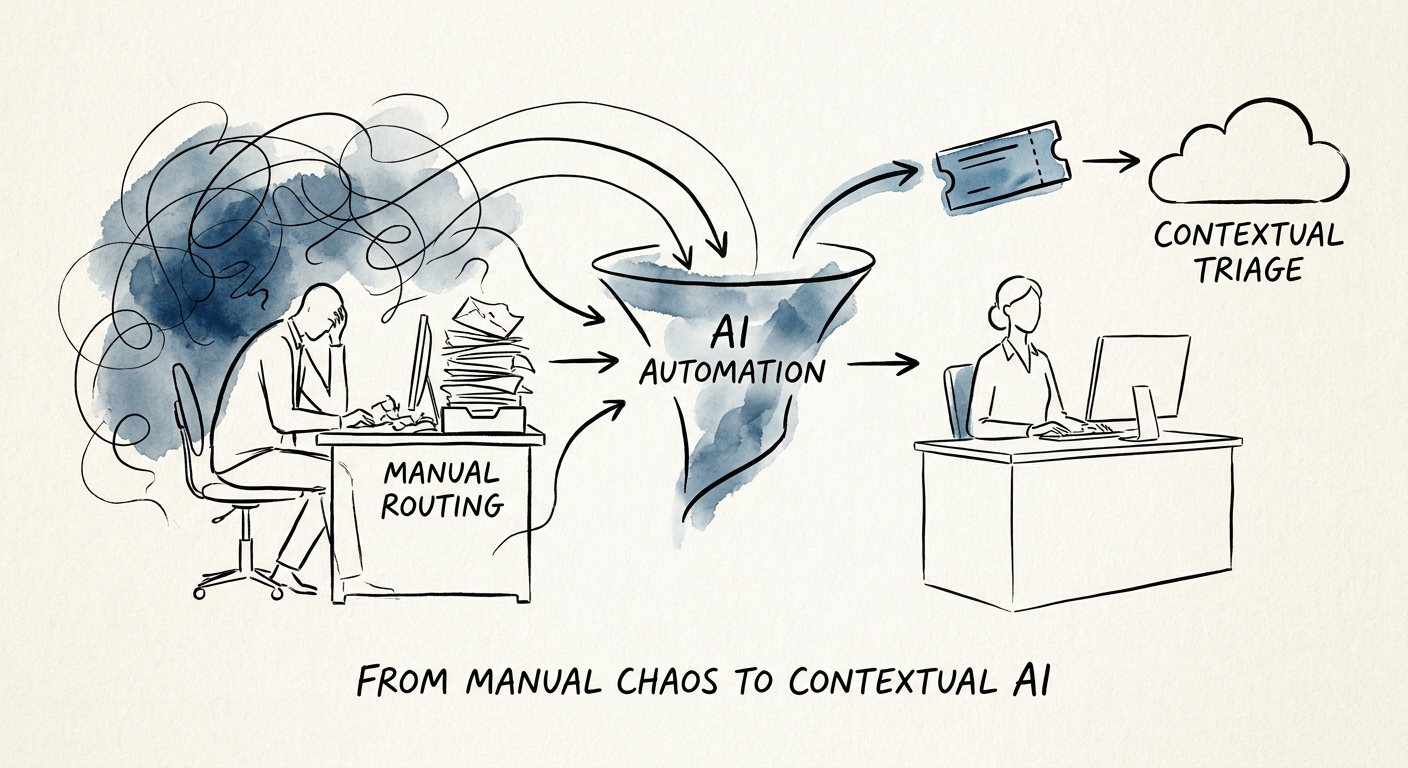
Picture a 30-seat support team on a Monday after a weekend outage. Three hundred tickets are stacked in one undifferentiated queue. An agent opens the top one, reads four paragraphs, realizes it's a billing dispute and not a bug, reassigns it, and the customer waits another six hours to hear from someone who can actually help. Multiply that by a few dozen and you have the real cost center in support: not the time spent writing replies, but the time spent figuring out what each ticket is and who owns it.
That's why the instinct to point AI straight at the reply box is backwards. Auto-answering is the flashy demo, but it fails loudly the moment the model confidently sends a wrong refund policy to an angry enterprise account. Triage fails quietly and cheaply by comparison — and it's where the hours actually leak. The first job worth automating is the boring one: read the inbound, decide the category, pull the customer's recent history, and drop it on the right person's desk with context attached.
The pattern shows up across the research on where AI value actually lands. McKinsey's 2025 State of AI and the IBM Institute for Business Value both point to operating-model design — not raw model capability — as what separates teams that get return from teams that get a pilot. In support, the operating model is the queue. Fix the queue first.
Four jobs, in order, before anything talks to a customer
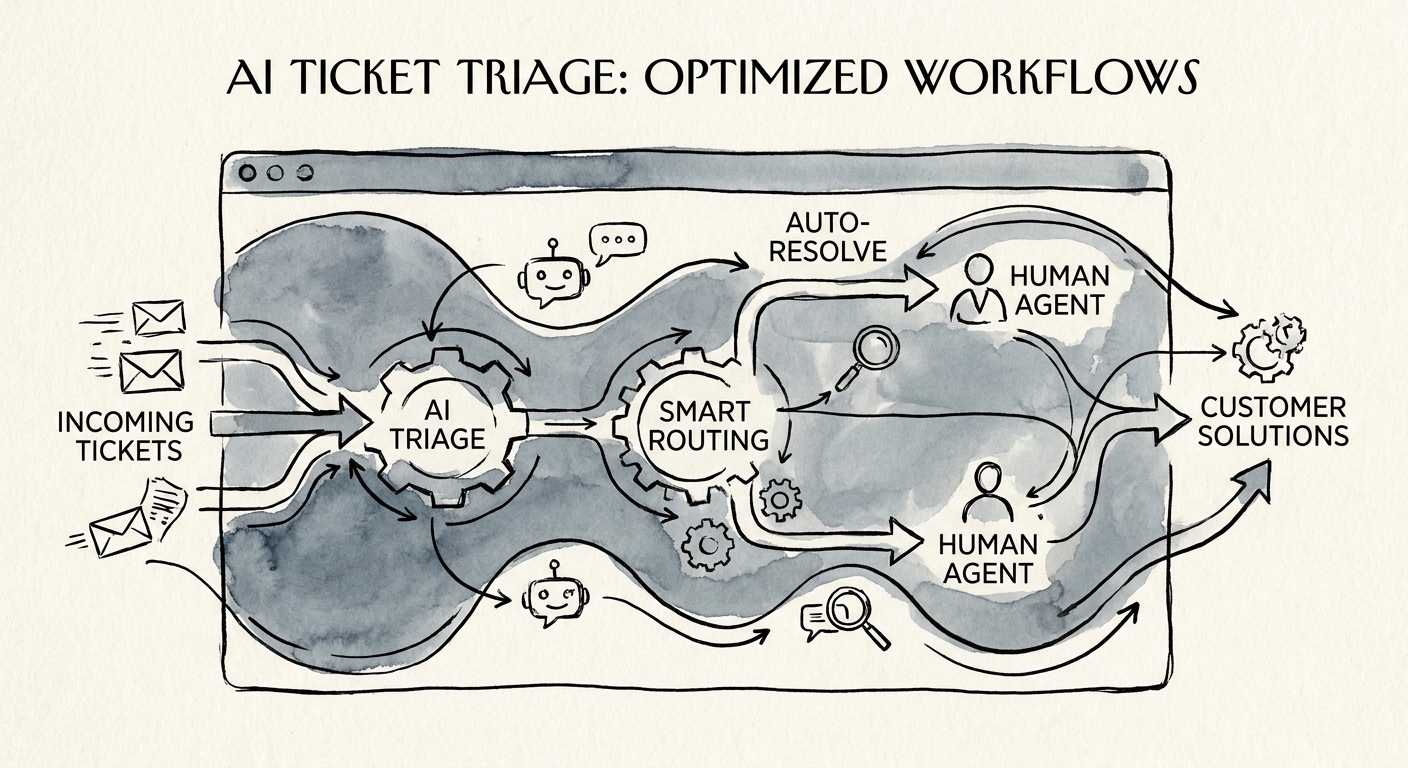
Break triage into discrete jobs so you can trust each one independently. First, classify: is this a bug, a billing question, a how-to, a churn-risk escalation, or a feature request? Your categories are probably a mess right now — agents invented tags over three years and half overlap. Clean that taxonomy before the AI touches it, because a model trained on inconsistent labels just automates your confusion at speed.
Second, summarize: a two-line synopsis plus the customer's plan tier, last three interactions, and any open tickets. This is the line item that kills the "re-explain everything" tax. Third, route: send it to the owner whose skills and current load match — a tier-1 password reset and a SOC2 security question should never land in the same lap. Fourth, review: define exactly when a human confirms before the ticket moves, especially for VIP accounts, refunds over a threshold, or anything the model flagged as low-confidence.
The discipline here is making the system show its work. A good triage workflow surfaces the category it chose, the knowledge article it leaned on, and how sure it was. When an agent can see "classified as billing, 71% confidence, no recent tickets found," they know whether to trust it or double-check. Bain's 2025 agentic AI research makes the same argument structurally: redesign the whole workflow rather than bolt automation onto a broken process. And the NIST AI Risk Management Framework gives you the vocabulary for the review gates — what gets logged, what needs a human in the loop, what happens when the model is uncertain. If triage is one slice of a larger support build, Customer Service AI covers the rest of the operating model.
Start with one queue, and measure routing — not replies
Pick a single issue family to start: say, billing disputes for your mid-tier accounts. It's high-volume enough to learn from and bounded enough that a misroute won't burn a flagship customer. Run the AI on classification and routing only, with a human confirming every assignment for the first two weeks. You're not measuring deflection or reply speed yet — you're measuring whether the thing routes correctly.
The numbers that matter are unglamorous: time to first correct assignment, the rate of reassignments after the AI's pick, escalation accuracy, reopen rate, and how often a customer has to follow up because context got lost. If reassignments are climbing, your taxonomy or your summaries are wrong — fix those before you touch anything customer-facing. PwC's 2025 Responsible AI survey is a useful reminder that the governance scaffolding — logging, review thresholds, override paths — is what lets you expand scope without flying blind.
Once routing is stable and reassignments are flat, you've earned the right to let the AI draft replies for the easy categories. Not before. To put numbers behind the case, model it in the AI ROI Calculator, then design the governed rollout with AI Workflow Automation.
