The Status Update That Lied To You
Picture the Monday operating meeting at a 120-person services firm. Someone pastes in the vendor status: 14 tickets open, 9 closed last week, average resolution holding steady. Everyone nods. What nobody sees is that three of those open tickets all trace to the same logistics vendor, that vendor's contract auto-renews in 41 days, and two of the incidents have already touched a customer's delivery window. The recap was accurate. It was also useless, because it counted tickets instead of surfacing the one decision the room actually needed to make.
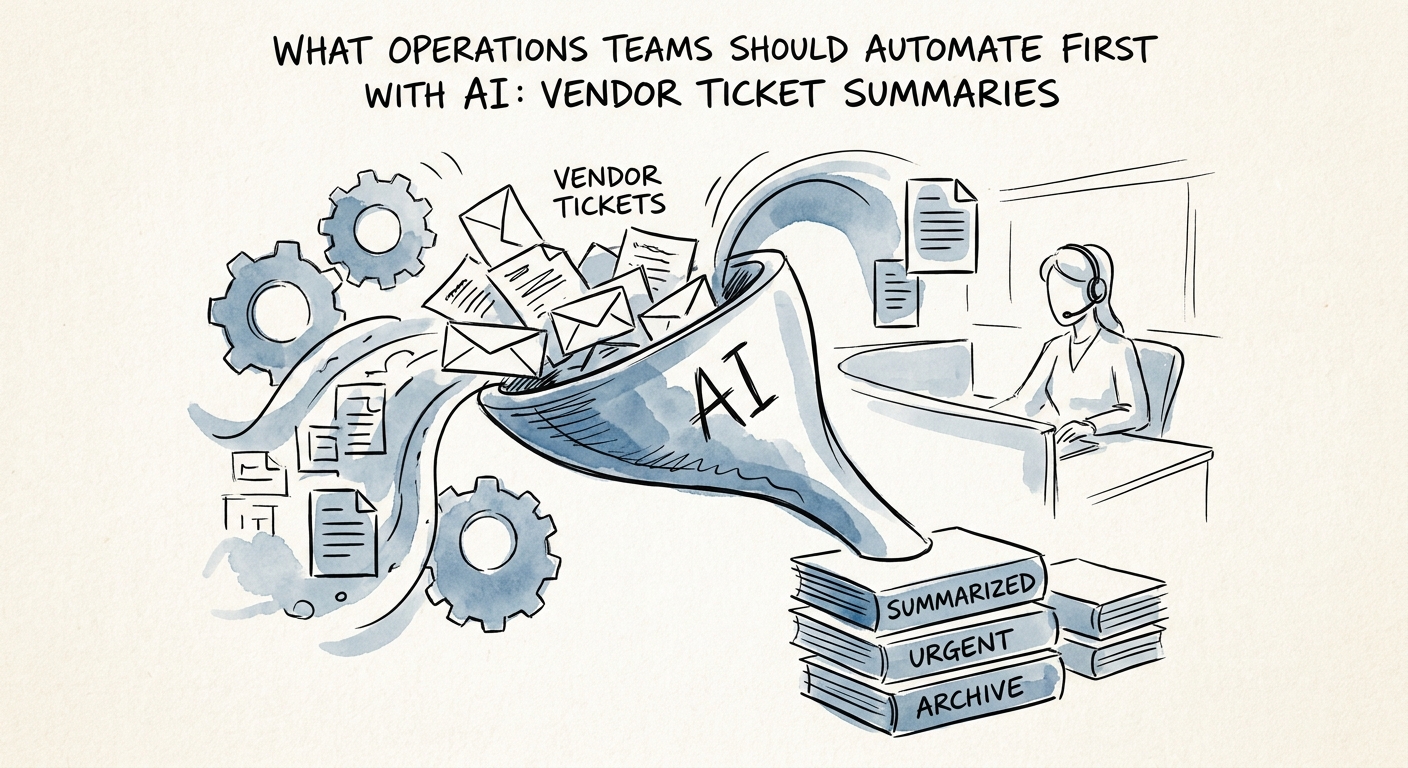
That gap is exactly why vendor ticket summaries are the first operations workflow worth automating with AI, and also why most teams automate the wrong version of it. The easy build condenses every ticket into a tidy paragraph. The build that earns its keep ranks open issues by who owns them, which contract they sit under, and whether a customer is already feeling it. Adoption evidence supports the instinct that this is fertile ground: the RSM middle-market AI survey, the San Francisco Fed small-business AI analysis, and the OECD SME AI adoption report all describe the same pattern: smaller firms move fastest when AI attaches to a repeating, document-heavy ritual rather than a general productivity promise. A weekly vendor review is precisely that ritual.
So before anyone tests a prompt, decide what the output is supposed to change. The job is not "summarize tickets." The job is "produce the one brief that tells operations and vendor managers which supplier relationship needs a decision this week, with the contract clock and the customer exposure attached." If your summary can't answer that, you've automated a status update, not a workflow.
What The Model Reads, And What It's Never Allowed To Touch
The reason vendor summaries are riskier than they look is that the source material spans systems that don't talk to each other: the ticket queue, the contract repository, the renewal calendar, and a manager's memory of which supplier promised what on a call. A model fluent enough to write a smooth paragraph will happily stitch those together and invent a confidence that isn't earned. So the design question comes before the prompt: what is the model allowed to read, and what is it forbidden to surface?
Use the NIST AI Risk Management Framework to fix three things in writing for this workflow: the context (a weekly vendor-risk brief, not a customer-facing document), a named reviewer who signs off before it reaches the meeting, and a measurable definition of a bad output. Use CISA AI Data Security Best Practices to draw the harder line: pricing terms, indemnity clauses, and any customer's protected data should be classified before they go anywhere near a model context, and most of it should never be in the brief at all. A vendor-risk summary needs to know a contract renews and whether an SLA was breached. It almost never needs to quote the dollar figure.
Concretely, the brief should carry exactly these fields and nothing extra: vendor owner, the ticket cluster (grouped by root cause, not by submission date), SLA or renewal exposure, a customer-impact flag, the dependency owner downstream, the follow-up deadline, and the decision the meeting is being asked to make. Those fields force a source trail. When the brief says "Vendor X, 3 clustered incidents, SLA breached twice, renewal in 41 days, customer delivery affected, decision: escalate or accept," a manager can trace every claim back to a ticket and a clause. A fluent paragraph with no owner attached is the failure mode you're automating away, not toward.
Run It For Six Weeks And Count Decisions, Not Summaries
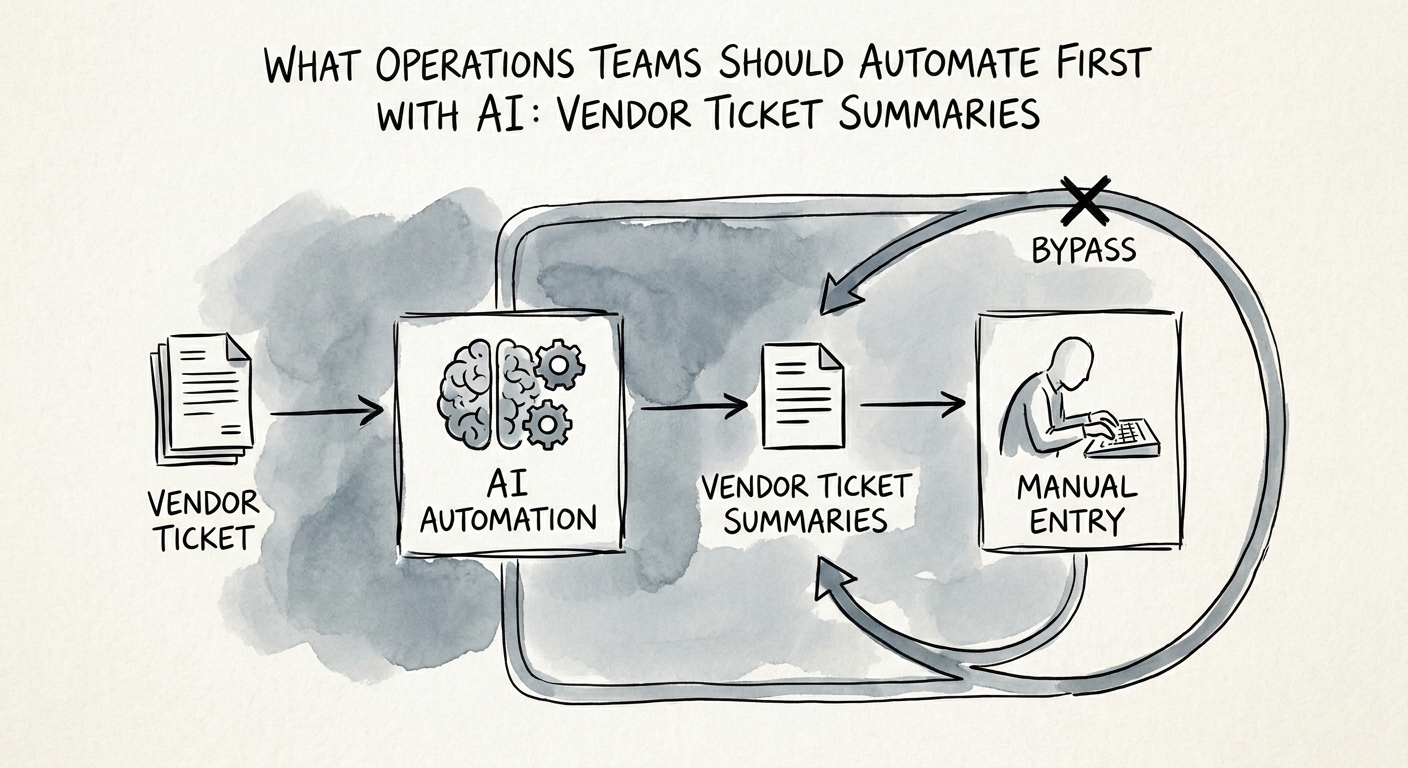
The trap with any AI pilot is measuring whether it produced output. It always produces output. Deloitte's State of AI in the Enterprise 2026 is worth reading here precisely because it pushes past pilot activity toward production value, and for this workflow production value has a sharp definition: did a vendor-risk decision reach the operating meeting earlier, with evidence attached, than it would have otherwise?
Track six numbers across the pilot: how many ticket clusters the brief identified by root cause, how many briefs arrived decision-ready (owner plus a clear ask), follow-up completion on the owners it named, vendor-response delay it caught early, customer-impact flags raised before a customer escalated, and contract or renewal exposures surfaced ahead of the deadline. Watch one failure signal above all: if a brief lands without an accountable owner or without a clear decision for the room, that is not a model problem to re-prompt away. It means your vendor ownership map is broken upstream, and you should fix that before adding any more AI surface on top of it.
Start narrow. Use the manual-work scoring guide to confirm the weekly vendor review is genuinely costing your team hours of manual reconciliation, then use the 90-day AI implementation plan to sequence it: clean the source data first, prototype the brief against last quarter's tickets, train the reviewer, launch into one weekly meeting, and only then expand. Require every summary to show its source tickets and its customer-impact classification. After six weeks, the test is simple: is the vendor conversation in your operating meeting about which tickets are open, or about which supplier relationship needs a decision? If it's moved to the second, the workflow earned its place.