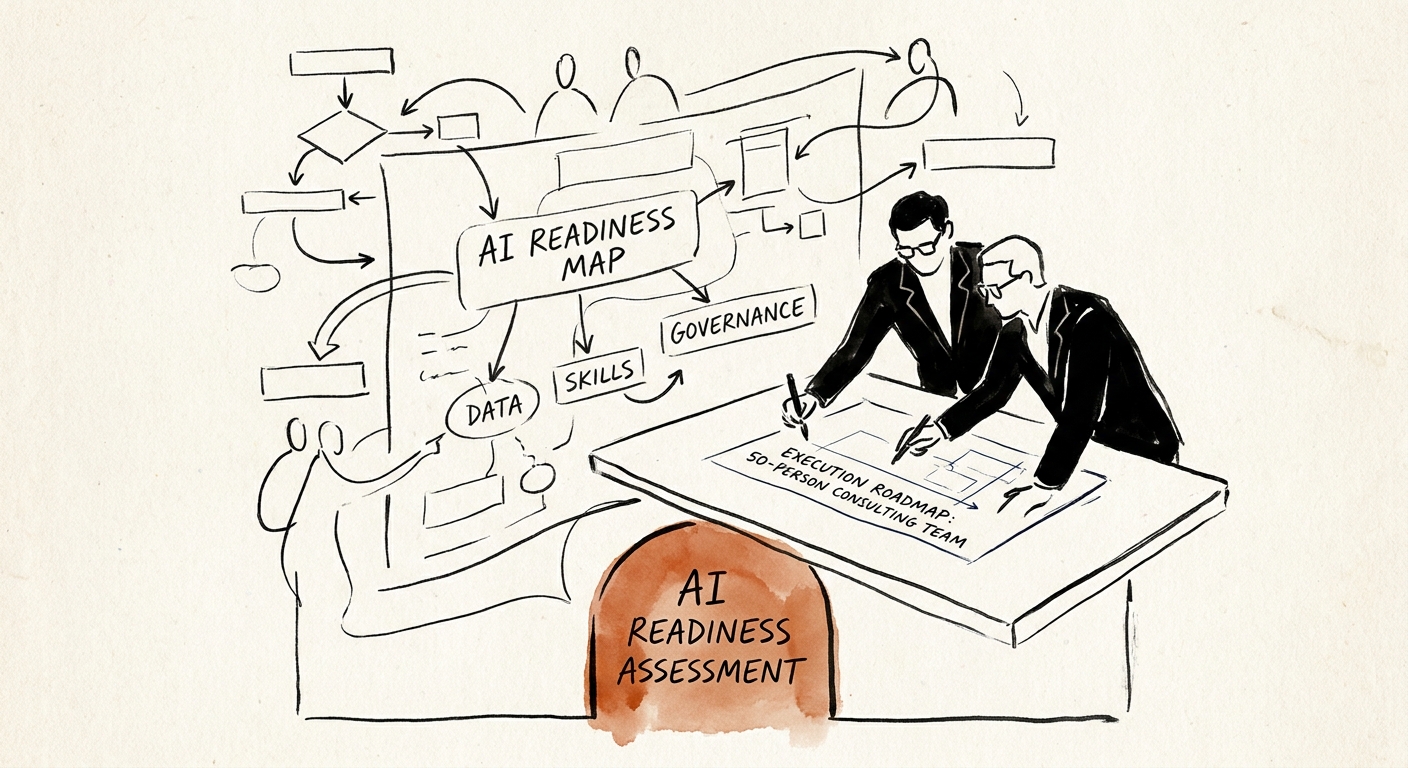
The seat license that nobody can tie to a billable hour
Picture the Monday after a 50-person consulting firm buys 50 AI seats. By Wednesday, three senior associates are drafting faster, two partners haven't logged in, and nobody can answer the only question that matters: did realization move? In a firm this size, you don't have a transformation budget to hide the cost in. You have roughly 35 billable people, a utilization target, and partners who notice when a tool shows up on the overhead line without showing up in the work.
That's why readiness here starts with delivery economics, not deployment. The RSM middle-market AI survey, the San Francisco Fed analysis of AI and small businesses, and the OECD report on AI adoption by small and medium-sized enterprises converge on a boring, useful rule: adoption sticks when the workflow, the data owner, and the result are named before the purchase order. For a consulting firm, the highest-leverage place to look isn't an internal chatbot. It's the proposal-to-delivery seam — the archive of past engagements, the research notes that never get reused, the workpaper drafts a manager rebuilds from scratch every time, the staffing handoff where context evaporates.
The screen is narrow on purpose: which single workflow, if it got faster or cleaner, would show up as recovered hours or a higher win rate? Run that question through the SMB AI readiness assessment before you let "the whole firm needs AI" turn into a procurement exercise.
Your client deliverables are also someone else's confidential data
Here's the part consulting firms underestimate. The asset that makes an AI workflow valuable — your archive of proposals, methodology files, and prior workpapers — is stuffed with client data you don't own. Feed an old discovery memo into a tool without rules, and you've potentially leaked Client A's numbers into a draft for Client B. A 50-person firm rarely has a CISO to catch that. The partner who signed the engagement letter is the control.
So provenance becomes a readiness gate, not an afterthought. The NIST AI Risk Management Framework gives partners a usable spine: map the use case, name the failure modes, assign the control, fix accountability on a person. The CISA AI Data Security Best Practices govern the source layer — which repositories are approved, where the client-data boundary sits, what gets logged, and who escalates when the context is incomplete. Concretely: say a research workflow can pull from your published frameworks and sanitized case patterns, but never from a named client's raw workpapers unless that engagement explicitly permits reuse. That one boundary, written down, is more readiness than any feature comparison.
Readiness fails the day a manager pastes a generated section into a deliverable and no partner knows where the underlying examples came from. Solve the source map and the review rule first. The 90-day AI implementation plan sequences the cleanup — source boundaries, partner sign-off rules, a contained prototype, then adoption — so the first workflow doesn't metastasize into a firmwide program your delivery calendar can't absorb.
Run it on the next ten proposals, then decide
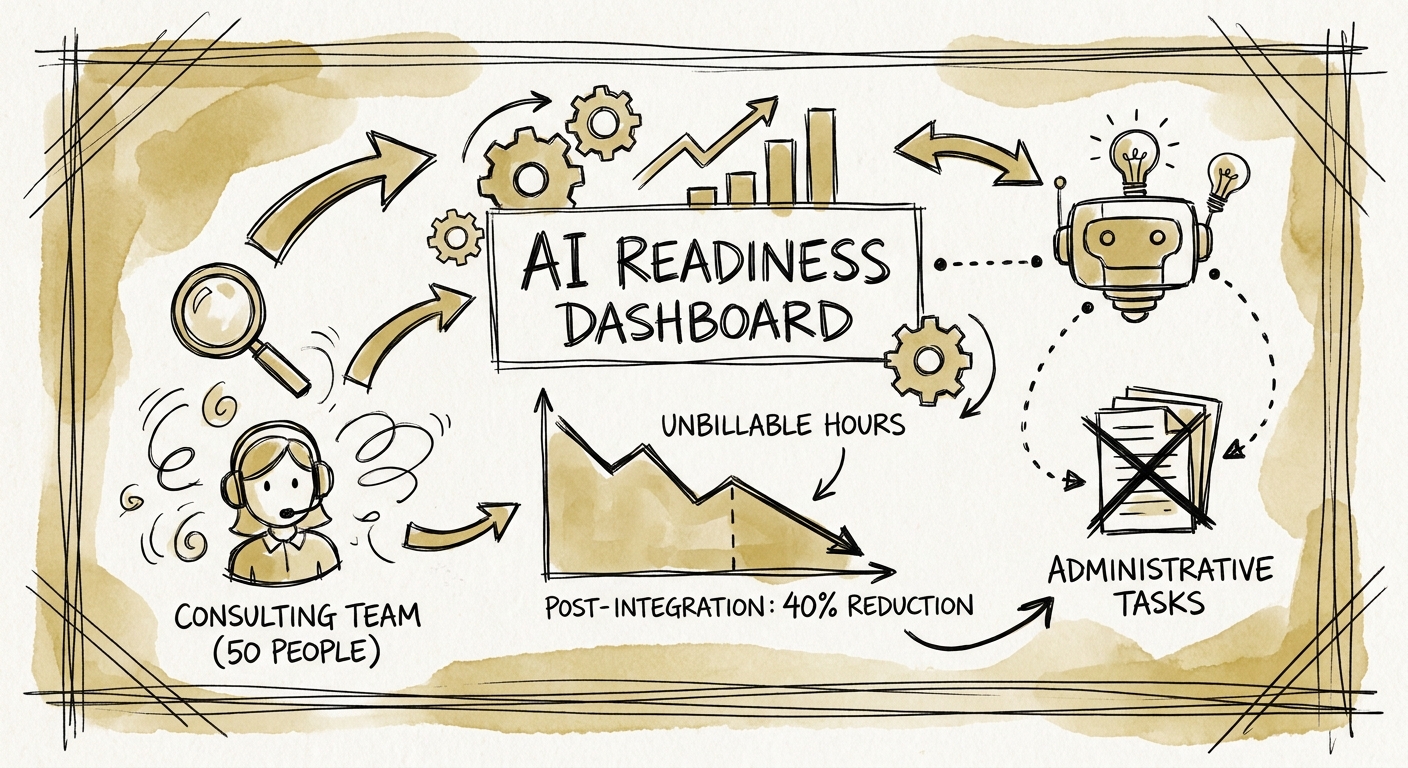
The Deloitte State of AI in the Enterprise 2026 is worth reading for one distinction: it separates what's actually in production from what's still a pilot people talk about. A 50-person firm can't afford a portfolio of "interesting experiments." Pick one workflow — proposal reuse is usually the cleanest — and instrument it across the next ten real opportunities.
Measure things a managing partner already cares about: hours to first proposal draft, how often a past engagement actually gets reused instead of rebuilt, partner-review rework after the AI pass, and realization leakage on the matters that ran the workflow versus the ones that didn't. Hold a 20-minute partner review every Friday with those numbers in front of you. Three outcomes only — scale it, change the scope, or kill it. No fourth option where it limps along consuming seats.
The bar for a consulting firm is specific: the workflow has to lift delivery leverage without costing you the trust that makes clients pay your rate. A draft that's faster but wrong in front of a client is worse than slow. Pressure-test the gains with the no-fake-savings ROI model before you greenlight the second use case — recovered hours only count if they show up as billable capacity or a closed deal.