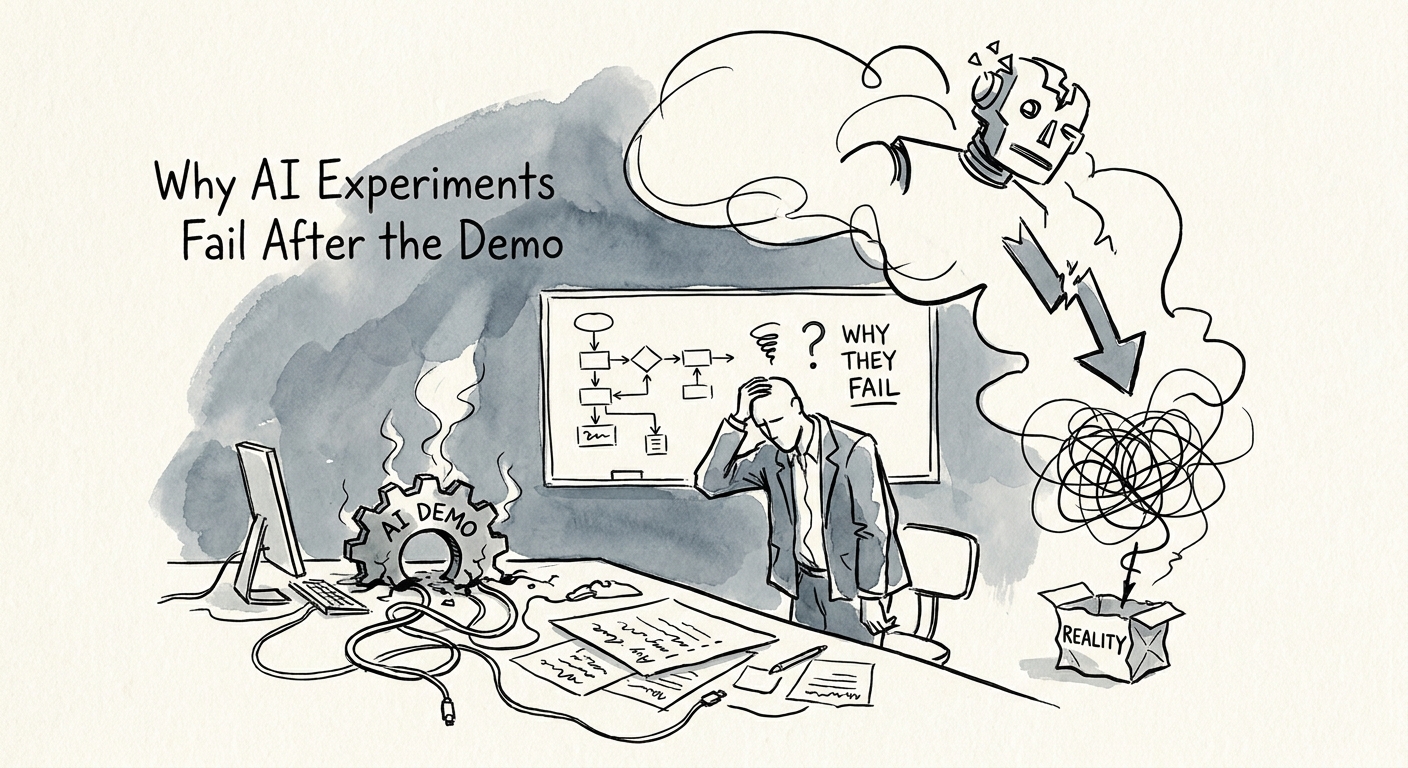
Friday the model dazzled. By Thursday it was a browser tab nobody opened.
Here is the pattern I watch play out in a 60-person company over and over. A manager wires up an AI tool, feeds it a few clean, hand-picked examples, and gathers four people around a laptop. The output is genuinely good. Everyone nods. Someone says "this changes everything." A budget line gets approved on the strength of that twenty minutes.
Then real life arrives. The intake form has a free-text field people fill out three different ways. The "obvious" source document lives in two folders with conflicting versions. The one person who understood the demo gets pulled onto a customer fire. Within six weeks the tool is a bookmark, and the story in the next leadership meeting is "AI didn't really work for us."
The model didn't fail. The demo answered a question nobody should have been impressed by: can it produce a plausible response to curated input? Of course it can. That was true on day one. The RSM middle-market AI survey captures the pressure middle-market leaders feel to move fast, and that pressure is exactly what manufactures shiny pilots that die quietly. The question the demo never touches is the only one that matters: did anyone's actual work move?
The demo answers one question. Production asks eight.
When a pilot stalls at a small company, it is almost never the model. It is one of eight unglamorous gaps the demo was structured to hide. Walk your own pilot against this list and you'll usually find the corpse before you've read three:
- No named owner. The demo had a champion. The workflow has nobody whose job description now includes it.
- Data access is harder than the demo. The clean file in the slideshow becomes a permissions request that sits in IT's queue for nine days.
- Source quality is worse than anyone admitted. Production inputs are inconsistent, half-finished, and contradictory in a way curated examples never are.
- No reviewer. Drafts pile up because nobody is accountable for saying "approved" or "fix this."
- No integration path. The output has nowhere to go — no system, no folder convention, no next step that fires automatically.
- Nobody was trained. The four people in the room understood it; the forty who do the work daily never got fifteen minutes.
- The success metric is a vibe. "It helped" is not a number you can defend when the renewal invoice shows up.
- No stop rule. When output disappoints, the team limps along instead of pausing to fix the cause.
Notice every one of these is operational, not technical. A model can hand you a genuinely useful draft and the workflow still collapses because the team doesn't know where to save it, who signs off, or how to tell whether it saved anyone an hour. The OECD report on AI adoption by small and medium-sized enterprises frames this correctly: adoption is organizational capacity, not access to tools. A 40-person agency and a 200-person manufacturer fail in the same eight places — the demo just hides them behind better lighting.
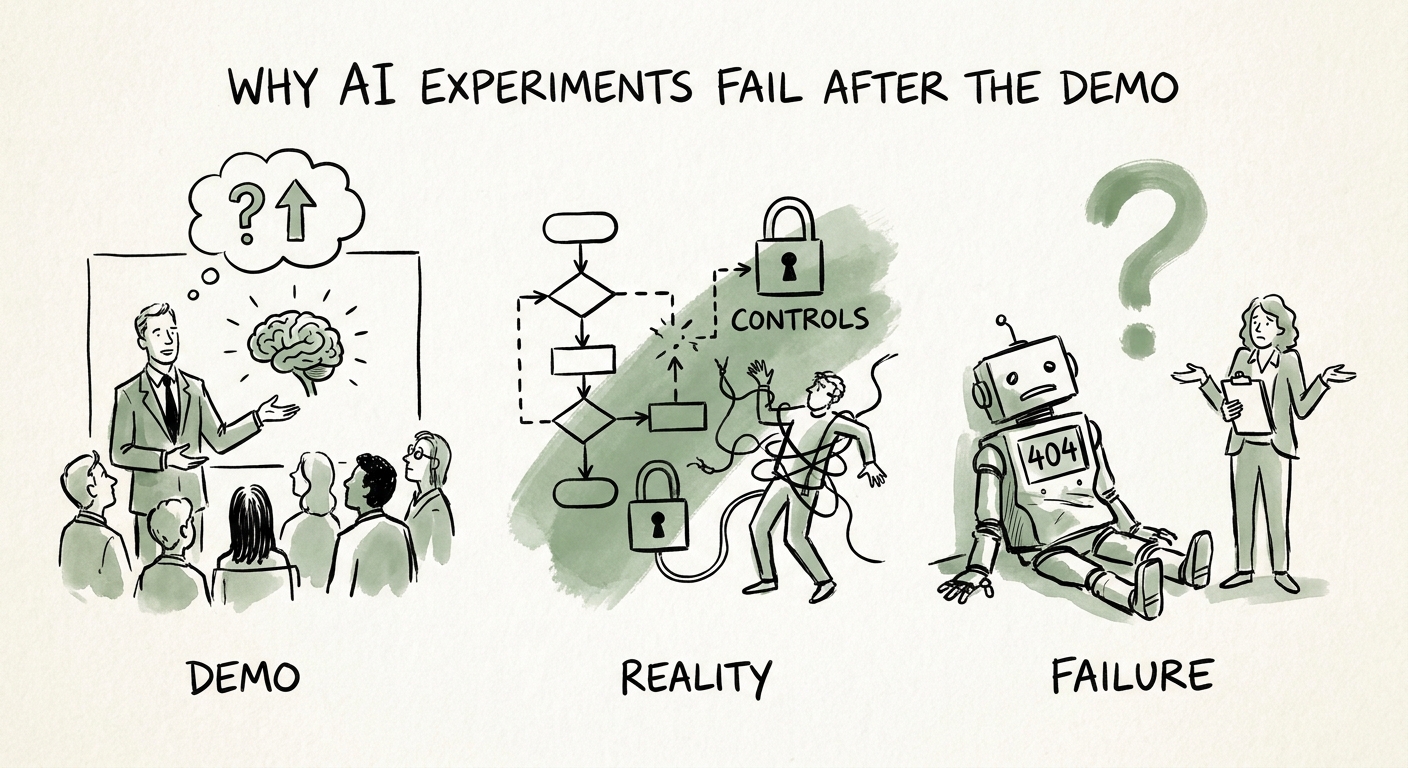
Convert the demo into a one-page handoff, or don't scale it
The fix is cheap and almost nobody does it: before you celebrate a working demo, write the handoff that lets a manager run the workflow after the demo team leaves the room. One page, not a deck. It names the owner, maps the steps, lists exactly where inputs come from, assigns the reviewer, sets a baseline metric, and states a stop-or-scale rule. If you can't fill that page, you don't have a workflow — you have a magic trick.
Then give it a clock. Pick the first focused workflow review at 90 days or fewer, and at that review you should be able to point to four things, not a feeling: people adopted a new step, a manager reviewed the evidence, errors got logged, and leadership can decide whether the thing earns more investment. This is the gap the Deloitte State of AI report keeps surfacing — usage is climbing while process change lags far behind, with a large share of organizations using AI with little or no change to how work actually flows. And it's why Gartner expects a large share of agentic AI projects to be canceled by 2027: ungoverned pilots that never became operating work. The same dynamic shows up in lender-side reads of SMB adoption like the San Francisco Fed analysis of AI and small businesses — interest is broad; durable process change is rare.
Do this Monday: take your most promising pilot and try to fill the one-page handoff. The blanks you can't fill are your real backlog. When the demo clearly works but the business process underneath it is still undefined, that's exactly the moment to Build the AI roadmap. We bring the same implementation discipline behind work like a 28,000-user migration with zero downtime — because a promising demo needs the identical path from idea to operating cadence, just at your scale.