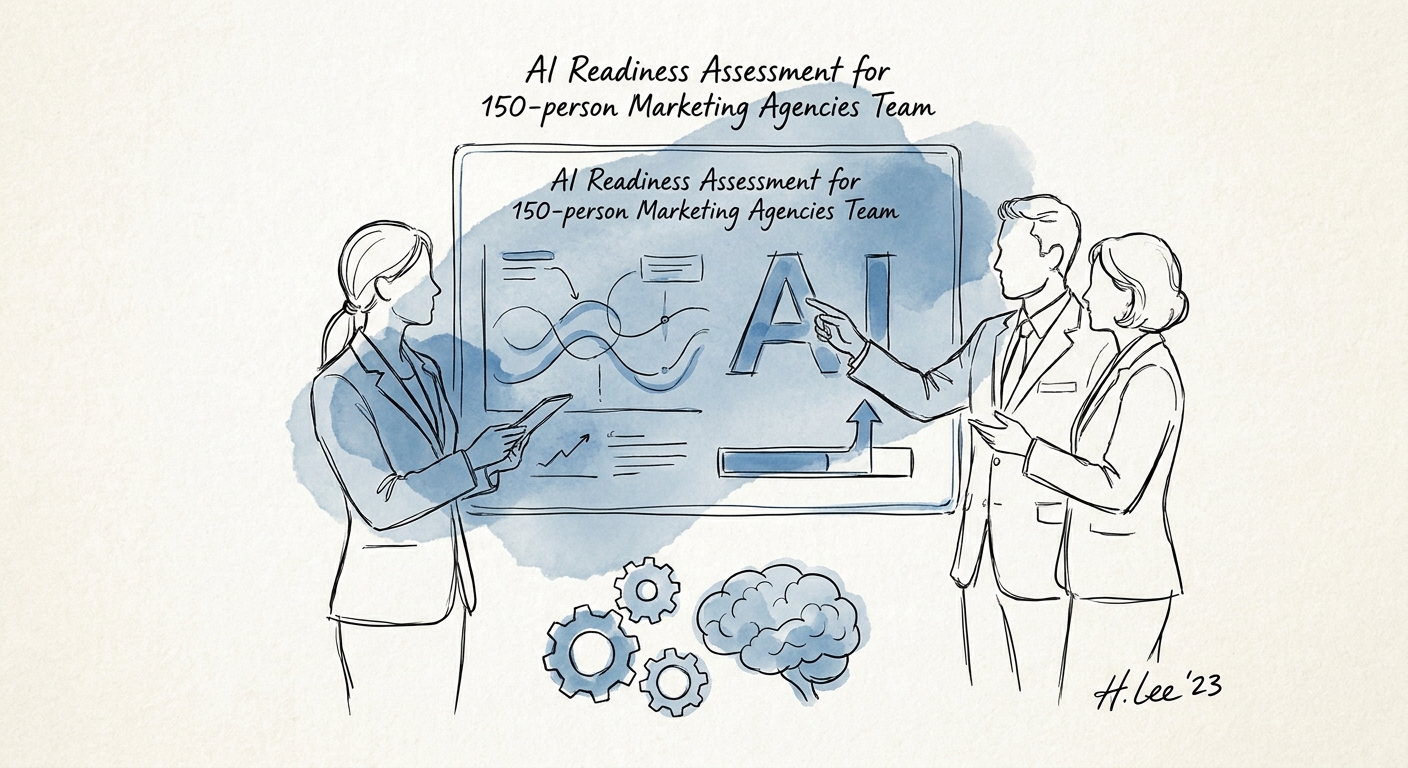
At 150 people, the leak is not creativity — it's the handoffs
Walk a 150-person agency on a Tuesday and you will not find a creativity shortage. You will find a media analyst pulling screenshots from four ad platforms into a deck, an account manager rewriting the same campaign narrative they wrote last month, and a strategist hunting through Slack for the brand guidelines a client signed off on in March. None of that is billable. All of it is where your margin quietly dies.
That is the difference between a 30-person shop and yours. At 30 people, one person holds the whole client context in their head. At 150, you have pods, specialists, and approval layers — enough structure to feel friction, not enough management bandwidth to babysit another disconnected tool that every team adopts differently. So the readiness question is not "can we use AI." Half your teams already are, off the books, with results nobody can see. The question is whether any of it shortens the path between a client request and an approved deliverable, or just adds a draft someone now has to check.
The honest first move is unglamorous: track where unbillable hours pile up. Reporting assembly, brief intake, proposal drafting, performance variance write-ups, asset versioning, onboarding. The research from McKinsey's growth, marketing, and sales practice, Gartner's marketing analysts, and Bain keeps landing on the same uncomfortable point: marketing AI value comes from redesigning the process and getting people to actually use it — not from the tool license. A seat nobody changes their workflow around is a recurring cost with no return.
Three workflows, ranked by how much unbillable time they eat
Start with campaign reporting, because it is the most measurable bleed in the building. Picture a pod running six retainer clients: that is six monthly reports, each a few hours of an analyst stitching platform exports, cleaning numbers, and drafting the "here's what happened" narrative. A governed workflow can pull the data, summarize the variance, flag the metrics that are missing or look wrong, and hand a draft to the account owner for the judgment call — which is the only part a client is paying a human for. You are not trying to remove the analyst. You are trying to stop renting them to do copy-paste.
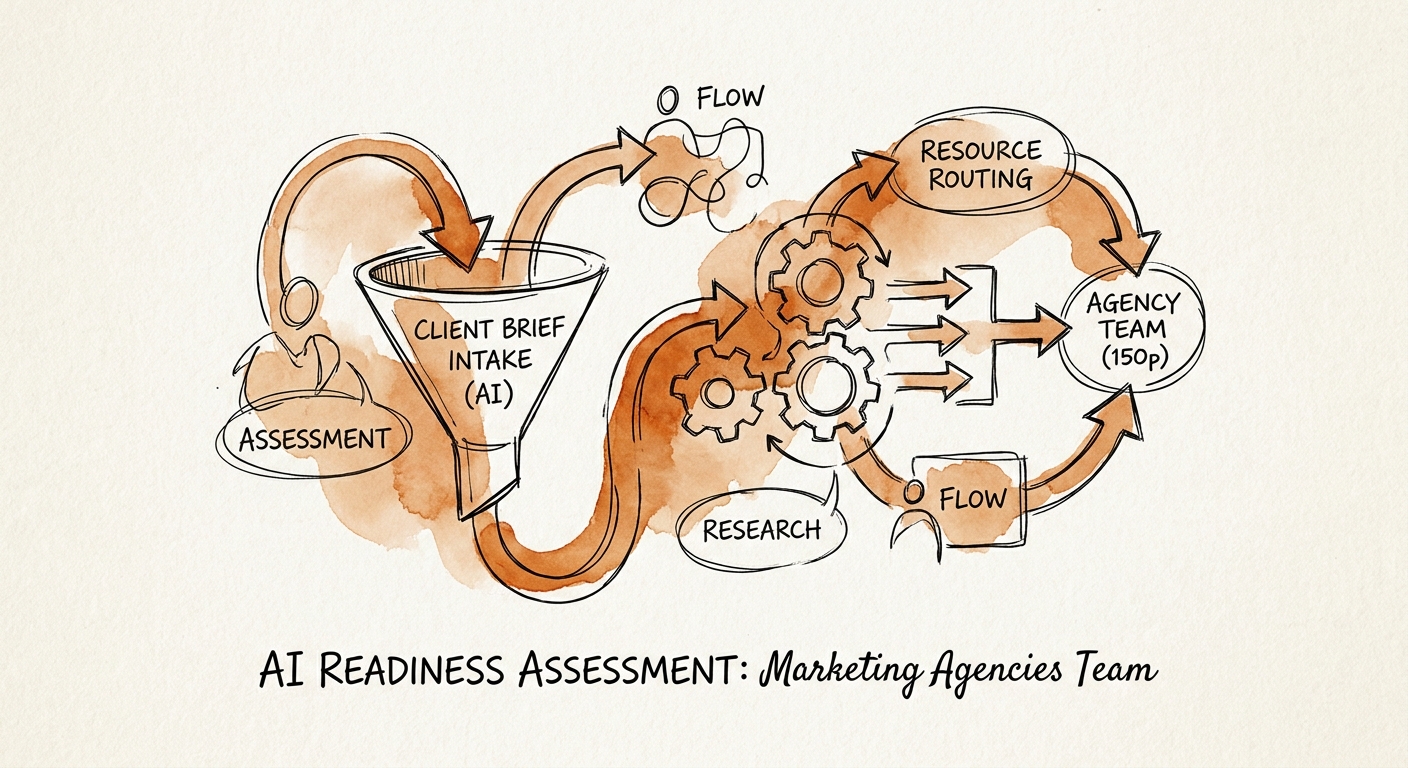
Brief intake is second, and it is the one teams underrate because it is not flashy. Half the chaos in production traces back to a brief that arrived missing the logo files, with a deadline nobody confirmed, and brand rules that live in someone's memory. AI here is not writing headlines — it is checking that the request has what production needs, classifying it, and routing it to the right pod before a single hour gets burned on a misunderstanding. Fixing the front of the line is worth more than speeding up the middle.
Proposal and pitch assembly is third. You already own the raw material: case studies, positioning, service descriptions, media plans, proof points. A secure knowledge workflow can assemble a first-pass deck from your approved library while pricing, performance claims, and anything client-specific stays locked behind a human sign-off — because that is exactly where an invented number gets you fired. The proposal drafting ROI breakdown has the measurement model, and the broader logic lives in the eight-dimension readiness framework. The thread across all three: pick the workflow that removes coordination work, not the one that generates the most output.
The governance you set before scaling — and the scorecard that proves it worked
Here is where agencies trip. The seductive metric is volume: look how many drafts we can produce now. But an agency lives or dies on client trust, and an AI workflow that touches client data, media spend, audience lists, or a regulated claim without a visible source and a named owner is not a productivity gain — it is a liability you have not been billed for yet. Before anything moves into live delivery, settle the boring rules: which tools are approved, what client data may and may not enter them, what gets reviewed, who owns brand safety, and what happens when the output is wrong. PwC's responsible AI work and MIT Sloan's AI coverage are useful here precisely because they treat governance as the enabler of scale, not the brake on it.
Then judge readiness on the metrics that actually move agency margin: cycle time per deliverable, number of review rounds, rework rate, billable-versus-unbillable utilization, client response speed, and quality. The single most telling number is review rounds. If a workflow shaves an analyst's two hours but adds a third revision pass for your creative director, you have not saved money — you have moved the cost to your most expensive person and made it harder to see. That is a failure dressed as a win.
Resist the company-wide rollout. The strongest first roadmap at your size is embarrassingly narrow: one reporting workflow, or one intake workflow, or one proposal workflow — with a named owner and explicit review rules — run for a quarter. That gives leadership real evidence instead of fifty quiet, unmeasured experiments scattered across pods. Score the candidates with the AI Opportunity Score to pick the first one, and when you are ready to move from assessment to a governed production rollout, the 90-Day AI Implementation Sprint is the path.
