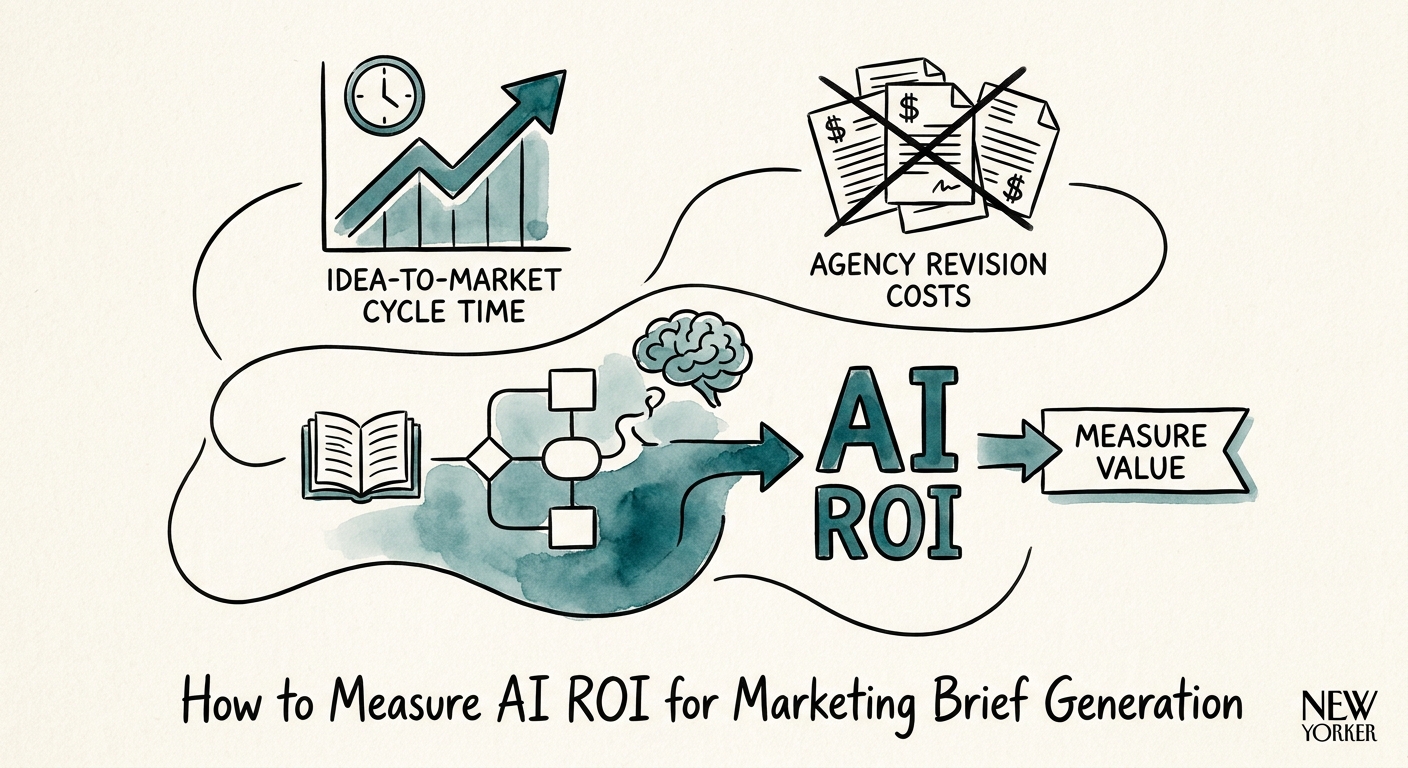
A brief drafts in four minutes. Then it bounces back three times.
Here is the scene every agency and in-house marketing lead knows. A strategist feeds the campaign goal into an AI tool, and forty seconds later there is a clean, well-formatted creative brief: objective, audience, key message, channels, mandatories. It looks finished. It gets sent to the creative lead. And then it comes back: "Which segment is this actually for?" "Did legal clear this claim?" "This contradicts the brand voice we locked in March." Round two. Round three. The brief that drafted in four minutes has now eaten a week.
That gap is the whole story. The minutes AI saves on the first draft are real but tiny. The cost lives in the revision loop, and a faster draft does nothing for the loop if the inputs feeding the brief were never any good. The RSM middle-market AI survey shows adoption climbing fast, but adoption is not the same as value. A finance leader signing off on a marketing AI spend should ask one question: did the briefs get better, or did they just get drafted faster?
So baseline the loop, not the keystroke. For your last ten briefs, count: how many revision rounds before a creative lead accepted it, how often a brief shipped missing an audience definition or an approved claim, how many days from "we need a brief" to "creative can start." Those numbers are your before-state. If AI does not move them, you bought a faster typewriter. The AI ROI without fake savings rule applies hard here: a saved draft minute is not margin unless throughput, staffing, or pricing actually changes.
What a good brief needs, AI cannot invent
The reason briefs bounce is almost never bad prose. It is missing or contested inputs: nobody agreed which customer segment, the offer changed last week, the channel team has constraints the strategist did not know about. AI drafting a brief from thin inputs just produces a confident, well-structured guess that the creative lead then has to unwind. The OECD report on AI adoption by small and medium-sized enterprises is blunt that value depends on data readiness and process ownership, not the model. For a brief, "data readiness" has a specific shape: a current segment library, locked brand voice and tone rules, an approved-claims list the AI can cite from, and channel specs that are actually maintained.
This is also where the AI earns its keep in a way a faster draft never could: catching what is missing. Point the tool at your brief template and your input sources, and the highest-value job is not writing the message, it is flagging "no target segment specified," "this claim is not on the approved list," "no success metric defined" before the brief leaves the strategist's desk. The NIST AI Risk Management Framework gives the guardrails that matter for marketing specifically: define which sources the AI may pull from, so it cannot fabricate a performance stat or a compliance-sensitive claim, and keep a named reviewer who owns final brand accuracy.
Now your ROI signals get concrete and marketing-specific. Track: revision rounds per brief, percentage of briefs that arrive with all the core inputs present on the first pass, hours of senior strategist time spent reconstructing a vague ask, and approval-cycle days. Pair the rollout with workflow discovery so you fix the intake that feeds the brief, not just the moment of drafting it. Drafting was never the bottleneck.
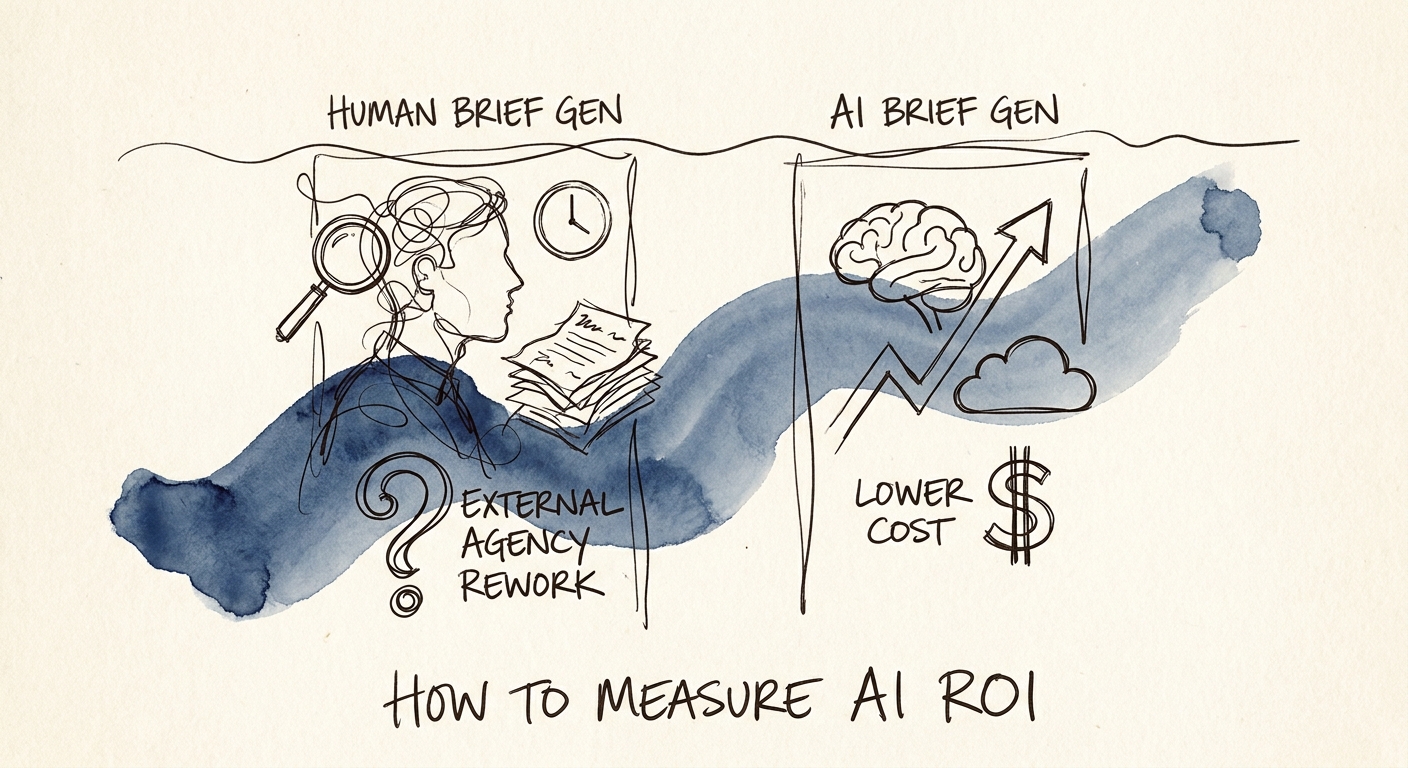
What changes when the brief loop gets shorter
Say a 40-person agency cuts average revisions per brief from three rounds to one and shaves four days off approval. That only becomes ROI if leadership does something with the reclaimed capacity: take on more accounts without adding headcount, move strategists off brief-wrangling and onto pitch work that wins business, or tighten the price on a retainer because delivery got predictable. The Deloitte State of AI report keeps landing on the same point: value shows up where the process and the economics change, not where a task got easier. If the briefs are faster but the agency still books the same work at the same margin, the win is comfort, not return.
And resist the pull toward automating the whole content pipeline next. The Gartner agentic AI project forecast warns that a large share of agentic projects get canceled, and a brief-to-publish chain with no human gate is exactly the kind of overreach that gets pulled. Prove the brief step first, with approved sources, a real reviewer, tracked numbers, and a rollback to manual if quality slips.
Do this Monday: pull your last ten briefs, count revision rounds and missing-input incidents, and you have a baseline by lunch. Then run a four-week pilot on one campaign type and compare the same numbers. When you are ready to scale it past one workflow, the 90-day AI implementation plan moves you from a single brief demo to a governed marketing operation, or start the AI roadmap.