The first draft was never the slow part
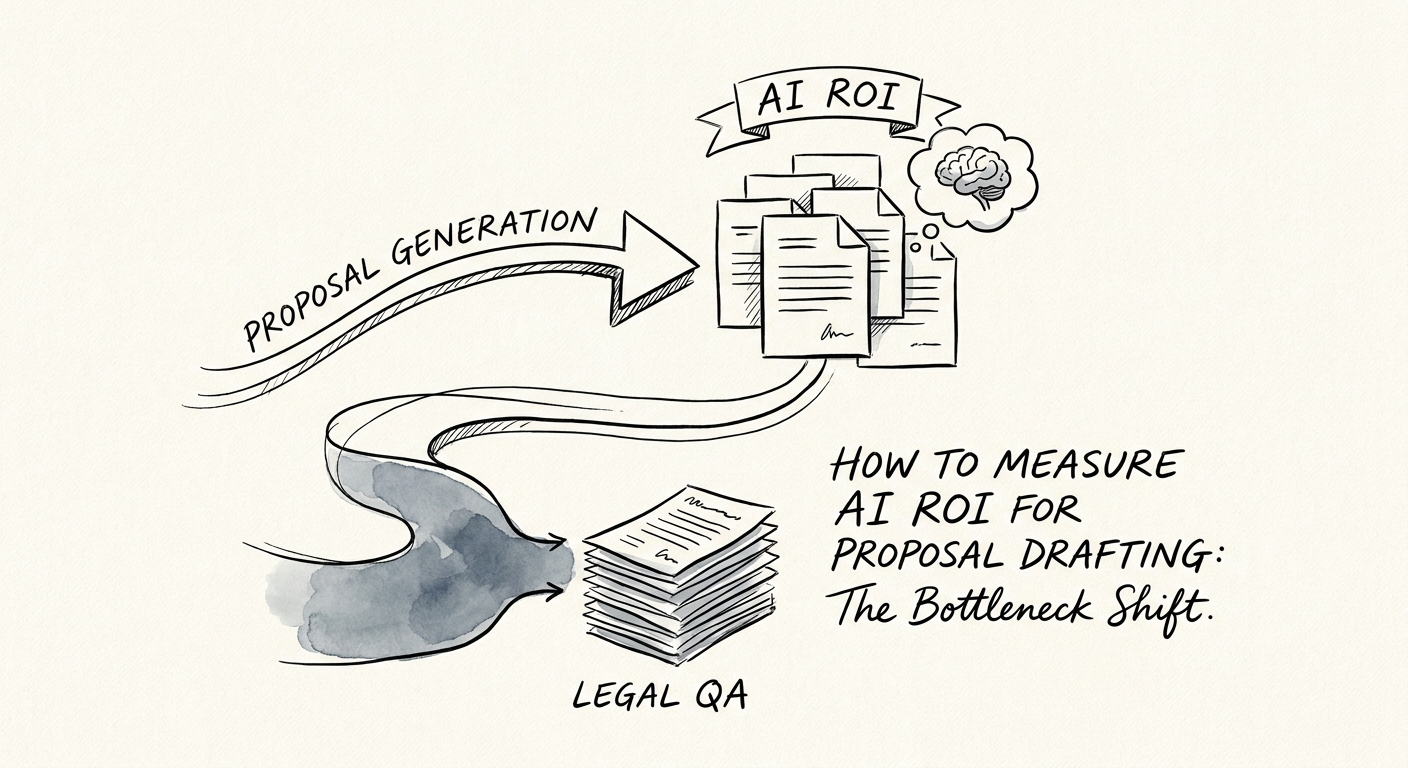
Picture a 60-person B2B technology services firm responding to a six-figure RFP. The 40-page draft used to take a writer two days. Now an AI tool produces it before lunch. Everyone celebrates. Then the response sits for nine days waiting on two sales engineers to validate the architecture section, confirm the integration approach, and rewrite the security questionnaire because the model invented a SOC 2 control the firm doesn't actually hold.
That is the trap. In technical-services proposals, the writing was rarely the constraint. The constraint is scarce expert attention: the solution architect who has to confirm the implementation is real, the delivery lead who has to commit to the timeline, the finance lead who has to defend the margin. Speeding up the part that was already fast, while feeding more drafts into the part that was already jammed, can make your cycle time worse even as your draft time collapses.
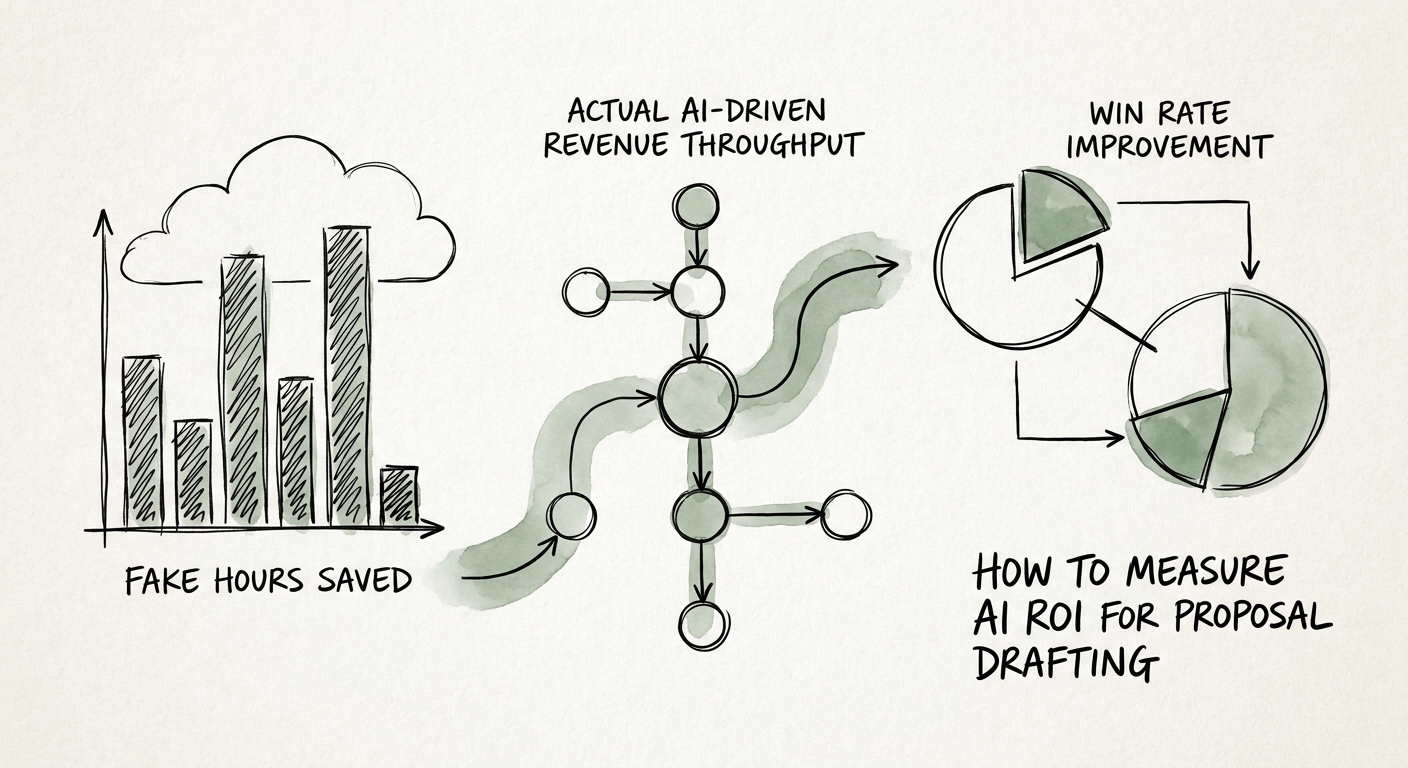
So the ROI question is not "how fast does the first draft arrive." It is whether AI moves the metrics that touch cash: the share of submitted proposals you actually want to win, the calendar days from RFP receipt to a signed-off response, the hours your sales engineers spend correcting AI output versus doing real discovery, and whether evaluators score you higher. Public research from IBM's Institute for Business Value, McKinsey's State of AI research, and PwC's responsible AI work keeps landing on the same point: returns come from redesigning the workflow and earning adoption, not from buying model access. A dashboard bragging about saved writing hours proves none of that. Pair this with the AI ROI measurement framework before you accept a vendor's time-savings math.
Four numbers that tell you the truth about proposal AI
For a technology-services shop where a sales engineer's hour is the most expensive input in the building, four metrics separate real return from theater.
1. Qualified submission rate. Count proposals that still clear your bid/no-bid rules: the right buyer profile, defensible margin, delivery capacity to actually staff it. AI makes it trivially easy to respond to everything, which is exactly the wrong reflex. If your submission volume jumps 40% but your win rate drops because you're now chasing misfit RFPs, the tool made you busier and poorer. Throughput only counts when the work passing through is work you'd be glad to win.
2. SME correction hours per proposal. This is the metric most firms refuse to track because it's embarrassing. Log the hours your architects and delivery leads spend fixing, not creating: rewriting hallucinated capabilities, correcting a timeline the model guessed at, stripping out compliance claims you can't back. If those hours go up, your "writing AI" has quietly become an expert-time tax. The whole case for the tool inverts.
3. End-to-end cycle time. Measure calendar days from RFP intake to executive signoff — the entire path through SME review, pricing, and legal, not just the drafting step. A draft that lands in 20 minutes but triggers three extra correction loops can stretch the real cycle. You want the full curve to bend, not one segment of it.
4. Win-rate and evaluator-score movement. AI earns its keep when it pulls approved proof points into the right answer and tailors the response to the buyer's actual problem. It loses when it pads 40 pages into 60 polished, generic pages that say less. Track win rate against a comparable prior cohort, and if you debrief evaluators, watch their technical-credibility scores. Longer is not better; specific is.
Build the model your finance lead can defend
Start with a clean baseline from the last two quarters of RFP activity: proposals submitted, qualified-submission rate, end-to-end cycle time, SME and reviewer hours per proposal, win rate, gross margin, and average deal size. Then run the AI-assisted process for a comparable cohort and measure the change across the whole system, not the drafting box alone.
On the cost side, count what firms conveniently forget. The license is the cheap part. The expensive part is keeping your approved content library current — every win story, certification, reference architecture, and security attestation the model pulls from — plus the integration into your CRM and proposal tooling, the training so reps actually adopt it, and the governance to keep claims accurate so you don't promise a control you don't hold. Proposal AI usually fails on the income statement not because the model is weak but because nobody funded the operational work that keeps its outputs true.
Then close the loop on recovered expert time. If your sales engineers genuinely get hours back, decide in advance where those hours go — deeper technical discovery, more rigorous qualification, validating the solution before you commit to it — and measure that redeployment. Recovered hours are only ROI when they land somewhere you can count. Use the proposal drafting automation guide to map the workflow and the AI ROI Calculator to run the economics. The business case worth signing isn't "we draft faster." It's "we bid on better-fit work, free our scarcest experts for higher-value pursuits, and win more profitable deals."