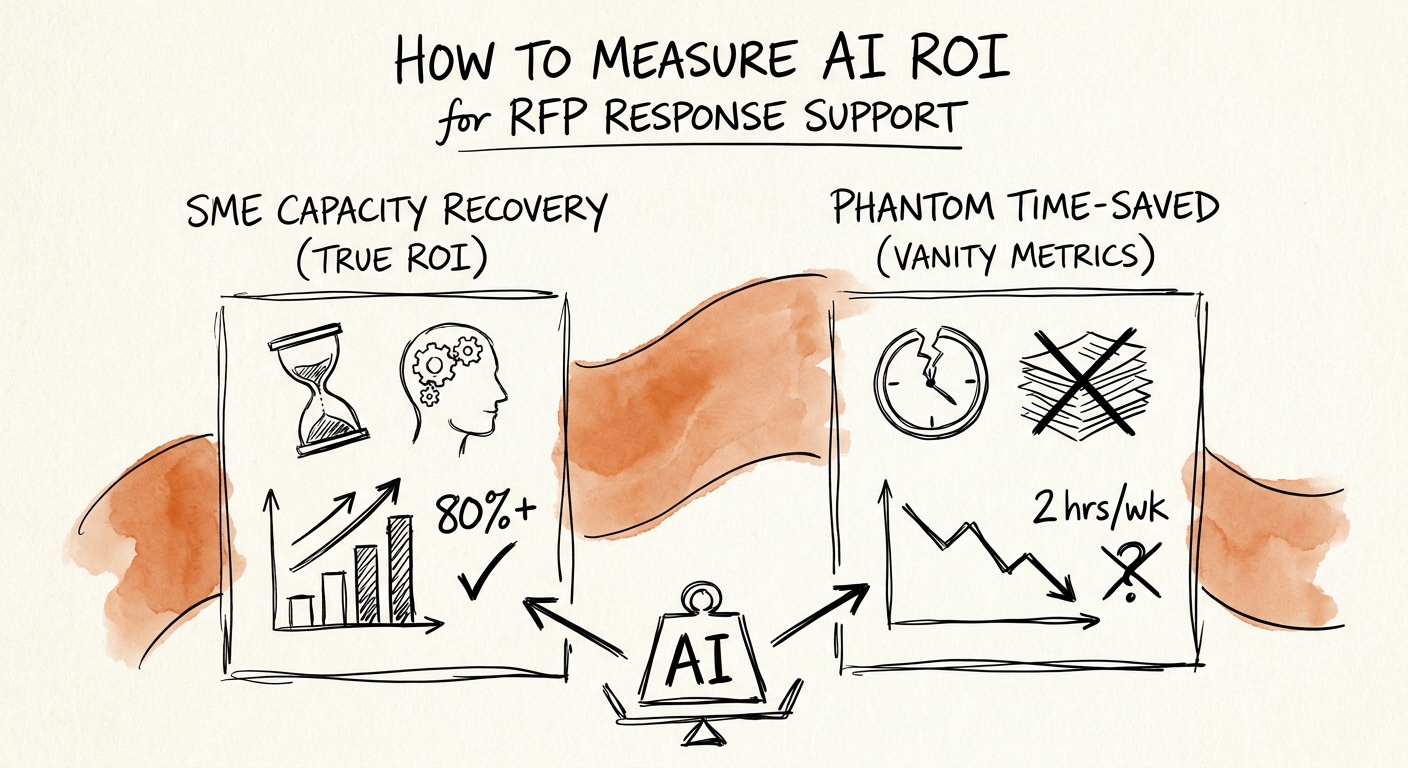
The Friday-night RFP, and where the AI actually pays you back
Picture the scene a lot of technology-enabled services firms know too well: a 90-question RFP lands Wednesday, it's due Monday, and the same three subject-matter experts who are also delivering client work get pulled in to write security, compliance, and methodology answers from scratch — again. Most of those answers already exist somewhere: in last quarter's bid, in a security questionnaire, in a half-finished response library nobody trusts. An AI response assistant is supposed to fix exactly that. But the moment teams switch it on, they measure the wrong thing. They count drafts produced and feel productive.
Drafts produced is not return. The return shows up in one number: how many AI-suggested answers a human subject-matter expert actually approved without rewriting them. That single ratio tells you whether your answer library is good enough to reuse and whether the assistant is pulling from it correctly. The Salesforce State of Marketing report shows revenue teams pouring AI energy into content and data — but a proposal is not a marketing asset. It's a commercial commitment a client can hold you to. So your baseline, before the assistant touches anything, needs five lines: approved-answer reuse rate, SME review hours per proposal, late compliance exceptions caught at red team, proposal cycle time, and how often a reviewer rejects AI-drafted language for thin source support. The IBM Institute for Business Value AI capabilities research is useful for framing what the capability should actually do; the five numbers tell you whether it did it.
The unapproved answer that costs more than every draft you saved
Here's the failure mode that should keep a pursuit leader up at night, and it's specific to RFP work in a way it isn't for, say, marketing copy. A subject-matter expert is racing a deadline. The assistant confidently fills in a security or data-residency answer pulled from a prior proposal — for a different client, under different contractual terms. Nobody catches it because it reads clean. You win the bid. Now you're contractually bound to a control you don't actually run. One stale answer just erased the value of every fast draft for the quarter, and then some.
That's why source provenance belongs in the ROI model, not in a separate "governance" conversation. The NIST AI Risk Management Framework gives you the structure: map the RFP use case, measure the failure modes (stale answers, unapproved pricing language, answers that should have triggered legal review), manage the controls, and govern who owns the call. Concretely, that means an approved source library with named reviewers, and a hard escalation rule the moment an answer touches pricing, security commitments, legal terms, or client-specific scope. And because pursuit teams pull from prior proposals, questionnaires, email threads, and shared drives, retrieval has to respect permissions and log what it touched — exactly the territory the Microsoft 365 Copilot data protection architecture documents. Permission-aware retrieval and an audit trail aren't compliance theater here; they're the difference between reuse you can defend and reuse that becomes a contract dispute.
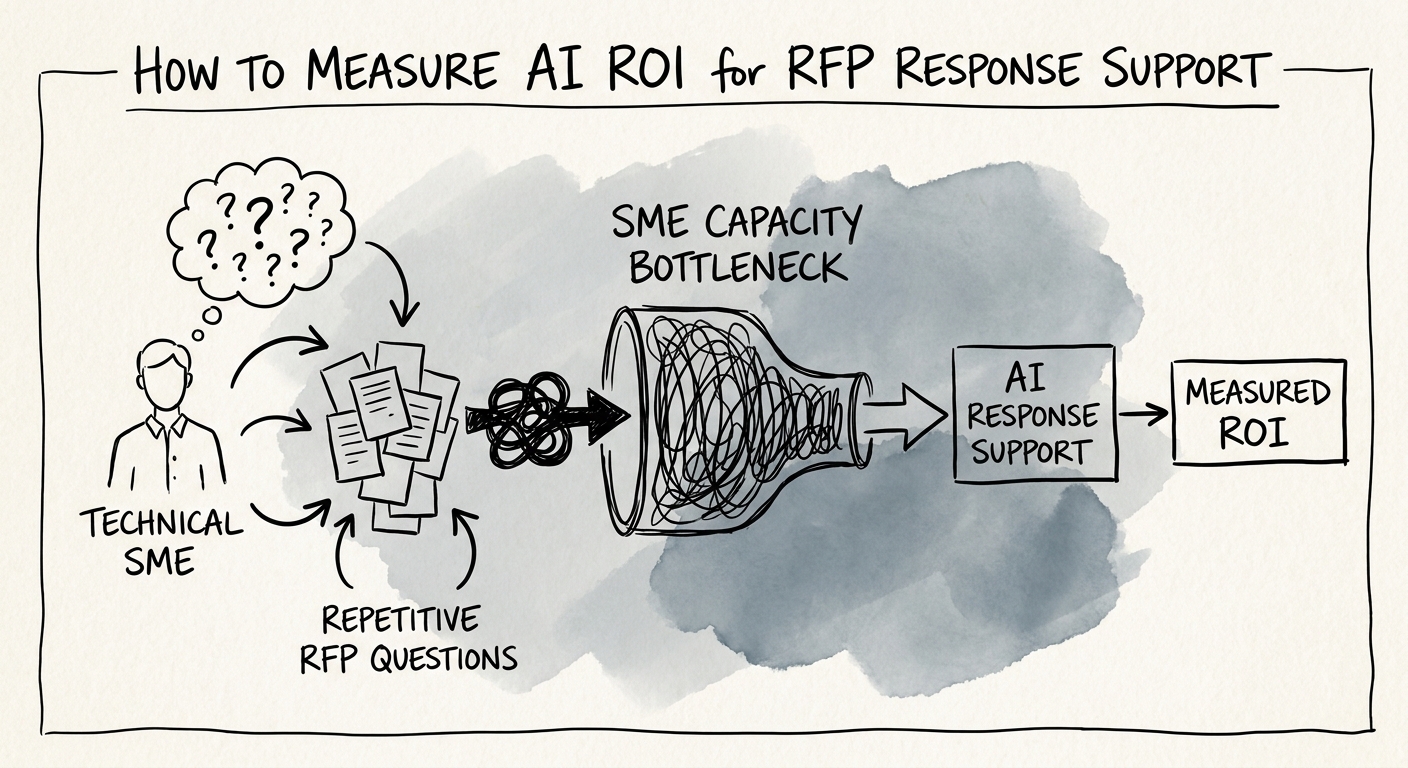
What you decide at day 90 — and the threshold that says scale or stop
Run one pilot, give it 90 days, and judge it on pursuit quality, not text volume. The pilot earns expansion if four things move in the right direction: SME review hours per proposal drop, cycle time shortens, fewer compliance exceptions slip through to red team, and answer rework falls — all while source-citation quality holds or improves. Watch for the trap: if the team is producing more text but still missing required answers or recycling language nobody has re-approved, the answer is not "scale it." The answer is "the library is the problem." Narrow the approved source set, fix the gaps your reviewers keep flagging, then re-baseline. Say, a 40-person services firm is far better off with 60 tightly-governed reusable answers than 300 the team second-guesses.
What you can do Monday: pull your last five proposals and hand-count how many answers were genuinely net-new versus reworded versions of things you'd already said. That ratio is your real reuse opportunity, and it sets the bar the assistant has to beat. Then run the numbers in the AI ROI Calculator, gut-check readiness with the AI Opportunity Score, and if you want a second set of eyes on the governance, Human Renaissance AI transformation services can help you turn RFP support into a measured pursuit decision instead of a draft factory.