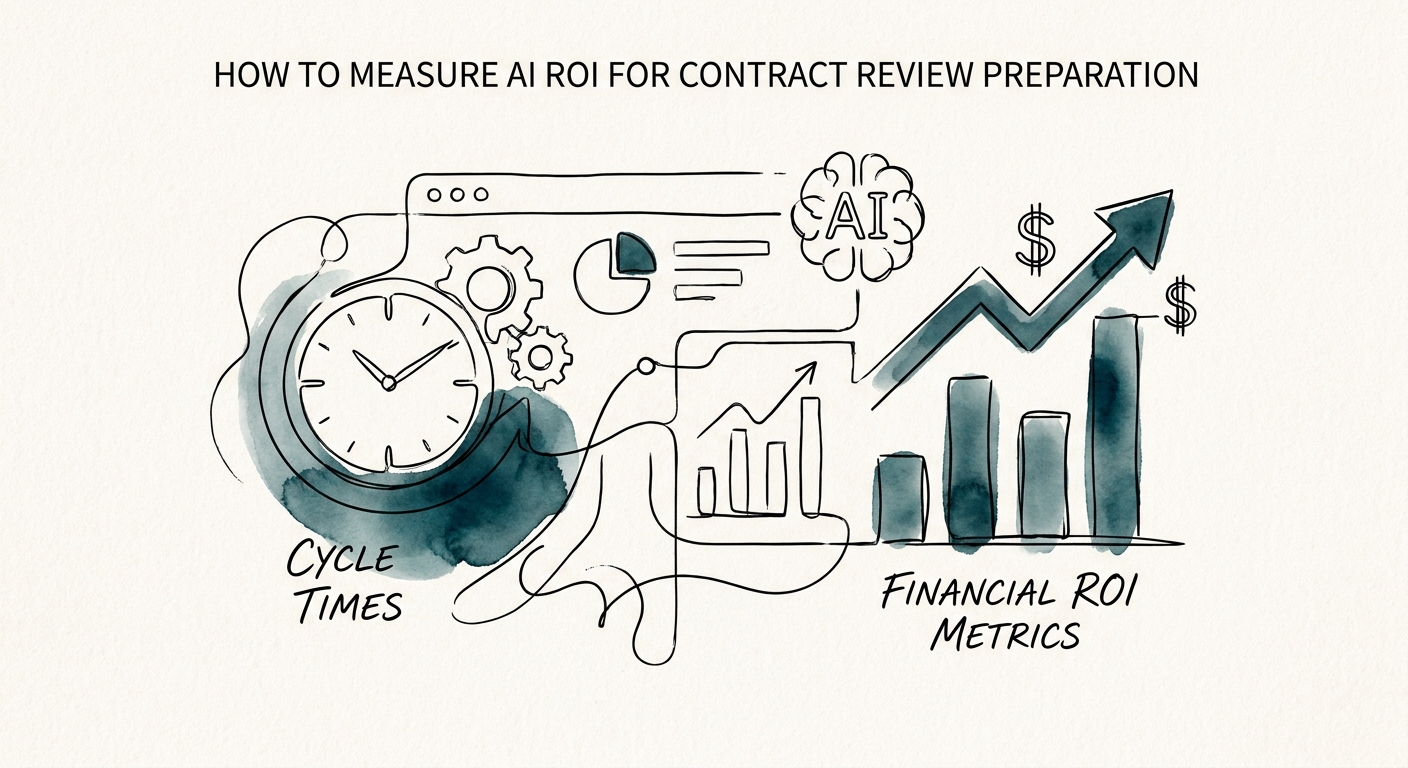
The hour a contract sits on the wrong desk
Picture a Tuesday at a 120-person managed-services firm. A vendor MSA lands in the reviewer's queue at 9 a.m. By noon she still hasn't opened the counterparty's paper, because she's chasing three things: which template version is current, what fallback position sales already verbally promised, and whether the indemnity cap in the deal-room PDF is the one that got approved or the one finance vetoed last quarter. That hunt is the cost. The reading was never the bottleneck.
So when people say AI will speed up contract review, they usually measure the wrong second. Time-to-read is cheap and already fast. What's expensive is the incomplete intake that forces a reviewer to stop, ask, wait, and restart. Your first baseline isn't "minutes per contract"—it's intake completeness: what share of contracts arrive with template, counterparty draft, requested fallback, business owner, commercial value, and a real deadline all attached. Track the missing-exhibit rate and the count of "where is X?" questions a reviewer fires before they get to substance.
IBM's Institute for Business Value AI capabilities research frames this as a capability problem, not a tooling one. An AI assistant can assemble the clause-question packet, but the return depends on whether your contract repository, playbook, and the sales or procurement people feeding it are actually wired together. The McKinsey State of AI 2025 pattern holds here too: the value shows up where a workflow gets redesigned, not where a model gets bolted onto a broken intake.
What the assistant flags vs. what the reviewer still owns
Here's the line that keeps this safe. The AI surfaces the questions; the lawyer answers them. It can spot that the limitation-of-liability clause deviates from your standard, that Exhibit C is referenced but missing, that the counterparty quietly struck the auto-renewal carve-out. It should not decide whether any of that is acceptable. Draw that boundary explicitly and the ROI story stops being scary to your general counsel.
The NIST AI Risk Management Framework gives you the shape: map the use case (contract-prep triage, not legal judgment), measure its failure modes (a flagged "nonstandard" term that's actually fine, a missed deviation), manage escalation, and govern who's accountable when it's wrong. For a services firm pushing dozens of vendor and customer agreements a month, that map is what lets you scale prep support without scaling legal risk.
Then there's the messiest part, which contract work makes uniquely acute: the documents live everywhere. Current template in SharePoint, the negotiated draft in someone's email, the approved fallback in a deal room, last quarter's term sheet in a shared drive that half the company can read. Microsoft 365 Copilot's data protection architecture matters precisely because permission-aware retrieval and an audit trail are not nice-to-haves here—a prep packet that pulls the restricted term sheet, or the superseded fallback language, isn't faster, it's a liability. Bake "did it cite the right, authorized draft" into your scorecard alongside speed.
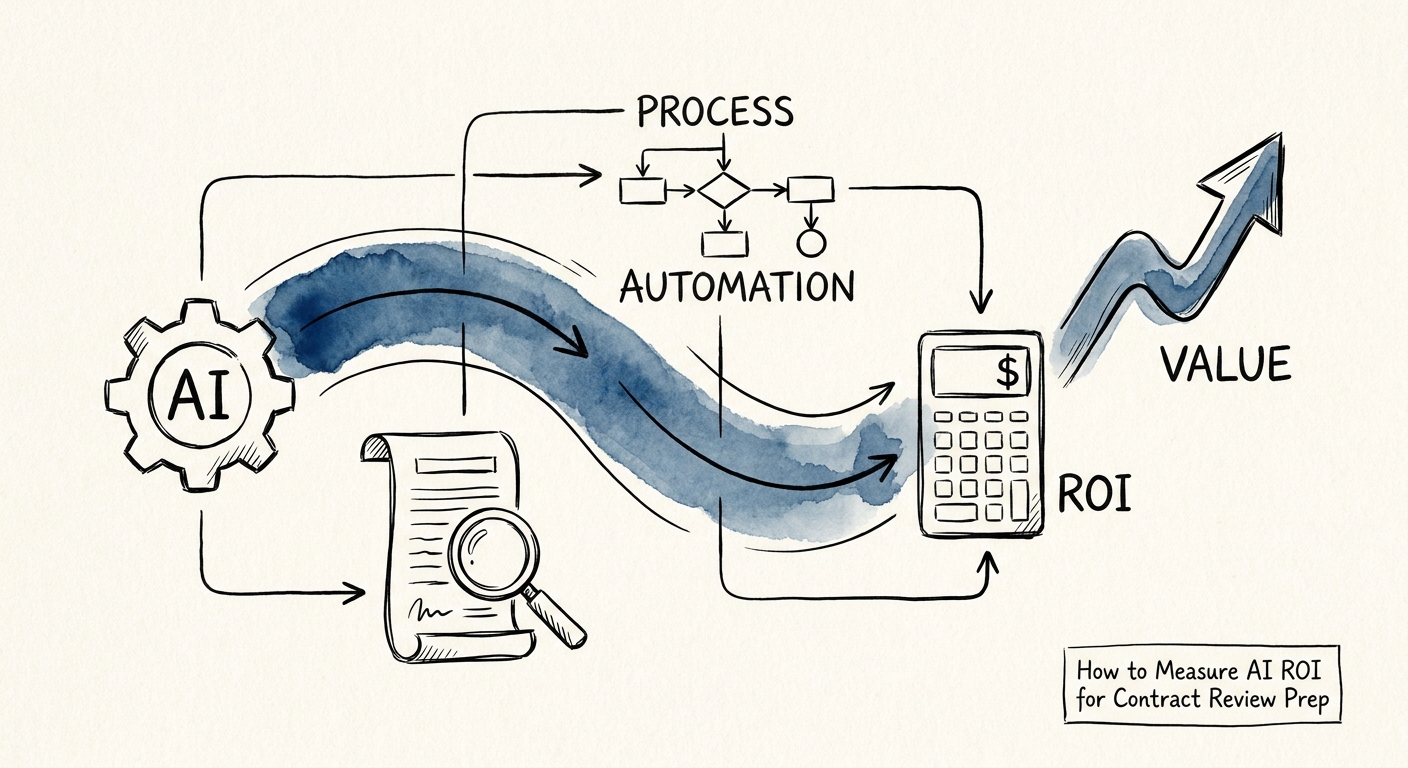
The five numbers, and the call you make at 90 days
Run one pilot on one contract type—say, inbound vendor MSAs, where volume is high and the template is stable. Take a single baseline, then track five things over 90 days: intake-rejection rate (packets sent back as incomplete), reviewer prep time, unnecessary redline loops, legal escalation volume, and approval-cycle time. The number that tells the truest story is redline loops. Every avoided loop is a round-trip with the counterparty you didn't have to take, and nobody bills for re-reading a contract they already read.
Be honest about what failure looks like. If intake-rejection rate stays high, your problem is upstream—sales and procurement aren't feeding clean packets—and no AI layer fixes that. If escalations to legal drop while approval time falls, you've genuinely freed your reviewers to spend time on real commercial and legal risk instead of fetching documents.
Set the baseline this week. Run the AI ROI Calculator against those five measures, pressure-test the opportunity with the AI Opportunity Score, and if you want a second set of eyes on whether to expand to customer agreements, narrow to one clause family, or pause until intake cleans up, that's exactly what Human Renaissance AI transformation services is built to help you decide.